
Soft Film or Hardened Buildup? What Home Care Can—and Cannot—Remove
Soft plaque can be disrupted with brushing and interdental cleaning; hardened, firmly attached tartar normally requires professional removal.
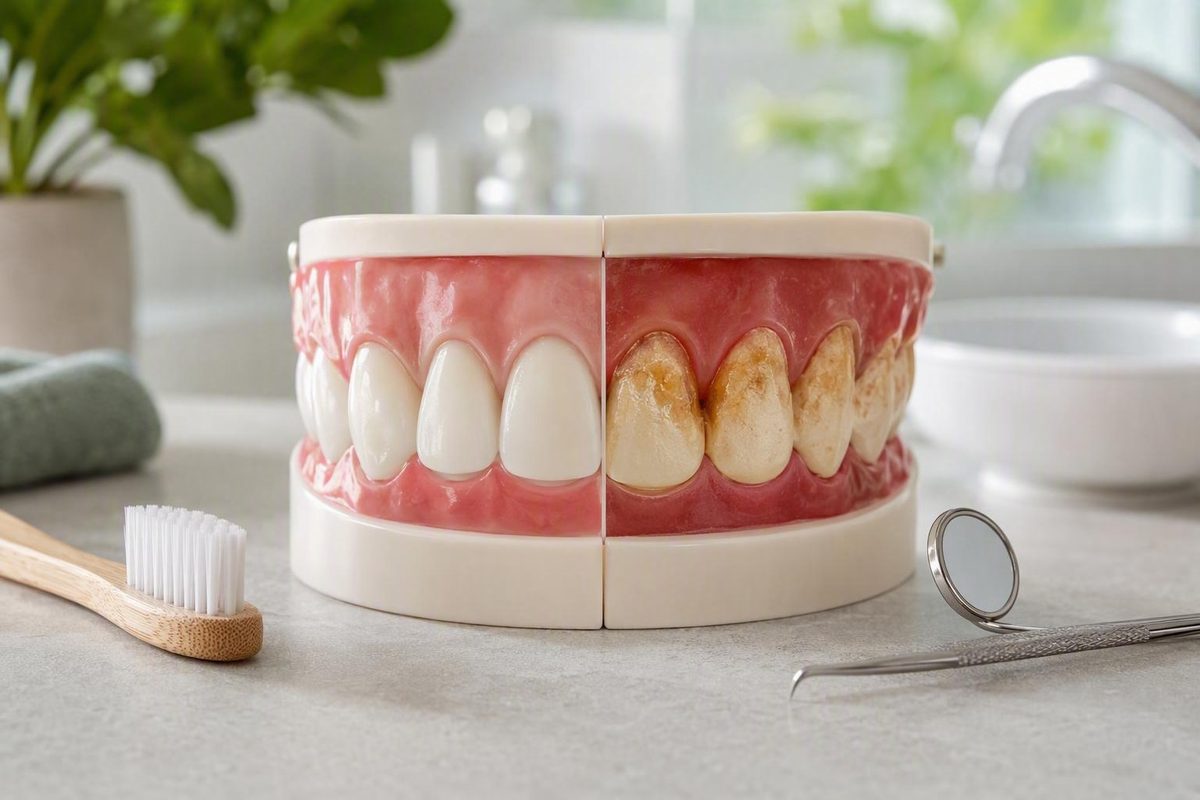
Soft film or hardened buildup? What home care can—and cannot—remove.
Plaque vs. tartar at a glance
Plaque is a soft, sticky bacterial biofilm that continually forms on teeth. Tartar—also called dental calculus—is plaque that has hardened through mineralization. The most useful practical difference is removability: brushing and cleaning between the teeth can disrupt plaque, but established tartar normally requires professional removal. Cleveland Clinic explains the distinction between plaque and hardened calculus.
Plaque and tartar are therefore not unrelated substances. They are stages in the same buildup process: plaque forms, some remains on the tooth, and minerals become incorporated into that retained film until it calcifies into a firmly attached deposit.
| Feature | Plaque | Tartar |
|---|---|---|
| Composition | A bacteria-containing biofilm that can include saliva and food particles | Mineralized, hardened plaque |
| Texture | Soft, sticky, fuzzy, or slimy | Hard, rough, crust-like, and firmly attached |
| Typical color | Usually colorless or pale yellow | Often yellow or brown and sometimes darker |
| Formation | Continually re-forms on tooth surfaces | Develops when retained plaque absorbs minerals and calcifies |
| Common location | Gumline, between teeth, and in grooves or sheltered areas | Often near the gumline, behind lower front teeth, beside upper molars, and potentially below the gums |
| Home removability | Can usually be disrupted by thorough brushing and interdental cleaning | Normally cannot be brushed or flossed away once established |
| Professional removal | Professional cleaning can remove plaque from areas home care misses | A dentist or dental hygienist removes it with scaling instruments |
| Oral-health relevance | Contains bacteria that produce acids and can irritate gums | Creates a rough, difficult-to-clean surface that retains additional plaque |
Calling tartar simply “worse” obscures the different roles of the two materials. Plaque is the active bacterial film: bacteria within it metabolize sugars and starches, produce acids, and remain in contact with teeth and gums. Tartar is mineralized rather than merely a thicker living film. Its rough, fixed surface makes the area harder to clean and gives new plaque more places to collect.
Appearance can offer clues, but texture and response to cleaning are often more informative. A fuzzy film that improves after brushing is more consistent with plaque. A fixed, rough patch that remains after careful brushing may be tartar. Neither observation confirms what a particular deposit is, especially when it is discolored or lies below the gumline.
What plaque is and why it keeps returning
Plaque is not an unusual contaminant that appears only when someone neglects their teeth. It is a biofilm that forms repeatedly in the normal environment of the mouth. It contains bacteria and may also include saliva and food particles, so even someone who brushes regularly develops new plaque between cleaning sessions.
The practical question is not whether plaque ever forms. It is whether that film is disrupted often and thoroughly enough to limit accumulation.
When oral bacteria metabolize sugars and other carbohydrates, they produce acids. Repeated acid exposure can contribute to mineral loss from enamel and, over time, cavities. Plaque retained along the gumline can also contribute to gingivitis, with possible redness, swelling, tenderness, or bleeding. These effects, together with plaque’s continuous formation, are described in Cleveland Clinic’s medically reviewed plaque overview.
Plaque commonly collects in places sheltered from casual brushing, including:
- Along the margin where teeth and gums meet
- Between adjacent teeth
- In pits and grooves on chewing surfaces
- Around crowded or overlapping teeth
- Around dental appliances or restorations
- On surfaces that are difficult to see or reach
A toothbrush can clean exposed surfaces well when used carefully, but its bristles do not effectively clean every contact area between neighboring teeth. Someone can therefore brush diligently and still leave plaque in interdental spaces or other awkward locations. Finding some plaque does not, by itself, prove neglect.
A fuzzy or coated feeling is one possible clue. If a tooth feels smoother after thorough brushing, the coating was more consistent with soft plaque or removable debris than with established calculus. Plaque can be difficult to see because it is generally colorless or pale yellow, although food particles and staining can make a coated area more noticeable.
Plaque control is an ongoing process rather than a one-time treatment. Cleaning removes the current biofilm, but it does not permanently prevent bacteria from recolonizing tooth surfaces. Each brushing and interdental-cleaning session interrupts the buildup again.
If one area remains rough despite careful cleaning, do not assume that more force is needed. A mirror or the tongue may detect a persistent difference, but neither can establish its cause.
How plaque hardens into tartar
The change from plaque to tartar can be understood as a sequence:
- Plaque forms on a tooth. Bacteria adhere to the surface and develop a soft biofilm.
- Some plaque remains in place. This is more likely in sheltered or difficult-to-clean areas.
- Minerals from saliva become incorporated into the retained plaque.
- The deposit calcifies. It becomes harder, rougher, and more firmly bonded to the tooth.
- New plaque collects on the rough surface. The area becomes increasingly difficult to clean at home.
Mineralization does not mean that saliva is harmful. Saliva has normal roles in the mouth. The relevant point is that minerals naturally present in it can harden plaque that remains attached to a tooth.
Estimates vary, but retained plaque may begin mineralizing within roughly 24 to 72 hours. That range is not a universal deadline or a prediction for an individual tooth; formation rates differ, and the beginning of mineralization is not the same as a large, mature deposit. One dental-provider comparison reports the 24-to-72-hour estimate, while another describes hardening in “as little as 48 hours,” illustrating why these figures should not be treated as a precise countdown.
The rate can vary with the location of the deposit, how effectively plaque is removed, and individual conditions in the mouth. Even generally good home care may miss a narrow interdental space, a crowded area, the back of a tooth, or a region close to a salivary-gland opening. Tartar can therefore form without proving that someone never brushes.
Once the deposit has calcified, its roughness matters. Soft plaque can be disrupted by bristles or interdental tools; hardened calculus does not respond in the same way. New plaque can attach to its irregular surface, while the deposit itself may obstruct cleaning around the nearby tooth and gum margin.
The resulting cycle is:
retained plaque → mineralization → rough calculus → greater plaque retention → more difficult cleaning
Daily care aims to interrupt this cycle by removing plaque consistently. Prevention is not a guarantee, however. If a hard deposit has already formed, controlling the soft plaque around it remains useful even though the calcified portion normally stays in place until professionally removed.
How plaque and tartar may look and feel
A cautious home check can provide clues:
- Soft, fuzzy, or slimy material that changes after brushing is more consistent with plaque or removable debris.
- A fixed, hard, rough, or crust-like patch that remains may be tartar.
- A persistent yellow or brown area may be tartar, but it could also be stain, debris, decay, dental material, or part of the tooth.
- A smooth tooth that merely looks darker may be stained rather than covered by a deposit.
Plaque is often difficult to see because it is usually colorless or pale yellow. It may be easier to notice as a fuzzy coating with the tongue than as a clearly defined patch in a mirror.
Tartar is generally more conspicuous. Deposits above the gumline are often off-white, yellow, or brown and commonly feel hard or rough. Coffee, tea, tobacco, and other staining substances may make deposits look darker, but color alone cannot identify the material.
Visible tartar often occurs near the gumline. Two commonly described locations are behind the lower front teeth and beside the upper molars, near openings from major salivary glands. Colgate’s overview identifies these characteristic accumulation sites.
What can be seen is only part of the picture. Plaque and tartar can occur above or below the gumline, and below-gum calculus may be hidden from view. A bathroom-mirror check cannot rule it out.
A sensible self-check
If you notice buildup, consider three questions:
-
Does it change after gentle, thorough brushing and cleaning between the teeth? A removable coating is more consistent with plaque or food debris.
-
Does the area feel fixed and rough afterward? A persistent rough patch may be calculus or another change that deserves assessment.
-
Are there gum symptoms nearby? Bleeding, swelling, tenderness, recession, pain, or persistent bad breath supports arranging a dental evaluation, but does not identify the cause.
Do not try to classify a deposit conclusively from color, photographs, or a description alone. A persistent hard or discolored area is a reason for assessment, not a basis for self-diagnosis.
How buildup affects teeth and gums
Plaque and tartar contribute to oral problems in related but distinct ways.
Plaque supplies bacteria and acids
Bacteria in plaque metabolize sugars and starches from foods and drinks. Acids produced during that process can contribute to enamel demineralization. When repeated acid challenges cause mineral loss to outpace repair, a cavity may develop.
Plaque retained near the gumline can also provoke inflammation. Early gum changes may include redness, swelling, tenderness, or bleeding during brushing or interdental cleaning. These signs are not specific to one condition, but persistent symptoms warrant professional assessment.
Tartar makes plaque control harder
Tartar is best understood as a hardened, plaque-retentive surface—not simply an independent layer of active bacteria. Its irregular texture gives fresh plaque places to adhere and may obstruct effective cleaning around the gum margin. The bacterial film on and around the deposit can consequently remain in contact with nearby tissues.
Ongoing plaque and tartar accumulation is associated with bad breath, cavities, gingivitis, gum recession, and periodontal disease. Advanced periodontal disease can damage the tissues and bone supporting teeth and may eventually contribute to tooth loosening or loss. A medically reviewed comparison of plaque and tartar outlines their distinct roles and associated oral-health problems.
These outcomes are not predictions about any individual deposit. A small hard patch does not establish that someone has periodontitis, bone loss, or any particular severity of disease. Nor does the amount visible above the gums reveal what is happening below them.
A dental professional may assess the teeth, gums, buildup location, and periodontal condition to distinguish routine surface deposits from deeper concerns. Home inspection cannot determine whether supporting tissues or bone have been affected.
The appropriate response is proportional rather than alarmed:
- Continue removing accessible soft plaque.
- Do not scrub aggressively at a fixed deposit.
- Arrange professional removal of suspected tartar.
- Seek assessment for persistent gum symptoms or changes in tooth stability.
- Do not assume that visible tartar proves advanced disease—or that no visible tartar rules it out.
What home care can remove—and what it cannot
Home care and professional cleaning have different jobs.
Home care can:
- Disrupt and remove soft plaque
- Clear food debris from accessible areas
- Reduce the amount of plaque available to mineralize
- Help prevent or slow new tartar accumulation
- Control fresh plaque collecting on and around existing calculus
Home care normally cannot:
- Remove firmly attached, established tartar
- Confirm whether a deposit extends below the gumline
- Determine whether gum or bone damage is present
- Replace professional scaling once calculus has formed
The difference is mechanical. A toothbrush and interdental cleaner can disturb a soft biofilm. Once that material has calcified and bonded to the tooth, it no longer behaves like a wipeable coating. Brushing longer does not reverse mineralization, and floss generally cannot lift a crust-like deposit from the tooth.
Why brushing harder is not the answer
Extra pressure does not turn a toothbrush into a scaling instrument. Use controlled pressure and focus on complete, systematic coverage rather than trying to grind away a fixed rough spot.
Continue cleaning gently around a suspected deposit to control fresh plaque. The fact that the hard material remains does not mean brushing is pointless; it means brushing and professional scaling are addressing different forms of buildup.
Do not scrape tartar with household tools
Do not use dental picks intended for professional-style scraping, metal instruments, knives, pins, or other sharp objects to chip tartar away. Without clinical training, visibility, and control, these tools can injure gums or damage teeth. Cleveland Clinic specifically advises against attempting to remove tartar yourself.
Professional scaling relies on appropriate instruments, knowledge of tooth anatomy, controlled technique, and an assessment of where the deposits are located.
Mouthwash, whitening products, and “tartar-control” labels
Mouthwash may form part of a broader plaque-control routine depending on the product and individual need, but it should not be presented as a way to dissolve established calculus.
Whitening products are intended to affect certain discolorations.
Prevention or control claims do not mean that the product removes calculus that is already firmly attached.
Electric toothbrushes and water flossers may help with plaque control when used appropriately. They should not be treated as home cures for existing tartar.
What about orange peel, aloe vera, oil pulling, or acidic mixtures?
Orange peel, aloe vera, oil pulling, vinegar mixtures, and similar remedies should not be represented as proven ways to dissolve established tartar in the mouth. Available evidence does not establish orange peel or aloe vera as effective tartar-removal methods, and laboratory findings involving calculus samples do not demonstrate safe or effective removal from teeth in a living mouth. Colgate reviews these limitations and advises professional removal.
Myth versus fact
Myth: Vigorous brushing will remove tartar if I keep trying. Fact: Brushing disrupts soft plaque; established mineralized calculus normally needs professional scaling.
Myth: A metal pick or household scraper is equivalent to a dental instrument. Fact: DIY scraping can injure gums or teeth and cannot safely assess deposits below the gumline.
Myth: A natural remedy can dissolve tartar safely at home. Fact: Common home remedies are not established treatments for calculus.
Myth: Waiting will eventually solve the problem. Fact: Established tartar is not expected to remove itself cleanly. Persistent buildup should be professionally assessed.
How to reduce plaque and prevent new tartar
Prevention centers on removing plaque consistently before it remains in place long enough to mineralize. The objective is not a permanently plaque-free mouth—plaque continually re-forms—but repeated disruption across as many tooth surfaces as possible.
A broadly supported routine includes:
-
Brush twice daily for two minutes. Use fluoride toothpaste and clean the outer, inner, and chewing surfaces rather than concentrating only on the visible front teeth.
-
Clean between teeth at least once daily. Floss, interdental brushes, or another suitable interdental aid can reach surfaces that ordinary toothbrush bristles do not clean effectively.
-
Pay attention to recurring trouble spots. Commonly missed areas include the gumline, the backs of the last molars, behind the lower front teeth, and crowded or overlapping spaces.
-
Limit frequent exposure to sugary and starchy foods and drinks. This does not require eliminating every carbohydrate. Reducing frequent exposure gives plaque bacteria fewer repeated opportunities to metabolize sugars and starches.
-
Avoid tobacco. This is a general oral-health measure, not a guarantee that tartar will never form.
-
Use professional care according to individual risk. Checkup and cleaning intervals should reflect gum health, buildup rate, cavity history, access for home cleaning, appliances, dry mouth, and other relevant factors.
The general recommendation to brush for two minutes twice daily with fluoride toothpaste and clean between teeth at least once daily is summarized in this plaque, tartar, and prevention overview. A dental professional can help adapt tools and technique to the individual.
Interdental cleaning deserves particular emphasis. Neighboring teeth create surfaces that a standard brush cannot fully access. Cleaning only what is easy to see can leave plaque around contact areas and near the gums even when the visible fronts look polished.
Consistency is more useful than occasional intensity. One forceful cleaning session does not compensate for repeatedly missed surfaces. A gentle, systematic routine is more appropriate than trying to scrub a stubborn spot away.
Prevention still has limits. Some people accumulate calculus readily, and deposits can form in locations that remain difficult to reach despite conscientious care. Tartar does not automatically mean the entire routine has failed; it may indicate that technique, tools, access, or the professional-cleaning schedule should be reconsidered.
It also helps to distinguish preventable buildup from problems that brushing has no mechanism to reverse. Decay Guide’s feature What Daily Brushing Cannot Fix explores that boundary further.
Professional removal and when to arrange an evaluation
A dentist or dental hygienist generally removes established tartar using specialized hand instruments, ultrasonic scaling instruments, or a combination suited to the location and clinical situation. Scaling detaches hardened deposits from tooth surfaces above and, when necessary, below the gumline.
The approach is not identical for every person. A professional must first determine what the deposit is and where it extends.
Routine cleaning is not the same as scaling and root planing
Routine professional cleaning may include scaling to remove plaque and calculus from accessible tooth surfaces. The word “scaling” does not by itself mean that someone has advanced gum disease.
Scaling and root planing is deeper periodontal treatment that may be used when significant below-gum deposits or periodontal disease are present. Root planing is not another name for every ordinary cleaning, and only a clinical assessment can determine whether routine cleaning or deeper treatment is appropriate. Professional removal may involve hand or ultrasonic scaling, while root planing may be considered when periodontal involvement is present.
Reasons to arrange a dental evaluation
Consider arranging an evaluation if you notice:
- A hard or rough deposit that persists after normal brushing
- Repeated or persistent gum bleeding
- Swollen, red, tender, or painful gums
- Gum recession
- Pain or sensitivity that does not settle
- Persistent bad breath
- A tooth that feels loose
- A discolored area that cannot be confidently explained
- Buildup that appears to extend beneath the gumline
These signs do not identify a cause by themselves. Bleeding, pain, discoloration, bad breath, and looseness can have more than one explanation. They are reasons for assessment, not proof that tartar or a particular stage of gum disease is responsible. Persistent deposits and symptoms such as bleeding, recession, or looseness are among the concerns described in a medically reviewed plaque-and-tartar comparison.
Tartar itself is not usually described as a dental emergency. Persistent buildup should nevertheless not be ignored, because established calculus normally cannot be managed through home care alone.
There is no single professional-cleaning interval appropriate for everyone. Someone who develops deposits quickly or has active gum problems may need a different schedule from someone with little buildup and healthy gums. Follow a risk-based interval determined with a dentist or dental hygienist rather than assuming that everyone requires cleaning on exactly the same timetable.
The practical dividing line remains simple: plaque is a recurring soft film that daily care can disrupt; tartar is plaque that has mineralized and normally needs professional removal. Continue controlling plaque around a suspicious area, but do not respond to a fixed rough deposit by scrubbing harder or trying to chip it away.
Visual clues remain imperfect, and below-gum tartar may be hidden. Decay Guide publishes general reference information rather than diagnosis or individualized treatment advice. A dental professional must determine what a specific deposit is, whether disease is present, and which cleaning interval or treatment is appropriate.
Can plaque turn into tartar overnight?
Plaque may begin mineralizing relatively quickly, with an approximate estimate of 24 to 72 hours reported by some dental sources. That means the process can begin over a short period, but it does not create a precise “overnight” rule. Timing varies among people and locations, and early mineralization is not necessarily the same as a large, mature tartar deposit. The estimate should be treated as a range rather than an individualized prediction.
The practical response is regular plaque removal, not watching a clock. Brush consistently and clean between the teeth so plaque is disrupted repeatedly.
Can brushing harder remove newly formed tartar?
Normally, no. Brushing can remove soft plaque, but once a deposit has mineralized and become firmly attached, additional pressure is not a reliable removal method. Forceful brushing may irritate gums or contribute to unnecessary abrasion.
Continue brushing the area gently to control fresh plaque, but have a persistent hard deposit assessed and professionally removed. Do not compensate with a metal pick or another sharp tool.
Is yellow or brown buildup always tartar?
No. Tartar is often yellow or brown, but stain, food debris, decay, exposed root surfaces, dental materials, and natural variations in tooth color can also look yellow, brown, or dark.
Texture and response to cleaning provide clues: a soft coating that improves after brushing is more consistent with plaque or debris, while a fixed rough patch may be calculus. Neither clue is conclusive. Persistent discoloration or roughness should be assessed rather than diagnosed from color alone.
Can tartar form below the gumline where I cannot see it?
Yes. Calculus can occur above or below the gumline, and below-gum deposits may be invisible during a mirror check. A clean-looking visible tooth surface therefore does not rule out deposits deeper around the tooth.
Do not probe under the gums yourself. A dentist or dental hygienist can examine the area and determine whether below-gum scaling or other care is appropriate.
How often should someone who develops tartar quickly get a professional cleaning?
There is no universal interval. Cleaning frequency should reflect factors such as how rapidly deposits recur, gum health, cavity history, access for home cleaning, tobacco use, dry mouth, appliances, and any history of periodontal disease.
Someone who accumulates tartar quickly may be advised to attend more frequently than someone with little buildup, but the schedule should follow an individual dental assessment. The goal is not adherence to an automatic six-month rule; it is choosing an interval that adequately addresses that person’s oral-health risks.