
How to Free Trapped Food Without Hurting Your Teeth or Gums
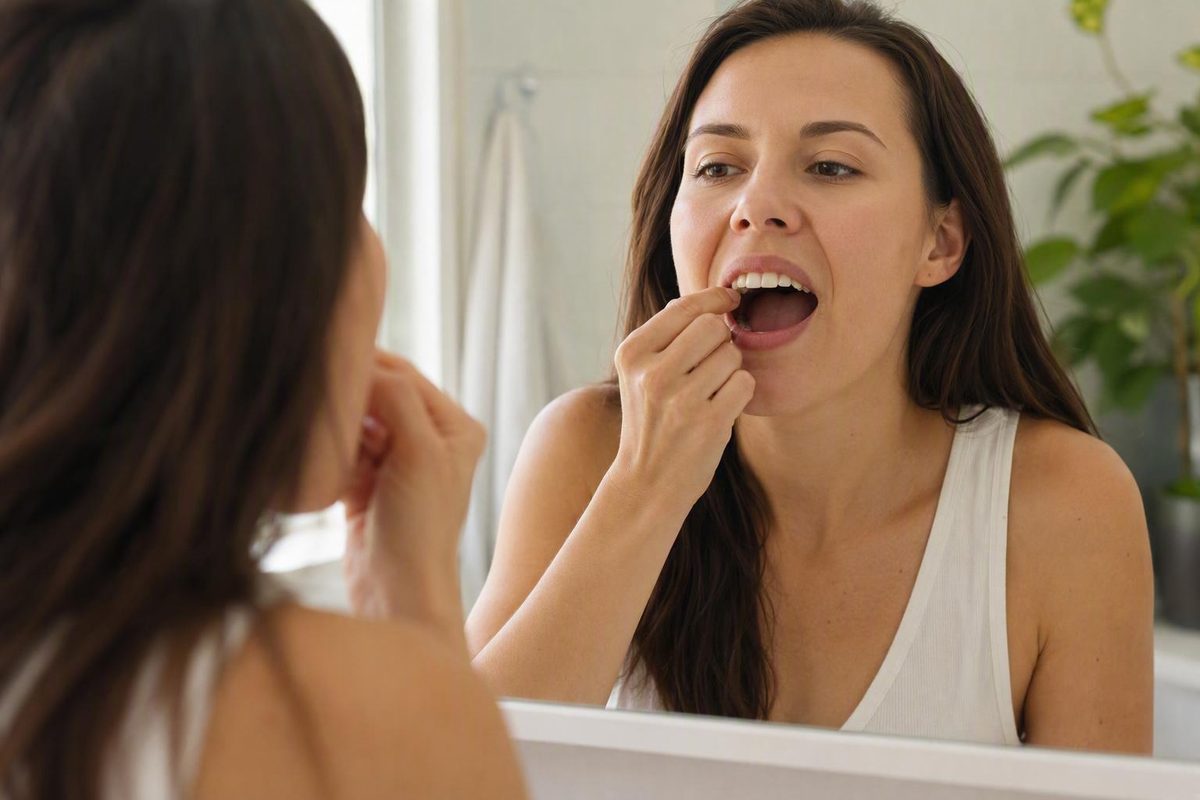
Food stuck between your teeth is usually an immediate cleaning problem, not a reason to panic. Start with a short sequence of low-force methods: rinse with lukewarm water, floss gently, and then consider an interdental cleaner suited to the space. The aim is to loosen and lift the food—not drive it toward or beneath the gumline.
If gentle methods fail, the location cannot be reached safely, or food repeatedly catches in the same place, arrange a dental assessment instead of continuing to probe.
What to do first: a low-force removal sequence
Try these steps in order:
- Rinse gently with lukewarm water. Move the water around the affected area without forceful swishing. This may release loose fibers, seeds, skins, or other small particles.
- Use dental floss carefully. Ease it through the contact between the teeth rather than snapping it downward. Clean against the side of each tooth and try to lift the obstruction away from the gum.
- Choose another interdental tool only if it fits the space. An appropriately sized interdental brush may help in a wider gap. A low-pressure water flosser may be practical when braces, dental work, or limited hand dexterity makes string floss difficult. A water flosser directs a stream of water at the teeth and can help remove food pieces from between them (Mayo Clinic’s comparison of floss and water flossers).
Whatever the tool, think loosen and lift, not dig and drive. Repeated or forceful attempts may irritate the gum or push material farther below the gumline. Stop rather than applying more force when careful flossing or another suitable cleaner does not work (guidance on what to do when flossing fails).
Stop immediately if:
- you feel substantial or increasing pain;
- the floss, brush, or other cleaner meets firm resistance;
- the site bleeds repeatedly as you retry;
- the material appears to move farther beneath the gum;
- tenderness or swelling is increasing;
- you cannot reach the location without digging.
A gentle warm saltwater rinse is sometimes suggested when the nearby gum feels irritated. It may feel soothing, but the supplied evidence does not establish saltwater as a reliable way to dislodge tightly impacted food. Do not make the rinse more forceful if it fails.
Much of the available advice about removing trapped food comes from dental-practice articles rather than clinical guidelines or direct comparative research. That limitation favors a conservative approach: use simple, purpose-made cleaning tools with minimal force, avoid unsupported tricks, and do not expect any method to guarantee removal.
How to use floss without forcing the obstruction
Floss can enter a tight contact that a toothbrush cannot reach, but technique matters. Snapping floss downward may strike the gum or move the food toward it.
Use this sequence:
- Take a clean length of floss and hold a short section securely between your fingers.
- Guide it slowly through the contact with a gentle side-to-side motion. Do not force it straight downward.
- Once it passes through, curve it into a C shape around one tooth.
- Move it gently along that tooth surface. Allow it to move slightly beneath the gum edge only if it slides there comfortably.
- Curve the floss around the neighboring tooth and repeat.
- Bring the floss and loosened material out without snapping the strand against the gum.
The purpose is to clean both tooth surfaces, not saw directly into tender tissue. Instructions for conventional floss commonly recommend sliding it gently through the contact and curving it around each tooth; the same source advises that an interdental brush should enter without pressure (floss and interdental-brush technique).
If plain floss repeatedly sticks at a tight contact, waxed floss may slide more easily. A floss holder may also be easier to control if handling a loose strand is difficult.
Do not:
- saw aggressively back and forth;
- snap floss into the gum;
- force it through a contact that will not yield;
- continue after substantial pain or repeated bleeding;
- use repeated bleeding as a reason to keep testing the site;
- tie a knot in the floss to drag an obstruction through.
Knotted-floss techniques appear in some practice blogs, but the supplied evidence does not establish their safety or effectiveness. Adding a knot also increases the bulk that must pass through the contact.
Pay attention to how the floss behaves. Repeated shredding, snagging, or failure to pass at one particular contact may reflect a very tight space or a rough area. If the pattern continues, stop forcing the contact and have it examined.
If floss passes through but does not retrieve the food, do not keep sawing at the gum. Consider a tool appropriate for the size and shape of the space, or stop if the material appears deep, painful, or inaccessible.
Choosing between an interdental brush and a water flosser
There is no single best cleaner for every mouth or every trapped particle. Choose according to the width of the space, the presence of braces or dental work, and how comfortably you can control the tool.
| Situation | Reasonable first choice | Main caution |
|---|---|---|
| Tight contact between teeth | String floss or waxed floss | Do not snap or force it through |
| Wider or irregular space | Appropriately sized interdental brush | It should enter without pressure |
| Braces or dental work that complicates flossing | Floss threader or low-pressure water flosser | Keep the stream controlled |
| Difficulty manipulating string floss | Floss holder or water flosser | Start gently and maintain control |
| Particle appears deep beneath the gum | Stop and seek professional help | Do not dig or irrigate aggressively |
An interdental brush is a small bristled cleaner designed to pass through spaces between teeth. It may be useful where a gap is wider or more irregular than a tight tooth contact.
Insert the brush gently and horizontally through the available space. It should pass without pressure. If it bends, buckles, hurts, or will not enter, do not push it. The brush may be too large, or that contact may be better suited to floss. A smaller size or guidance from a dentist or hygienist may be needed.
A water flosser—also called an oral irrigator or dental water jet—directs a stream of water between and around teeth. It may help move food pieces and can be easier to use around braces, bridges, or other dental work. It may also suit someone who has difficulty manipulating string floss.
For an attempt to loosen debris, begin on low pressure and keep the stream controlled. Do not use it as a high-pressure probe against painful tissue, and do not expect it to release material tightly packed beneath the gum.
It is important to distinguish immediate particle removal from long-term plaque control. A systematic review that included seven randomized controlled trials found that most included trials favored water flossers over dental floss for reducing plaque. The outcome was plaque-score reduction, however—not removal of a newly lodged seed, hull, skin, or meat fiber (systematic review of water flossers and dental floss).
That research therefore does not prove that a water flosser will remove a particular obstruction. Nor does the supplied evidence establish one tool as universally superior. Floss may suit a tight contact, an interdental brush may fit a wider opening, and a water flosser may be more manageable around an appliance. Fit, comfort, control, and the location of the food matter more than declaring a universal winner.
What not to use—and when to stop trying
Do not use the following to pry food from between your teeth or gums:
- pins or needles;
- knives or forks;
- paper clips;
- tweezers;
- fingernails;
- sewing tools;
- rigid household picks;
- any other sharp, pointed, dirty, or improvised object.
These objects may puncture or irritate the gum, damage a tooth, or push debris deeper. A dental-practice source addressing difficult or painful trapped food advises against persistent probing, particularly when material is deep or hard to reach (guidance on avoiding unsafe removal attempts).
A purpose-made cleaner can still cause harm if used forcefully. Do not snap floss into the gum, push an interdental brush through resistance, or direct a high-pressure water stream into painful tissue.
Advice about toothpicks is inconsistent across the supplied practice articles. Some allow purpose-made soft or flexible dental picks, while others advise avoiding toothpicks altogether. The conservative approach is not to use a rigid household or wooden toothpick to pry at a lodged object. If you need an alternative to floss, choose a purpose-made interdental cleaner whose size and design are suitable for your teeth.
Other commonly suggested tactics—eating crunchy food, probing with a finger, trying to create suction with the tongue, or tying a knot in floss—do not have adequate support here as reliably safe and effective removal methods. They may also subject an already irritated area to more pressure.
The practical stop rule is simple: if the object does not move after a few controlled attempts, do not escalate. Put the tools away if you encounter pain, firm resistance, repeated bleeding, increasing tenderness, or apparent movement below the gumline.
Serious complications should not be presented as the expected outcome of ordinary food trapped between teeth.
When failed removal or persistent symptoms need a dentist
Arrange a dental assessment when:
- rinsing and careful interdental cleaning do not release the material;
- the food appears lodged deeply beneath the gum;
- the location is behind a back tooth or otherwise cannot be reached safely;
- pain persists or worsens;
- swelling develops or increases;
- the site bleeds repeatedly;
- there is a persistent bad taste or odor;
- chewing on that side hurts;
- discomfort continues after the food appears to be gone;
- food or floss repeatedly catches in the same location.
These are reasons for assessment rather than proof of any particular dental condition. Practice-based guidance supports seeking help when food remains trapped, symptoms continue, or the same location repeatedly catches food or floss (guidance on persistent and recurrent trapping).
A dentist or hygienist can use appropriate instruments to remove retained material and clean the area without blind probing. They can also examine why the food became lodged—something home cleaning cannot determine.
There is no well-supported universal deadline such as “exactly 24 hours.” One supplied practice article proposes that threshold, but the wider evidence pack does not establish it as a reliable cutoff for everyone. Base the decision on whether gentle methods have failed, how deep or inaccessible the material appears, whether symptoms are progressing, and whether the problem keeps returning.
Persistent discomfort after apparent removal also deserves attention. The sensation does not prove that food remains. The gum may be irritated from pressure or repeated cleaning, or the rough or painful spot may involve a tooth surface, restoration, crack, cavity, tartar, or inflamed tissue. Further probing cannot reliably distinguish among those possibilities.
The available sources do not support a complete symptom-by-symptom emergency-triage system. As a cautious boundary, severe or rapidly worsening symptoms call for prompt professional assessment rather than continued home attempts. If you are unsure whether dental or medical evaluation is appropriate, contact a dental professional or healthcare service for individualized direction.
Why food keeps catching between the same teeth
A food trap is a space where food repeatedly collects between teeth. Food impaction is sometimes used for material that becomes tightly packed between teeth or beneath the gum. The terms may overlap in everyday use, but repeated trapping matters because it can point to a local feature that cleaning alone will not change.
Recurrence is a clue—not a diagnosis. Possible explanations include:
- a natural gap or one that has developed as teeth shift;
- rotated, crowded, or otherwise misaligned teeth;
- tooth shapes or contacts that do not meet normally;
- gum recession that exposes more space between the roots;
- a gum pocket;
- a cavity or rough area of decay;
- a chipped, cracked, or fractured tooth;
- a worn, damaged, or poorly fitting filling;
- a crown, bridge, or another restoration with an irregular contact;
- braces or another appliance that creates a difficult-to-clean area;
- a partially erupted or difficult-to-clean wisdom tooth.
Dental food-impaction guidance distinguishes loose collection from material tightly packed into an anatomical or restorative site. It lists gaps, unusual tooth anatomy, misalignment, recession, damaged dental work, and tooth cracks or chips among possible causes (overview of dental food impaction). Other supplied practice guidance identifies cavities, braces, and partially erupted wisdom teeth as additional possible trapping sites.
At an examination, a dentist may assess:
- whether neighboring teeth contact each other properly;
- whether either tooth surface is rough, decayed, chipped, or cracked;
- whether a filling, crown, bridge, or other restoration has worn or changed;
- the gumline and condition of the surrounding gum;
- whether tooth position or bite alignment encourages food packing;
- whether a wisdom tooth or orthodontic appliance limits access for cleaning.
The appropriate response depends on what the examination finds. A cavity may require a different approach from an open contact beside a crown, gum recession, a crack, or tooth misalignment. Symptoms alone are not enough to prescribe a filling, crown replacement, orthodontic treatment, or periodontal procedure.
This is why repeated cleaning may manage each episode without solving the pattern. If food catches beside the same filling after many meals, careful flossing may remove each piece, but it cannot reshape the contact. Recurrence shifts the question from “How do I remove this piece?” to “Why does this space keep trapping food?”
After the food is out: soreness, prevention, and extraction-socket exceptions
The area may remain tender or continue to feel as though something is present after the food comes out. That feeling is not proof that more material remains.
Once the particle appears to be out:
- stop probing;
- rinse gently if that feels comfortable;
- brush the nearby teeth with light pressure;
- return to normal, careful interdental cleaning rather than repeatedly targeting the sore spot;
- avoid testing the area over and over with floss or a fingernail.
Arrange an assessment if discomfort persists or worsens, swelling appears, bleeding keeps recurring, or the tooth becomes painful or sensitive while chewing. The same applies if the sensation returns whenever you eat.
Retained debris may irritate nearby gum tissue and encourage plaque to accumulate locally. Those outcomes involve more complex and prolonged processes than a single short-lived food trap.
For prevention, clean between the teeth daily with a tool that fits the space, brush twice daily, and obtain regular dental care at an interval suited to your needs (Mayo Clinic’s interdental-cleaning guidance). These habits can reduce food debris and plaque, but they cannot repair a cavity, crack, open contact, receding gum, or defective restoration. Persistent trouble despite careful cleaning calls for assessment rather than more aggressive cleaning.
Important exception: a recent extraction socket
Ordinary instructions for food between intact teeth do not apply to a healing tooth socket, including a recent wisdom-tooth extraction site. A protective blood clot forms as healing begins, and forceful rinsing or irrigation may disturb it. Follow the treating clinician’s postoperative directions about when and how to rinse or irrigate.
Medically reviewed guidance for wisdom-tooth sockets says not to rinse during the first 24 hours after surgery and recommends consulting a dentist before using a water flosser near the site (guidance for food in a wisdom-tooth extraction hole).
Do not place floss, an interdental brush, a fingernail, or a sharp object inside the socket. If the postoperative instructions do not address retained food—or pain, swelling, or bleeding is worsening—contact the treating dental office for advice appropriate to your stage of healing.
Frequently asked questions
Will food stuck between my teeth dissolve or come out on its own?
Some loose particles may wash away with saliva or come out during ordinary brushing and interdental cleaning. Most solid pieces do not dissolve quickly, however, and a tightly wedged hull, seed, skin, or fiber may remain in place.
Try lukewarm water and gentle flossing rather than waiting while the area becomes increasingly irritated. If the particle does not move with low-force methods, appears beneath the gum, or is associated with worsening discomfort, swelling, recurrent bleeding, bad taste, odor, or chewing pain, stop trying and arrange an assessment.
Is a water flosser better than string floss for stuck food?
Not universally. String floss often suits a tight contact because it can slide along both tooth surfaces. An interdental brush may fit a wider or irregular gap, while a water flosser can be convenient around braces or dental work and for people who find string floss difficult to handle.
Research comparing water flossers with string floss primarily addresses plaque reduction, not guaranteed removal of a specific lodged object. A low-pressure water flosser may loosen a food piece, but it may not release tightly impacted material. Choose the tool that fits the space and stop if it causes pain, repeated bleeding, or deeper movement.
Why does it still feel like food is stuck after I removed it?
The nearby gum may remain compressed, scratched, or irritated after pressure from the particle or your removal attempts. That can create a lingering foreign-body sensation even when the food is gone.
Stop probing and clean the area gently. If the feeling persists, worsens, or is accompanied by swelling, recurrent bleeding, bad taste, odor, or chewing pain, have the area examined.
What does it mean when food and floss keep catching in exactly the same place?
It suggests that the location itself may be contributing. Possible causes include a gap, an unusual tooth contact, shifting or misaligned teeth, gum recession, a gum pocket, a cavity, a crack or chip, or worn or poorly fitting dental work.
The pattern is a diagnostic clue, not proof of any one condition. If floss also shreds, snags, or cannot pass without force, stop sawing at the contact and arrange a dental examination. The appropriate solution depends on what the examination finds.
What should I do if food is in a recent wisdom-tooth extraction hole?
Treat this as a healing-socket issue, not ordinary food stuck between intact teeth. Do not place floss, an interdental brush, a toothpick, a fingernail, or another object into the hole. Avoid forceful rinsing or irrigation because the healing clot needs protection.
Follow the surgeon’s or dentist’s postoperative directions, including their timing for gentle rinsing or syringe use. If those instructions do not cover the situation, contact the treating office before using a water flosser or another irrigating device. Worsening or severe symptoms require prompt professional assessment rather than continued home attempts.
The compact decision rule is: rinse, clean gently with a tool suited to the space, and stop rather than force the area. If the particle will not move, symptoms persist or worsen, or food repeatedly catches in the same place, a dental examination is more useful than continued probing. Cleaning alone cannot correct an underlying gap, damaged tooth, gum problem, or defective restoration.
Decay Guide publishes general dental-health information. It is not a dental practice and does not diagnose, treat, or provide individualized dental advice.