
A Cleaner-Looking Smile Is Not Necessarily a Whiter One
Studies have generally measured salivary bacteria, plaque scores, gingival scores, bleeding, or related oral-hygiene outcomes instead of objective tooth color.
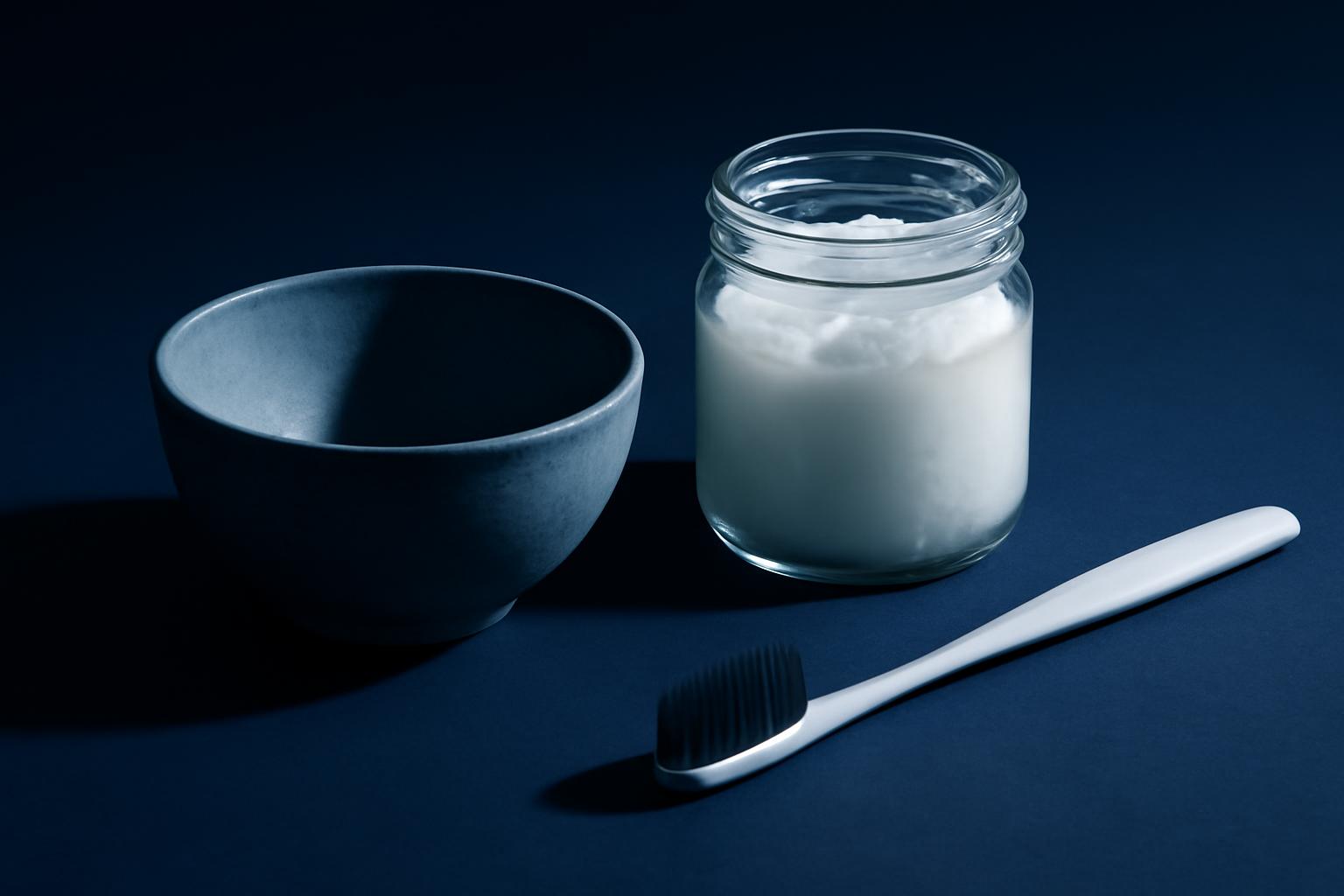
The short answer: oil pulling is not a proven whitening treatment
Reliable evidence does not show that oil pulling whitens teeth or meaningfully changes their natural shade. Swishing oil may move loose food debris and leave the mouth feeling cleaner, but that is different from reliably removing surface stains—and further removed from bleaching tooth color.
“Whiter” can refer to three distinct outcomes:
- Removing loose debris. Teeth may look cleaner once food particles are gone.
- Reducing superficial material. Deposits or external stains can affect brightness, although oil pulling has not been shown to remove specific stains reliably.
- Bleaching natural tooth color. This seeks a broader shade change rather than simply cleaning the surface.
Oil pulling is not an established bleaching treatment. If teeth seem brighter afterward, the observation may be sincere, but it does not establish that the underlying shade changed.
The American Dental Association says no reliable scientific studies show that oil pulling whitens teeth, reduces cavities, or improves oral health and well-being. It does not recommend oil pulling as a dental-hygiene practice because the supporting evidence is insufficient; brushing and flossing remain more effective ways to remove debris and care for teeth, according to the ADA’s summary of oil-pulling evidence.
Whitening must also be assessed separately from salivary bacteria, plaque measurements, gingival health, breath, and a subjective sense of freshness. Evidence for one outcome cannot establish another.
Decay Guide is an informational publisher, not a dental practice, and does not diagnose or treat readers. Its articles are written by a health writer rather than a dentist and have not been reviewed by a clinician. Nothing here replaces an examination or personalized advice about your teeth, as explained in the site’s authorship and clinical-review disclosure.
What oil pulling is—and why swishing oil is not bleaching
Oil pulling involves putting an edible oil in the mouth, swishing it, and then spitting it out. Coconut, sesame, and sunflower oil are commonly mentioned, but there is no reliable evidence that one produces better whitening than another.
Descriptions of the practice often call for roughly a tablespoon of oil and 10–20 minutes of swishing. That describes how oil pulling is commonly performed; it is not a scientifically validated whitening protocol. Suggested times vary between sources, and no optimal duration or frequency has been established for changing tooth color.
The central difference between oil pulling and bleaching is the intended mechanism.
Oil does not contain an established bleaching agent such as hydrogen peroxide. Swishing is a mechanical action: liquid moves around accessible surfaces and may carry away some loose material. That does not establish that oil dissolves plaque, penetrates enamel, or reliably removes pigmented stains.
Peroxide-based products belong to the bleaching category. Their intended role is to alter tooth color rather than merely move surface debris. Many products marketed as “whitening toothpastes” instead rely primarily on surface-cleaning action. Products using the same marketing term can therefore serve different purposes.
Oil pulling should not be described as drawing stains through enamel. Claims that it draws toxins from the blood, treats non-oral disease, balances the oral microbiome, or removes toxins from internal organs also go beyond the supplied evidence.
A useful comparison is rinsing dust from an object versus changing the color of the material itself. The first process can improve surface cleanliness; the second requires a different mechanism. Oil pulling is closer to the first category, although its ability to remove established surface stains has not been demonstrated reliably.
A person may still enjoy the experience or prefer how the mouth feels afterward. That personal response should not be converted into a claim about bleaching, cavity prevention, detoxification, or disease treatment.
What researchers measured—and what they did not
Most oil-pulling research has not been designed to answer the question readers are asking: Does oil pulling really whiten teeth? Studies have generally measured salivary bacteria, plaque scores, gingival scores, bleeding, or related oral-hygiene outcomes instead of objective tooth color.
| Review | Participants | Outcomes measured | Principal result | Important limitation |
|---|---|---|---|---|
| 2022 meta-analysis | 9 randomized controlled trials; 344 participants | Salivary bacterial colony counts, plaque index, gingival index | Bacterial colony counts decreased compared with controls, but plaque and gingival indices did not improve significantly | Tooth color was not measured; the evidence base was small, and 4 trials were assessed as low quality (2022 meta-analysis) |
| 2020 systematic review | 4 randomized trials; 182 participants | Plaque, gingival and stain indices, bleeding on probing, Streptococcus mutans, and salivary bacterial colony counts | Some outcomes produced potentially favorable signals | Trials lasted only 7–14 days; methods differed, risk of bias was mixed or high, and the findings were not conclusive (2020 systematic review) |
The 2022 analysis included studies using sesame or coconut oil and comparisons with chlorhexidine or water-based controls. It found a statistically significant reduction in salivary bacterial colony counts but no statistically significant improvement in plaque or gingival indices. Because the review did not measure objective tooth color, it cannot show whether teeth became lighter or whether any type of discoloration changed.
A bacterial colony count is not a tooth-shade measurement. Nor does a change in saliva automatically show that established plaque was removed from every tooth surface or that cavities, gum disease, or whitening outcomes improved.
The 2020 review focused on coconut-oil pulling. Its four small trials reported their data in different ways and were clinically heterogeneous, so the reviewers did not perform a meta-analysis. The evidence was considered insufficient for conclusive findings.
One study included in that review reported a statistically significant stain-index difference compared with chlorhexidine. The supplied result does not establish the direction, size, visibility, or clinical importance of that difference. A stain index may concern surface staining, and statistical significance alone does not show that teeth were visibly or desirably bleached.
The reviews also demonstrate why the statement “oil pulling removes plaque” is too confident. Some outcomes in the 2020 review appeared favorable, while the larger 2022 analysis did not find a statistically significant plaque-index improvement. Study design, duration, oils, comparison groups, participant characteristics, and measurement methods differed.
To establish a whitening effect, researchers would need adequately sized controlled trials using standardized, objective tooth-shade measurements. Follow-up would also be necessary to determine whether any visible effect persisted.
Until then, findings about salivary bacteria cannot be translated into claims that oil pulling:
- removes plaque from all tooth surfaces;
- prevents cavities;
- treats gingivitis or gum disease;
- eliminates persistent bad breath;
- removes coffee, tea, or tobacco stains; or
- changes the natural shade of teeth.
These are separate outcomes involving different processes and measurements.
Why teeth might look brighter even when their shade has not changed
A person can sincerely report brighter-looking teeth without having experienced measurable bleaching. Subjective appearance and objectively measured tooth color are not the same outcome.
Loose debris, a surface film, or deposits around teeth can affect how clean a smile looks. If swishing moves some loose material—or encourages someone to brush more carefully afterward—the surface may seem smoother or glossier.
That is a possible explanation, not proof that oil pulling removes established stains. Existing evidence does not identify which surface stains, if any, respond to oil pulling or quantify how visible a change might be. It is therefore more accurate to say teeth might look cleaner than to say oil pulling whitens them.
Testimonials cannot settle the question. Someone who starts oil pulling may also improve their brushing technique, clean between their teeth more often, change toothpaste, reduce stain-producing drinks, receive a professional cleaning, or use whitening strips. Without controlling for those changes, the result cannot be attributed confidently to oil.
Before-and-after photographs introduce further uncertainty. Apparent tooth color can change with:
- room lighting or flash;
- exposure and white balance;
- image editing or filters;
- camera angle and distance;
- surrounding colors;
- whether teeth are wet or dry;
- recent brushing or professional cleaning; and
- use of another whitening product.
Myth versus evidence
- “My teeth feel cleaner.” That describes an experience, not proof that tooth color changed.
- “A study found fewer bacteria.” A bacterial reduction does not establish stain removal or bleaching.
- “A stain index changed.” Without direction, magnitude, and clinical context, that result does not prove visible whitening.
- “The oil turned cloudy.” Oil mixing with saliva does not demonstrate that toxins or deep stains were extracted.
- “My photo looks brighter.” Lighting, exposure, moisture, cleaning, and other products may explain the difference.
There is no reliable whitening timeline. Evidence does not establish that oil pulling produces visible whitening after a certain number of days, requires daily use, or creates an effect that lasts for a predictable period.
Surface stains, natural shade, and discoloration inside a tooth
The cause of discoloration affects which response makes sense. Teeth that look yellow, brown, gray, or dark do not necessarily have the same underlying issue, and color alone cannot identify the cause safely.
A basic distinction is between:
- Extrinsic discoloration: material or staining associated with the outer surface of a tooth.
- Intrinsic or internal discoloration: a color change arising within the tooth structure rather than on its surface.
Several appearance categories can overlap with that distinction:
- Superficial staining or buildup: Deposits on a tooth may make it look duller or darker.
- Natural tooth color: Healthy natural teeth vary in shade and are not necessarily bright white.
- Enamel changes: Changes in enamel can affect the appearance of the tooth and how underlying structure is seen.
- Decay: Tooth damage can sometimes be accompanied by an appearance change, but color alone cannot diagnose it.
- Restorations: Fillings, crowns, veneers, and other restorations can differ in color from nearby natural teeth.
- Internal tooth changes: A tooth may darken for reasons that require assessment rather than surface cleaning.
Oil pulling has not been shown to bleach natural tooth shade or remove deep discoloration. The evidence also does not establish that it reliably removes coffee, tea, tobacco, wine, or food stains. Those are reasonable consumer concerns, but a theory about surface cleaning should not be presented as a proven treatment for a named stain.
A yellow appearance does not automatically indicate poor hygiene. Natural shade and changes involving enamel can influence how teeth look. Scrubbing harder or repeatedly trying home remedies may therefore fail to address the actual reason for the appearance. Readers concerned about a duller or yellower appearance can also review Decay Guide’s explanation of enamel erosion from acidic drinks.
A short decision framework can help organize the options without attempting a diagnosis:
-
Does the concern seem related to surface buildup? Focus on routine brushing and cleaning between the teeth, and consider whether a professional cleaning is due.
-
Is the goal an overall change in the shade of natural teeth? Compare actual whitening methods rather than assuming that more vigorous cleaning will bleach the teeth.
-
Is the change sudden, limited mainly to one tooth, uneven, painful, or persistent? Arrange a dental assessment before trying cosmetic treatment. These patterns cannot be interpreted safely from color or photographs alone.
A dental-practice evidence overview identifies surface stains, natural shade, enamel changes, decay, restorations, and internal tooth changes as different possible explanations for discoloration. It also advises assessment when a color change is sudden, localized, painful, uneven, or persistent (overview of oil pulling’s limits and discoloration concerns).
Possible oral-health effects are separate from whitening
Oil pulling should not be labeled simply “effective” or “ineffective.” Each proposed effect needs its own evidence and outcome measure.
Salivary bacteria: possible effect, uncertain importance
Limited research suggests that oil pulling may reduce some salivary bacterial counts. That was the clearest favorable signal in the 2022 meta-analysis, but it remains a surrogate outcome.
A surrogate is an indicator rather than a direct demonstration of the result people ultimately care about. Fewer colonies in a saliva sample do not necessarily mean less established plaque on every tooth surface, fewer future cavities, healthier gums, fresher breath, or whiter teeth.
The mouth also contains complex microbial communities. A change in one organism or in total colony counts does not establish that oil pulling has “balanced” the oral microbiome.
Plaque: mixed evidence
Plaque findings are inconsistent. The 2022 analysis found no statistically significant plaque-index improvement compared with controls. The smaller 2020 review reported favorable signals for some plaque-related outcomes, but its trials were short, heterogeneous, and at mixed or high risk of bias.
The fair conclusion is not that one review must be right and the other wrong. It is that evidence for plaque reduction remains limited and mixed. It does not establish that oil pulling reliably cleans every tooth surface, reaches below the gumline, or performs the same role as brushing and interdental cleaning.
For readers who want to improve mechanical plaque removal, Decay Guide has a separate guide to proper toothbrushing technique.
Gingival health: uncertain
Research on gingival outcomes is also uncertain. The 2022 analysis found no statistically significant gingival-index improvement. The 2020 review reported signals in some measures but could not reach conclusive findings because of the studies’ size, duration, heterogeneity, and risk of bias.
These findings do not establish that oil pulling treats gingivitis or gum disease.
Bad breath: uncertain
Some people report that their mouth feels fresher after swishing. The experience might reflect the oil’s taste, movement of loose food particles, greater attention to oral care, or a temporary change in mouth feel.
Evidence that oil pulling reliably treats persistent bad breath is insufficient. Because bad breath can have different contributing factors, a temporary fresh feeling does not show that the cause has been treated.
Cavities, enamel, and disease treatment: unsupported claims
Available evidence does not establish that oil pulling prevents cavities, reverses decay, remineralizes enamel, treats gum disease, or creates a reliably healthier oral microbiome. Those conclusions do not follow from a change in salivary bacterial counts.
Likewise, feeling smoother, cleaner, or fresher after swishing is not evidence that disease has been reversed. Personal experience can describe comfort or preference, but it cannot replace measurements designed to assess tooth damage or periodontal health.
The most defensible conclusion is narrow: oil pulling may affect certain bacterial measurements, and some studies suggest possible effects on selected oral-health indices. The evidence is limited and mixed, and none of it establishes tooth whitening.
Choose an option that matches the actual goal
The useful comparison is not “natural versus conventional.” It is whether the goal is routine cleanliness, removal of surface material, or a broader change in the shade of natural teeth.
| Option | Intended role | Basic mechanism | Reasonable expectation |
|---|---|---|---|
| Oil pulling | Optional swishing practice | Mechanical movement of edible oil around accessible surfaces | May move loose debris or create a cleaner feeling; not an established bleaching treatment |
| Routine brushing and interdental cleaning | Daily oral hygiene | Physical disruption and removal of debris and plaque from accessible surfaces and between teeth | Supports routine cleanliness; not intended to create a major change in natural tooth shade |
| Stain-removing toothpaste | Surface cleaning | Cleaning or polishing action | May address some external material; should not be assumed to correct internal discoloration |
| Professional cleaning | Removal of deposits and some surface material | Dental instruments and polishing | Can improve surface cleanliness and address deposits that home care may leave behind; not the same procedure as bleaching |
| Over-the-counter peroxide products | Whitening natural teeth | Peroxide-based bleaching action | Belongs to the whitening category; suitability depends on the product and the reason for discoloration |
| Dentist-supervised whitening | Planned color change in natural teeth | Bleaching agents used following professional assessment or supervision | Seeks a broader shade change but is not automatically appropriate for every person or every type of discoloration |
The table intentionally stays at category level. The evidence pack does not support promises about a number of shades, treatment duration, cost, durability, or universal safety.
Professional cleaning and whitening are separate procedures:
- Cleaning addresses deposits and some surface discoloration.
- Whitening seeks a broader color change in natural teeth.
Someone concerned mainly about buildup may not need bleaching. Conversely, someone seeking to change natural tooth shade should not expect cleaning—or oil pulling—to produce the same result as a bleaching method.
Peroxide-based whitening belongs to a different category from oil pulling, while whitening toothpastes generally focus more on surface cleaning. Existing sensitivity, restorations, uneven discoloration, and the reason for the color difference may affect whether a particular option is suitable. A detailed comparison is available in Decay Guide’s guide to over-the-counter and professional teeth-whitening options.
No option should be selected solely from a photograph or social-media recommendation. A whitening method may not address deposits, restoration-related color differences, or changes arising within a tooth, while cleaning should not be expected to bleach natural tooth shade.
Safety, routine care, and reasons to seek an examination
Oil pulling should never replace brushing, cleaning between the teeth, fluoride use when recommended, dental examinations, or professional cleaning. At most, it should be treated as an optional addition for an adult who chooses to use it—not as a substitute for established care.
Possible adverse effects include:
- jaw fatigue or muscle strain from prolonged swishing;
- nausea or stomach upset, particularly if oil is swallowed;
- coughing or choking; and
- aspiration concerns if oil enters the airway.
Aspiration-related lipoid pneumonia has been described in rare case reports associated with oil pulling. Case reports support caution but do not establish that the complication is common. A university-affiliated dental practice discusses jaw and stomach effects and cites a report involving two patients with lipoid pneumonia in its oil-pulling safety review.
Adults who still choose to try oil pulling should use conservative precautions:
- Do not swallow the oil.
- Do not inhale it.
- Spit it into a trash can rather than a sink.
- Stop if swishing causes jaw strain, nausea, coughing, choking, or other discomfort.
- Do not continue merely to reach a time promoted on social media.
These precautions are harm-reduction measures, not a recommended whitening regimen. A dental-practice safety overview similarly advises avoiding swallowing or inhaling the oil, disposing of it in the trash, and stopping if discomfort occurs (oil-pulling instructions and cautions).
There is no evidence-based duration or frequency for whitening. Common descriptions of oil pulling should not be mistaken for medically validated instructions, and daily use cannot be assumed to be safer or more effective than occasional use.
Seek dental assessment rather than relying on cosmetic self-treatment when discoloration is:
- sudden;
- mainly confined to one tooth;
- accompanied by pain;
- noticeably uneven;
- associated with another new symptom; or
- persistent despite ordinary cleaning.
An examination may be needed to distinguish surface staining or deposits from decay, enamel changes, restoration-related appearance, or a change arising within the tooth. Decay Guide cannot make that distinction for an individual reader; its terms explain the limits of non-clinical information.
Frequently asked questions
How long does oil pulling take to whiten teeth?
There is no reliable timeline because oil pulling has not been shown to produce a meaningful change in tooth shade. The commonly mentioned practice of swishing for 10–20 minutes describes how some people perform oil pulling; it is not a validated whitening protocol.
Research has mainly measured bacteria, plaque, and gingival indices rather than standardized tooth color. It therefore cannot establish how many sessions would be required, when a visible effect should appear, or how long one would last.
If teeth look brighter immediately afterward, loose debris, moisture, recent brushing, or lighting may explain the impression. That is not evidence of bleaching.
Can coconut oil remove coffee, tea, or tobacco stains?
It has not been reliably shown to remove coffee, tea, or tobacco stains. These substances can be associated with surface discoloration, but oil-pulling research does not establish which specific stains respond, how much material might be removed, or whether a change would be visible.
For suspected surface staining, routine hygiene, a surface-cleaning toothpaste, or professional cleaning matches the surface-cleaning goal. A peroxide-based product belongs to the bleaching category when the goal is a broader change in natural tooth shade.
Persistent or uneven discoloration should not automatically be attributed to drinks or tobacco. An examination may be needed to determine what is affecting the appearance.
Is coconut oil better than sesame or sunflower oil for whitening?
No reliable evidence shows that coconut oil is better than sesame or sunflower oil for whitening. Studies have used different oils, methods, comparison groups, and oral-health outcomes, while objective tooth whitening has generally not been measured.
Research involving coconut oil should not be generalized automatically to every oil. Studies using sesame oil likewise do not prove that it changes tooth color. There is no established best oil, dose, duration, or frequency for whitening.
Taste and texture may affect personal preference, but preference is different from comparative effectiveness or safety.
Can oil pulling replace brushing, flossing, or mouthwash?
No. Oil pulling should not replace brushing, flossing or other interdental cleaning, fluoride use when recommended, dental examinations, or professional cleaning.
Swishing may move some loose debris, but it has not been shown to perform the same role as cleaning every accessible tooth surface and between the teeth. Evidence concerning plaque and gingival outcomes remains mixed, and a change in salivary bacteria does not prove equivalent plaque removal.
Whether a person needs a particular mouthwash depends on why it is being used. Oil pulling should not be assumed to reproduce the purpose or performance of a therapeutic rinse recommended for a specific condition.
Is it safe to oil pull every day?
There is no evidence-based daily oil-pulling regimen for whitening, and daily use should not be assumed to be optimal or risk-free. Possible problems include jaw fatigue, stomach upset if oil is swallowed, coughing, choking, and aspiration concerns. Rare aspiration-related lipoid pneumonia has also been described in case reports (Penn Dental’s review of reported risks).
Anyone who chooses to try oil pulling should avoid swallowing or inhaling the oil, dispose of it in a trash can, and stop if it causes jaw strain, nausea, coughing, choking, or other discomfort. It should not displace routine oral care.
Most importantly, repeating oil pulling every day does not correct a mismatch between the method and the problem. Surface deposits, a desired change in natural tooth shade, restoration-related color differences, and an internally darkened tooth are different concerns.
The takeaway is twofold: oil pulling may make the mouth feel cleaner, but current evidence does not show that it truly whitens teeth. If the goal is a cosmetic change, first distinguish possible surface buildup from a desired change in natural tooth color, continue established oral care, and arrange an examination when discoloration is sudden, localized, painful, uneven, or persistent.