
When At-Home Whitening Is Usually Safe—and When to Stop
Lasting damage is unlikely on healthy teeth with exact label use, but zero risk isn't proven. Severe, localized or worsening pain warrants an exam.
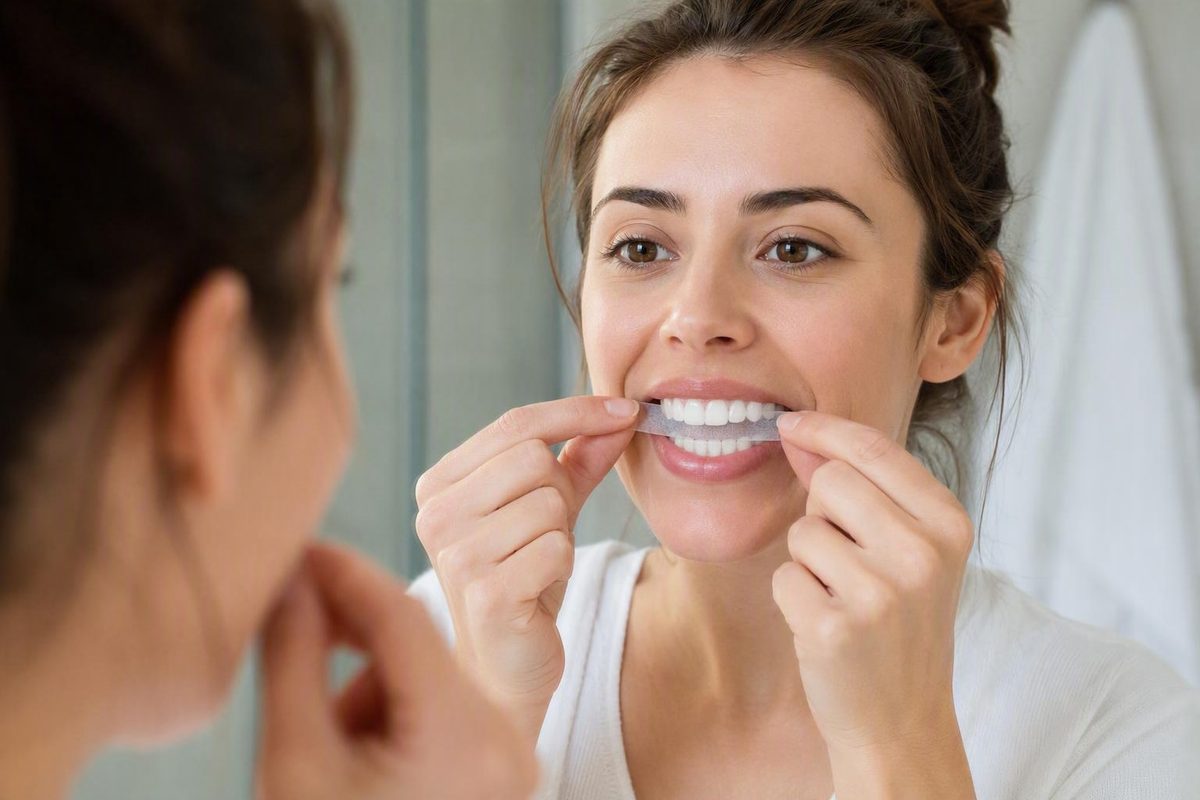
The short answer: correct use is different from overuse
Do whitening strips damage teeth? Lasting damage to healthy teeth appears unlikely when a peroxide whitening product is used exactly as directed, but correct use cannot guarantee zero risk. Temporary tooth sensitivity and mild gum irritation are the adverse effects reported most consistently in the evidence reviewed here. Risk rises when strips are worn too long, applied too often, placed over the gums, or used on teeth with untreated problems. A 2014 peer-reviewed review of peroxide whitening reached a generally favorable safety conclusion when manufacturers’ protocols were followed, while identifying sensitivity and mild gum irritation as common adverse effects.
It helps to separate whitening concerns into three groups:
- Expected temporary effects: generalized sensitivity across several treated teeth or mild irritation where gel briefly touched the gums.
- Problems associated with misuse or excessive exposure: more intense sensitivity, chemical irritation of the gums, and greater concern about effects on enamel, restorations, or tissue inside the tooth.
- Symptoms that may reflect another dental problem: severe pain, pain concentrated in one tooth, significant swelling, or discomfort that persists or worsens after whitening stops.
The review above covered several hydrogen peroxide and carbamide peroxide whitening methods rather than whitening strips alone. It was published in 2014, so it cannot establish the safety of every newer strip formulation or provide a comprehensive assessment of literature published since then. The conclusions in this article are therefore limited to the evidence reviewed here.
Risk depends on more than whether a product is called a whitening strip. Relevant variables include:
- Peroxide type and concentration
- Contact time
- Application frequency
- Total course length
- Placement and gum overlap
- Other ingredients in the formulation
- Baseline tooth sensitivity
- Cavities, cracks, exposed roots, worn enamel, or gum disease
Neither extreme answer is justified. Ordinary, label-compliant use should not be described as routinely eroding enamel, but whitening strips should not be described as incapable of causing harm.
How peroxide strips whiten teeth
Whitening strips are flexible pieces of material coated with a whitening gel. The active bleaching ingredient is commonly hydrogen peroxide or carbamide peroxide; carbamide peroxide releases hydrogen peroxide.
Once placed over the outward-facing surfaces of the teeth, the strip holds gel against the enamel. Peroxide breaks down colored pigments associated with staining, making the color less concentrated and the teeth appear lighter. A commercial Colgate explanation of whitening-strip composition and function similarly describes flexible strips coated with hydrogen peroxide or carbamide peroxide gel.
Contact between peroxide and enamel is an intended part of whitening. It does not, by itself, establish that the strip is removing enamel. Whitening changes stain molecules; it is not intended to grind or peel away the tooth’s outer layer.
What matters is total exposure. Concentration, duration, and application frequency can affect both the whitening result and the likelihood of sensitivity or irritation. The 2014 review specifically associates adverse-effect severity with factors including peroxide concentration, treatment duration, and other formulation ingredients.
This has two practical implications:
- Do not assume that leaving a strip on longer will produce a proportionally better result.
- Do not copy a schedule from a study, social-media post, or different brand.
A regimen tested or labeled for one product cannot automatically be transferred to another.
Explanations claiming that whitening “opens enamel pores” and directly exposes tooth nerves are not necessary and may oversimplify the process. The better-supported practical point is that peroxide can produce temporary sensitivity, particularly when exposure is more aggressive or a tooth is already compromised.
Temporary sensitivity and gum irritation versus structural damage
Temporary symptoms are not the same as permanent enamel loss. At the same time, pain should not be dismissed merely because it began during whitening.
Tooth sensitivity
Teeth may react more strongly to cold air, drinks, or foods during a course or shortly after an application. In the evidence reviewed here, sensitivity is a recognized adverse effect that is generally temporary and may improve when whitening is paused or stopped.
The pattern of pain can help determine how cautiously to respond, but it cannot identify the cause. Mild, diffuse sensitivity around treatment is different from severe, spontaneous, worsening, or sharply localized pain. Dental-practice guidance on safe strip use and warning symptoms advises stopping and obtaining professional input when pain is severe or lingering, particularly when unhealthy teeth may be involved.
Gum irritation
Whitening gel is intended for the teeth, not prolonged contact with soft tissue. If a strip is too wide, shifts during use, or overlaps the gumline, the exposed tissue may become:
- Red
- Sore or tender
- Swollen
- Painful or burning
- Temporarily white or blanched
Dental-practice guidance focused on gum exposure from whitening strips describes redness, tenderness, swelling, pain, and chemical irritation as possible effects of gel contact or overuse. The source does not establish how frequently these effects occur.
Temporary whitening of the gum is not the same as tooth whitening. It can indicate chemical irritation. Remove the strip and rinse away the gel rather than continuing the application.
Structural concerns
Aggressive peroxide whitening has produced laboratory findings involving:
- Tooth microstructure
- Surface erosion or mineral degradation
- Susceptibility to demineralization
- Dental restorative materials
- Possible effects on the dental pulp inside the tooth
Context is critical. Many such findings came from laboratory studies involving extracted teeth, isolated restorative materials, or exposure conditions that may not reproduce a living mouth. A microscopic laboratory change does not necessarily amount to clinically meaningful enamel loss in a person completing one course correctly.
The evidence reviewed here does not provide a reliable incidence of permanent enamel or pulpal injury from modern whitening strips used exactly as labeled. That gap cannot be converted into either a promise that lasting harm is impossible or a warning that routine strip use destroys enamel.
A practical symptom guide
| Mild or generalized symptoms: pause treatment | Gum-contact symptoms: remove and rinse | Symptoms warranting dental evaluation |
|---|---|---|
| Mild sensitivity across several treated teeth | Burning or soreness where gel overlaps the gum | Severe or escalating pain |
| Brief sensitivity to cold, air, or sweet foods | Redness, tenderness, or localized swelling | Sharp, spontaneous, or persistent pain focused in one tooth |
| Discomfort that improves after strip removal | Temporary whitening or blanching of gum tissue | Pain that persists or worsens after whitening stops |
| Mild irritation without blistering or substantial swelling | Gel visibly left on the gum after removal | Significant swelling, blistering, peeling, or extensive burn-like tissue |
For mild, generalized symptoms, do not immediately apply another strip. Pause treatment while symptoms persist and consult the product directions or a dental professional before changing the schedule.
For gum-contact symptoms, remove the strip and rinse away residual gel. Do not reapply a strip to tissue that remains sore.
For severe, localized, persistent, worsening, swollen, blistered, or burn-like symptoms, stop whitening and arrange an examination. These features are reasons to seek assessment, not diagnostic proof of decay, a crack, or any other particular condition.
What overuse can change—and what the evidence cannot quantify
Overuse increases total peroxide exposure. It includes:
- Leaving strips on longer than the label permits
- Applying more strips per day than directed
- Adding treatment days
- Repeating courses more often than instructed
- Sleeping in strips not labeled for overnight use
- Continuing despite notable sensitivity or gum soreness
More aggressive exposure is associated with greater concern about sensitivity and gum irritation. Laboratory findings involving enamel, mineral content, restorations, and pulpal tissue also become more relevant as exposure becomes more aggressive.
The evidence reviewed here does not establish a universal number of minutes, peroxide percentage, repeat-course interval, or cumulative dose at which permanent damage begins. A dental-clinic discussion of prolonged wear and excessive strip use warns about sensitivity and possible erosion while emphasizing that wear instructions vary by product.
“Longer” and “more often” are meaningful only in relation to the exact label. A duration permitted for one strip may be excessive for another. The same applies to application frequency and course length.
What if a strip was left on too long once?
Remove it, rinse away residual gel, and do not add another application to compensate. Follow the symptom guide above. Mild sensitivity or irritation calls for a pause; severe, localized, worsening, or burn-like symptoms call for professional assessment.
One mistake does not prove that permanent enamel loss has occurred. Conversely, an absence of immediate pain does not make repeated off-label exposure safe.
What about repeated courses over several years?
Repeated whitening beyond the directions is a reasonable cumulative-exposure concern. However, the evidence reviewed here does not establish whether years of properly spaced, label-compliant courses cause lasting harm. It also does not establish a universally safe repeat interval.
Product formulations and oral health can change. Recheck the current label and consider the condition of your teeth rather than treating whitening as an automatic recurring routine.
Check for dental problems before whitening
Whitening is cosmetic. It should not be used to test whether a painful tooth is healthy, conceal unexplained discoloration, or postpone assessment of a known problem.
Before beginning, consider whether you have:
- An untreated cavity
- A cracked, chipped, or broken tooth
- A damaged restoration
- Gum disease or already inflamed gums
- Receding gums
- Exposed tooth roots
- Noticeably worn or eroded enamel
- Marked sensitivity before whitening
- Recent dental work
- Unexplained pain
- A sudden color change in one tooth
- Visible crowns, fillings, veneers, bonding, or implants
Peroxide reaching a compromised surface or exposed root may cause substantial discomfort. Commercial dental-provider guidance, including a Cambridge Dental overview of whitening-strip risks, advises people with cavities, cracks, gum disease, extreme sensitivity, or exposed roots to obtain dental guidance before whitening.
This is a prudent screening measure, but the supplied support comes mainly from commercial clinical sources rather than comparative studies quantifying the risk posed by each condition. It does not prove that every person with a filling, sensitivity, or previous dental work will be harmed.
Why localized pain matters
If one tooth already hurts, do not use a whitening strip to see whether it improves, worsens, or “reacts normally.” Whitening cannot diagnose the tooth. Decay, a crack, an exposed root, and other conditions can produce overlapping symptoms that cannot be separated reliably at home.
Likewise, discoloration confined to one tooth may have a different cause from generalized yellowing. Extending the course or using a stronger product may increase exposure without addressing that cause.
Plan around restorations
Restorations belong on the checklist even when there is no structural problem. Whitening can lighten nearby natural teeth while a restoration remains its original shade, making a filling, crown, veneer, or bonded area more conspicuous.
That difference is generally a cosmetic mismatch, not evidence that the strip damaged the tooth or restoration. Discuss the likely result before whitening prominent restored teeth.
Decay Guide publishes general dental-health information and is not a dental practice. This checklist cannot determine whether your teeth are suitable for whitening or identify the cause of an individual symptom.
A lower-risk way to use whitening strips
The most important safety rule is straightforward: follow the exact directions supplied with the exact product.
Check the label for:
- Permitted wear time
- Applications per day or week
- Total course length
- Correct placement
- Storage and handling
- Whether rinsing is required
- Age restrictions
- Instructions for missed applications
- Warnings about sensitivity, restorations, or dental conditions
Do not extend a session or add applications to accelerate the result. More exposure can mean more discomfort without producing a predictable improvement.
Place the strips carefully
Prepare the teeth only as the product instructs. Align the gel-coated area over the natural tooth surfaces and avoid placing it directly on the gums. Smooth the strip enough to keep it in place, but do not fold gel-covered material onto soft tissue unless the directions explicitly show that placement.
If gel reaches the gums:
- Remove the excess rather than leaving it on the tissue.
- Reposition or remove the strip if it cannot be kept off the gums.
- Stop the application if the tissue becomes sore or burns.
- Rinse away residual gel.
Commercial oral-health guidance also recommends following package directions, limiting gum contact, removing strips when soreness develops, and rinsing with water.
Respond to symptoms rather than whitening through them
If notable sensitivity, soreness, or burning develops, use the symptom guide above: remove the strip, rinse away remaining gel, and pause while symptoms persist. Do not reapply to sore tissue. Seek dental guidance when symptoms are severe, localized, persistent, worsening, swollen, blistered, or burn-like.
Sensitivity toothpaste is commonly suggested as a comfort measure. It may make mild sensitivity easier to manage, but it does not show that continued whitening is safe despite significant pain.
If you want to shorten sessions or increase the interval between applications, consult the product directions or a dental professional. Do not assume that a personally modified schedule will remain effective or suitable.
Do not invent a brushing interval
Recommendations about brushing immediately before or after strips differ among products and commercial sources. Follow the instructions for your product rather than applying a universal waiting period. Formulations, adhesives, and intended sequences may differ.
Evaluate claims product by product
An ADA Seal, where present, applies to the particular accepted product and its intended use. It does not mean whitening strips as a category have been accepted. Manufacturer guidance on using whitening strips likewise emphasizes product-specific instructions, although it should be understood as commercial guidance rather than independent evidence.
When to stop whitening and arrange an examination
Stop using the strips and seek dental evaluation for:
- Severe or escalating pain
- Pain focused in one tooth
- Throbbing or spontaneous pain
- Symptoms that persist or worsen after treatment stops
- Significant swelling
- Blistering, peeling, or extensive burn-like tissue
There is no supported universal deadline—such as an exact number of hours—after which all sensitivity becomes abnormal. Severity, location, persistence, and progression are more useful reasons to seek assessment than an arbitrary clock. Commercial dental-provider guidance similarly distinguishes mild temporary sensitivity from more serious symptoms and recommends professional input for severe effects or untreated dental problems.
Immediate response to gum exposure
If a strip or gel burns the gums:
- Remove the strip immediately.
- Rinse away the gel with water.
- Do not reapply a strip to sore or visibly injured tissue.
- Pause the whitening course.
- Seek dental advice if pain, swelling, blistering, peeling, or tissue whitening is substantial or does not improve.
Why an examination may be necessary
Whitening sensitivity, decay, cracks, exposed roots, and restoration problems can produce overlapping sensations. A sharp pain in one tooth does not prove that there is a cavity or crack, but it should not automatically be treated as routine whitening sensitivity either.
Whitening strips do not treat the cause of pain. They also do not repair damaged enamel, close a crack, fill a cavity, or address discoloration caused by an injury inside a tooth. Cosmetic whitening and dental treatment serve different purposes.
What strips will not whiten
Whitening strips are designed to lighten natural tooth structure. They generally do not change the shade of:
- Tooth-colored fillings
- Crowns
- Veneers
- Composite bonding
- Dental implants
- Other fixed restorative materials
If natural teeth become lighter while restorations remain unchanged, the result may look patchy or uneven. This is a cosmetic planning issue, not necessarily evidence of damage. Aspen Dental’s guide to whitening strips and restorations likewise states that strips lighten natural enamel but not crowns, veneers, bonding, fillings, or implants.
The contrast can be especially visible when a crown or bonded area is on a front tooth. The strip has not necessarily darkened the restoration; the surrounding natural teeth have become lighter.
Some discoloration also responds less predictably than ordinary staining. Color changes associated with medication exposure or tooth injury may not improve adequately with strips. A single dark, gray, or otherwise unusual tooth should not automatically be treated with a longer or stronger course.
If you have prominent restorations or unexplained discoloration, clarify the likely result before whitening. Increasing exposure will not force a crown or filling to change color and may increase sensitivity or gum irritation.
Frequently asked questions
Can one correctly used course of whitening strips permanently damage enamel?
Lasting damage appears unlikely in healthy teeth when a peroxide strip is used exactly according to its instructions, but zero risk has not been proven. The evidence reviewed here does not provide a dependable incidence of permanent enamel injury from modern strips, and many structural findings come from aggressive exposure or laboratory research rather than ordinary use in living teeth.
The balanced conclusion is that one label-compliant course should not be described as routinely removing enamel. It also should not be presented as guaranteed harmless, especially when cavities, cracks, exposed roots, worn enamel, or other untreated conditions are present.
Is sensitivity after whitening strips normal, and when should I stop?
Mild, generalized sensitivity around treatment is a recognized and usually temporary adverse effect. Pause rather than trying to whiten through notable discomfort.
Stop and arrange an examination if pain is severe, localized, persistent, or worsening, or occurs with significant swelling or visible tissue injury. These features do not establish a diagnosis, but they warrant professional assessment.
What should I do if whitening gel touches or burns my gums?
Remove the strip, rinse away the gel, and do not reapply it to tissue that remains sore. Mild irritation may improve after exposure stops.
Seek dental advice for substantial pain, swelling, blistering, peeling, extensive white or burn-like tissue, or symptoms that do not improve.
How often can I repeat a whitening-strip course?
There is no universal repeat interval that applies to every product. Follow the specific label, including any directions about repeat courses, and do not transfer a schedule from another brand.
The evidence reviewed here does not establish whether repeated label-compliant courses over many years are completely safe or predictably harmful. If the label is unclear, your oral health has changed, or you feel the need to whiten frequently, ask a dental professional before starting another course.
Why did my natural teeth whiten but my fillings or crowns did not?
Peroxide strips lighten natural tooth structure but generally do not change the color of fillings, crowns, veneers, bonding, or implants. As natural teeth become lighter, restorations can remain at their original shade and look darker by comparison.
This mismatch is usually cosmetic rather than a sign of damage. Using more strips is unlikely to make the restoration match and may increase sensitivity or irritation.
Properly used peroxide whitening strips are unlikely to permanently damage healthy teeth, but temporary sensitivity and gum irritation remain possible, and excessive exposure increases concern. Follow the exact label, stop when significant symptoms develop, and seek an examination for severe, localized, persistent, or worsening pain or a suspected gum burn. The evidence reviewed here supports neither the claim that strips routinely destroy enamel nor the promise that lasting harm is impossible.