
How Teeth Whitening Options Stack Up: From OTC Products to Professional Treatments
In-office treatment is usually fastest, but crowns, veneers and fillings generally stay the same shade. One dark tooth may need diagnosis first.
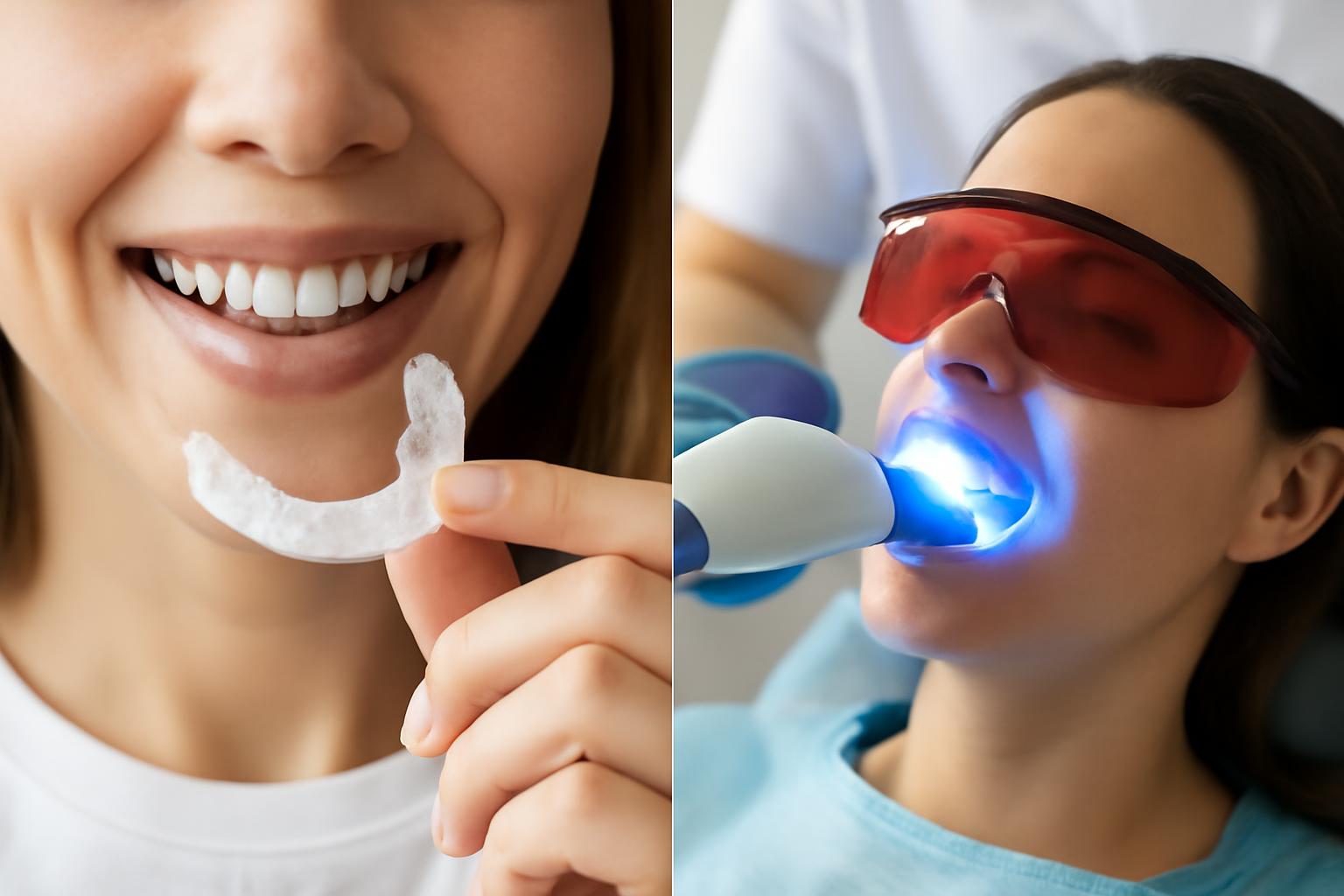
If you are comparing teeth whitening options, the most useful question is not just which method is “strongest.” It is which method matches the kind of discoloration you have, how fast you want a result, how much sensitivity risk you can tolerate, and whether a dentist needs to rule out something else first.
That matters because whitening is not one thing. It is a group of approaches: over-the-counter products, dentist-supervised take-home systems, and in-office procedures. Many use similar bleaching chemistry, but they differ in strength, tray fit, contact time, tissue protection, and how predictable the result is. A strip, a custom tray, and a chairside bleaching visit can all lighten teeth, but not at the same pace or with the same tradeoffs.
The comparison also gets muddled because brighter-looking teeth do not always mean the same problem was solved. Some people mainly have fresh surface stain. Others have deeper discoloration inside the tooth, an old front filling that no longer matches, or one dark tooth after trauma. In those cases, “better whitening” and “better diagnosis” are not the same task.
Understanding Tooth Stains and How Whitening Works
Tooth discoloration is usually described as extrinsic or intrinsic. Extrinsic stains build up on or near the enamel surface and are commonly linked to coffee, tea, red wine, tobacco, and other pigmented exposures. Intrinsic discoloration sits inside the tooth structure and can be related to aging, genetics, fluorosis, trauma, or some medications. Whitening also has a built-in limit: it changes natural tooth structure, but it does not whiten crowns, veneers, fillings, or other tooth-colored restorations, which is why shade mismatch after treatment is common according to the American Dental Association.
Most whitening systems rely on hydrogen peroxide or carbamide peroxide. These agents oxidize stain molecules so they reflect light differently. Carbamide peroxide is not percentage-for-percentage the same thing as hydrogen peroxide; the ADA notes that carbamide peroxide releases about one-third hydrogen peroxide, which is one reason product labels can be confusing when you try to compare a home tray with a chairside treatment.
That chemistry helps explain why whitening works best on some stains and less well on others. Surface staining is usually the most straightforward target. Deeper intrinsic discoloration can improve in some cases, but the outcome is less predictable and may require longer treatment. Also, some of the very bright look immediately after bleaching may not all represent stable long-term change: review-level evidence notes that temporary dehydration can make teeth look whiter right after treatment, with some rebound as the tooth rehydrates afterward in the PubMed Central review on tooth whitening.
This is why realistic expectations matter. If the main problem is recent coffee or tea staining, whitening may help a great deal. If the problem is a single dark tooth, visible front crowns, or discoloration from damage inside the tooth, the first priority is often not a stronger whitener but identifying the cause. Whitening also cannot fix issues that are not really stain problems in the first place; some persistent dental changes are examples of problems daily brushing cannot fix, and bleaching is no substitute for diagnosing them.
Over-the-Counter Whitening Products
Over-the-counter whitening includes several quite different products. Whitening toothpastes mostly work through abrasives and polishing agents that remove surface stain rather than deeply bleaching the tooth. Strips and gels apply peroxide directly to the teeth, often for daily use over about 10 to 14 days. Rinses typically need much longer use because contact time is brief, and OTC trays or pens depend heavily on how evenly the product actually touches the teeth, as summarized in WebMD’s medically reviewed guide.
In practical terms, OTC products are usually the easiest entry point for mild extrinsic staining. They are convenient, widely available, and much easier to try than booking treatment through a dental office. For people whose teeth have simply picked up routine staining from coffee, tea, or smoking, strips or peroxide gels may be a reasonable first attempt.
The tradeoff is predictability. Whitening toothpaste may help with fresh surface stain and can be useful for maintenance, but it is not the same as bleaching deeper discoloration. Rinses are usually slower still because they do not stay on the tooth long. Paint-on products and pens can work unevenly if the gel dries patchily, misses the edges of the teeth, or does not stay in contact long enough.
Fit is another weakness of the OTC category. A generic tray may leak onto the gums or fail to press the gel evenly against the visible front surfaces. That does not make OTC whitening ineffective; it just makes the result more technique-dependent than many packages suggest.
OTC use also puts more judgment on the buyer. If a product causes noticeable sensitivity, it is easy to assume the answer is to push through for a “better” result, or to use it more often than directed. But more exposure does not always mean proportionally better whitening. It can simply mean more irritation, more sensitivity, or a patchier final shade.
So OTC whitening is best understood as a low-barrier option for mild, mostly surface staining. It can work well enough for the right problem. It is just not the same thing as professional bleaching in either strength or supervision.
Dentist-Supervised At-Home Kits and Trays
Dentist-supervised take-home whitening sits between store-bought products and an in-office procedure. These systems usually involve whitening gel placed in trays that are worn for hours at a time or overnight over days to weeks. Review and practice summaries commonly describe custom-tray take-home regimens in the 10% to 38% range with wear times of roughly 2 to 10 hours a day over about 6 to 28 days, depending on the formulation and treatment plan, as summarized in this comparison of whitening options.
What separates this category from OTC whitening is not only stronger chemistry. It is also fit. A tray made for your teeth tends to place gel more evenly across the visible surfaces than a one-size tray bought off a shelf. That does not eliminate gum irritation or sensitivity, but it usually makes both the coverage and the outcome more consistent.
The second difference is screening. A dentist can check whether whitening is a good idea before treatment starts. That matters if you have front fillings, gum recession, untreated decay, exposed roots, a very dark single tooth, or a type of discoloration that may not respond well. In those situations, the value of professional oversight is not just “stronger gel.” It is avoiding the wrong treatment.
Dentist-supervised home whitening also still requires compliance. If the plan is nightly wear for two weeks, you do not get the intended result by wearing the trays a few times and stopping when the color seems “good enough” under bathroom lighting. This category can be more noticeable and more even than OTC options, especially for generalized yellowing and common extrinsic stain, but it still depends on contact time and follow-through.
A useful way to think about it is that take-home professional whitening offers more control without demanding an office appointment for every application. For many people, that balance is the main reason it becomes the middle-ground choice.
In-Office Professional Whitening Procedures
In-office whitening is the fastest category because it uses high-concentration bleaching agents under direct supervision. Practice-based consumer summaries commonly describe office systems as using roughly 35% to 40% hydrogen peroxide, applied during a visit that often lasts about 30 to 90 minutes, with the gums and other soft tissues protected before treatment begins, as outlined in Gentle Dental’s overview of professional vs. at-home whitening.
From a patient’s perspective, the main benefit is speed. If you want the quickest visible change for routine external staining, this is usually the category that delivers it. Placement, timing, and tissue protection are controlled by dental professionals, which reduces the chance of the user errors that happen at home, such as overfilling trays, leaving material on the gums, or overusing the product because “one more round” sounds harmless.
That does not mean in-office whitening is automatically comfortable. Stronger, faster treatment can still cause temporary soreness or sensitivity. Some people also notice gum tenderness afterward even when the tissues were protected carefully. The advantage is not zero side effects. The advantage is that the process is monitored rather than improvised.
The better-supported conclusion is narrower. The bleaching effect comes from the peroxide itself, and review-level evidence has found mixed or limited proof that added light meaningfully improves the final result compared with peroxide alone, despite how often lights appear in marketing and treatment branding, according to the same PubMed Central review.
So when people compare office systems, the most useful questions are usually not “Which light is most advanced?” but “How strong is the hydrogen peroxide, how are the gums protected, how long is the exposure, and what is the plan if sensitivity becomes a problem?”
Effectiveness Comparison: Speed, Stain Types, and Limitations
If you compare whitening methods by speed alone, the pattern is straightforward. Whitening toothpastes and rinses are slowest, because they either do not bleach deeply or they contact the teeth only briefly. OTC strips, gels, and trays are faster than that, but still depend on repeated home use. Dentist-supervised take-home trays are generally stronger and better fitted than OTC products. In-office whitening is usually the quickest route to a visible change because the chemistry is stronger and the application is tightly controlled.
But speed is only one part of effectiveness. The more important question is what kind of color change you are trying to achieve. Yellowing from age and common staining habits tends to respond better than very dark, gray, trauma-related, or some medication-related discoloration. Consumer medical guidance notes that people with yellow tones to their teeth tend to respond best, while practice comparisons also describe gray and certain deeper stains as less reliable whitening targets in WebMD’s review.
That is why “best whitening option” has no universal answer. For mild coffee staining, a strip may be good enough. For broad yellowing before an event next week, in-office bleaching may fit better. For one dark front tooth after injury, neither the fastest nor the strongest category is necessarily the right first move.
There is also a hard limit that applies across categories: restorations do not whiten. A crown, veneer, bonded edge, or tooth-colored filling usually stays the same shade while nearby natural teeth lighten. In some smiles that difference is minor. In others, whitening exposes the mismatch more clearly than before. If front restorations are involved, the real comparison may not be “OTC vs office whitening” but “whitening alone vs whitening plus later replacement of visible restorations.”
Here is the quick-scan version:
| Option | Best suited to | Typical pace | Supervision / fit | Main tradeoff |
|---|---|---|---|---|
| OTC toothpaste or rinse | Mild surface stain control, maintenance | Slowest | Self-directed; minimal customization | Modest change, brief contact time |
| OTC strips, gels, trays, pens | Mild extrinsic stain when convenience matters | Days to weeks | Self-directed; fit varies | Uneven coverage and overuse are easier |
| Dentist-supervised take-home trays | More noticeable home whitening with better fit | Days to weeks | Dental screening plus custom or dentist-supplied trays | Still requires disciplined use |
| In-office whitening | Fastest visible change for common external staining | Usually same visit | Direct professional application and tissue protection | More intensive session, sensitivity can still occur |
That table is only a shorthand. The most important limit remains the same: whitening categories compare delivery systems, not guarantees. Stain type still matters more than marketing language.
Risks and Side Effects Across Whitening Methods
Across whitening methods, the two most common side effects are temporary tooth sensitivity and gum irritation. The ADA notes that sensitivity can occur in up to about two-thirds of users, and gingival inflammation is also common, especially when whitening material contacts soft tissue or when exposure is prolonged, in its whitening guidance.
In general, risk rises with three things: higher concentration, longer contact time, and poorer control of where the gel goes. That is why a whitening toothpaste is usually easier to tolerate than an overnight tray, and why a custom tray is often more predictable than a loose one-size tray. It is also why office whitening can trigger more immediate sensitivity even though it is professionally managed.
The more serious concerns tend to show up with aggressive or repeated use. Review evidence describes concerns about enamel and dentin changes, demineralization, surface softening, and effects on some restoration materials under stronger or longer bleaching regimens. That does not mean normal whitening inevitably damages every tooth or filling. It does mean that the idea that “if some is good, more must be better” is the wrong model.
OTC misuse adds another layer of risk. Reapplying strips too often, sleeping in a product that was not meant for overnight wear, or using a poorly fitting tray can lead to patchy color, irritated gums, and more sensitivity than the user expected. Professional treatment reduces some misuse risk by giving the regimen structure and protecting soft tissue better, but higher strength does not erase side effects. It changes how they are managed.
A practical comparison looks like this:
- Toothpaste or rinse: lowest-intensity category, usually the least dramatic result, often the lowest sensitivity burden
- OTC strips, gels, trays, pens: moderate risk of sensitivity or unevenness if technique is poor
- Dentist take-home trays: stronger treatment and longer contact, but better fit and screening
- In-office whitening: strongest and fastest category, monitored directly, but still capable of causing short-term sensitivity
So the safest-looking option is not always the gentlest in real life, and the strongest option is not automatically reckless. The fit between the product, the stain, and the person’s teeth matters more than the label category alone.
Key Considerations: Who Should Avoid Whitening and Maintenance Needs
Not everyone is a good whitening candidate right now. UK NHS guidance advises against whitening for people 17 or younger, those who are pregnant or breastfeeding, and those with unhealthy teeth or gums; it also says a dentist should check the teeth and gums first to confirm whitening is appropriate, as explained in the NHS overview of teeth whitening. More broadly, consumer medical guidance also warns people with significant sensitivity, active decay, gum disease, dark single teeth, or visible restorations to get checked before using whitening products.
That screening step matters more than many shoppers expect. Whitening does not treat decay, gum inflammation, exposed roots, or the internal cause of a dark tooth. If your teeth already hurt with cold drinks, adding peroxide may make the situation harder to tolerate before it makes anything look better. And if there are crowns or tooth-colored fillings in the smile zone, knowing in advance that they will not change shade can save a lot of frustration.
Maintenance is the other half of the comparison. Whitening is not permanent. Teeth are re-exposed to staining drinks, tobacco, and ordinary aging, so color tends to drift again over time. That is not a sign that whitening “failed.” It is simply the reality that tooth shade keeps changing after treatment ends.
For that reason, maintenance is usually gentler than the initial round. That may mean better routine brushing and flossing, less all-day sipping of staining drinks, occasional touch-ups, or using a whitening toothpaste to manage surface stain rather than repeating the most aggressive approach immediately. People who keep chasing the first-day post-whitening shade are often reacting to a temporary peak that was never going to remain unchanged.
Coverage is a separate practical issue. Whitening is usually treated as a cosmetic service rather than a medically necessary one, so insurance coverage is often limited or absent, as noted in CareCredit’s consumer guide to teeth whitening costs and coverage.
Taken together, the best candidate for whitening is usually someone with healthy teeth and gums, mostly natural visible teeth, realistic expectations, and staining that bleaching can actually change. Everyone else may still have options, but those options are less plug-and-play and more dependent on an exam.
Does teeth whitening work on crowns, fillings, or veneers?
No. Whitening acts on natural tooth structure, so crowns, fillings, veneers, and similar restorations generally stay the same color. That is why people sometimes whiten their natural teeth and then notice that an older filling or crown looks darker by comparison, a point also made in Gentle Dental’s overview of whitening products.
The practical consequence is often more important than the chemistry. If the restoration is visible when you smile, whitening may brighten the surrounding teeth but make that restoration stand out more.
Is teeth whitening safe for sensitive teeth or during pregnancy?
Pregnancy is generally treated as a reason to postpone, and existing sensitivity is a reason to be cautious rather than assume whitening is harmless. The NHS specifically advises against whitening during pregnancy or breastfeeding and says it should be avoided when teeth or gums are unhealthy, in its teeth whitening guidance.
For sensitive teeth outside pregnancy, “safe” is not a simple yes-or-no answer. Others should not start until the cause of sensitivity is checked. If cold drinks already hurt, adding peroxide without an exam is usually a poor first step.
How long do whitening results typically last?
There is no single timeline that applies to everyone. Results are not permanent, and how long they remain noticeable depends heavily on starting stain, the method used, diet, tobacco exposure, and whether you do touch-ups. WebMD notes that whitening can begin fading again as teeth are re-exposed to staining foods and drinks, sometimes fairly quickly in people with heavy stain exposure, in its teeth whitening reference.
The most realistic way to think about longevity is by habits, not promises. In-office whitening is usually the fastest way to get a visible change, dentist-supervised trays can be more controlled than a brief OTC experiment, and whitening toothpaste works best as maintenance rather than transformation. But any method can seem short-lived if the teeth are continually re-stained.
Do LED lights or lasers improve whitening results?
Sometimes they make a treatment look more high-tech, but they are not the main reason teeth whiten. The peroxide gel does the bleaching.
The evidence on added benefit from LED or laser activation is mixed. Some office systems include lights as part of the protocol, but review-level evidence has not consistently shown that lights produce a clearly better final result than peroxide alone. So if you are comparing options, the more dependable questions are about peroxide strength, gum protection, supervision, and sensitivity planning.
Are natural remedies like baking soda or oil pulling effective for whitening?
Not in the same way peroxide whitening works. Some low-tech methods may help remove surface stain, but that is different from bleaching deeper discoloration. Practice summaries note that oil pulling lacks good clinical support for whitening, while baking-soda toothpastes may help with stain removal because they are abrasive rather than because they chemically bleach the tooth, as discussed in this comparison of whitening approaches.
That distinction matters. A baking-soda toothpaste may make teeth look cleaner if the problem is external stain. It is much less likely to change intrinsic discoloration. Remedies involving charcoal, acidic fruits, or abrasive pastes bring another problem: even if they remove some stain, they may also increase wear or irritation if used aggressively. “Natural” is not automatically gentle, and “helps with surface stain” is not the same as “works like peroxide bleaching.”
In short, teeth whitening options compare less like a ladder of “weak to strong” than like a set of tools for different jobs. OTC products can make sense for mild extrinsic stain and lower-cost experimentation. Dentist-supervised take-home trays offer stronger home treatment with better fit and screening. In-office whitening is usually the fastest route to a visible change, but it is not a cure-all for intrinsic discoloration, dark single teeth, or restorations that will not whiten.
The most useful comparison is the one that starts with the cause of the color change, not the ad copy on the box. This article is general information, not personal dental advice; if your discoloration is uneven, sudden, painful, or tied to existing dental work, a dental exam is usually more valuable than simply choosing the strongest product available.