
What Heat-Only Tooth Pain Can—and Cannot—Tell You
That pattern alone cannot distinguish exposed dentin from decay, a crack, restoration trouble or pulp inflammation. Recurring pain in one tooth needs an appointment.
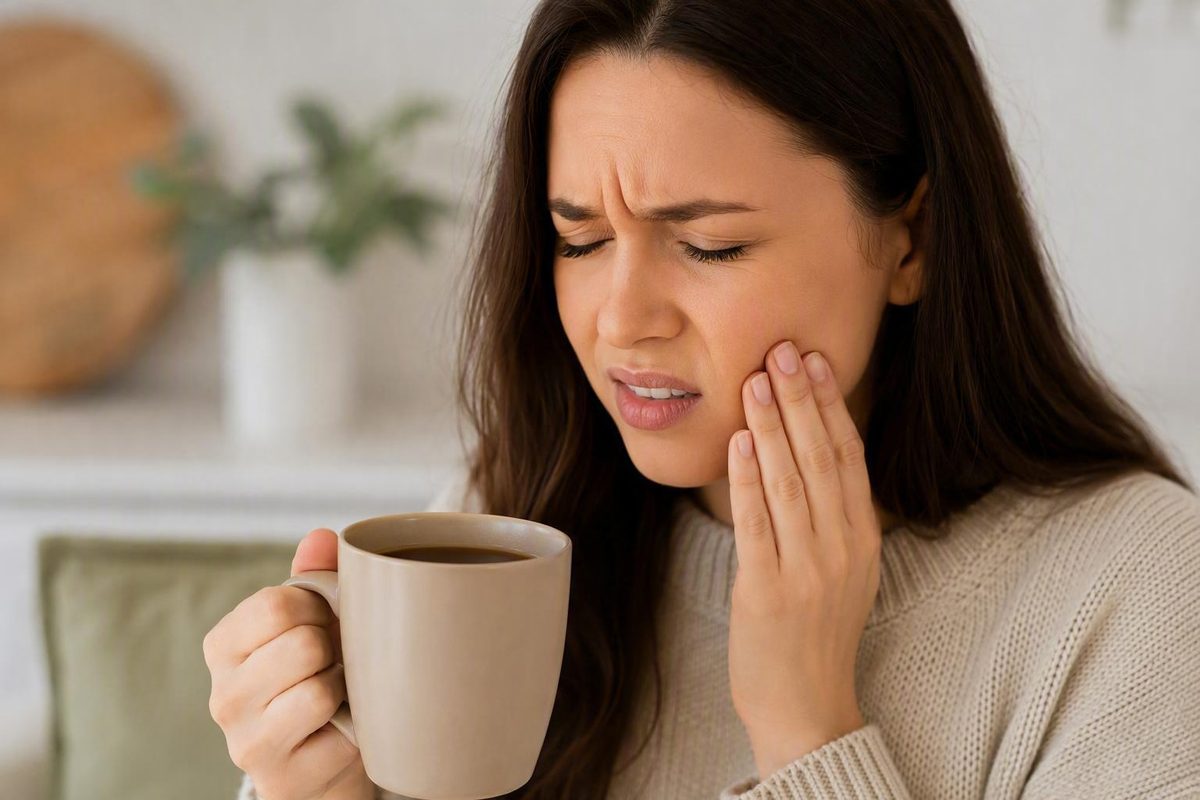
The short answer: heat-only sensitivity is a clue, not a diagnosis
A tooth may hurt with hot coffee, tea, or food because heat is reaching sensitive dentin beneath the tooth’s protective surface. In other cases—particularly when pain continues after the heat is gone—the reaction may be associated with irritation or inflammation deeper inside the tooth.
What the pattern cannot do is identify the cause by itself. The absence of cold sensitivity does not reliably distinguish a minor irritation from serious damage to the pulp, the soft tissue containing the tooth’s nerves and blood vessels. It also does not prove that the nerve is dying, that an infection is present, or that root canal treatment is necessary.
Possible explanations include:
- Exposed dentin or an exposed root
- Worn or eroded enamel
- Gum recession
- Tooth decay
- A crack or chip
- A worn, loose, or otherwise defective filling
- Temporary irritation after dental treatment
- Inflammation involving the pulp
The general mechanism of temperature sensitivity is well established. When dentin loses the protection normally provided by enamel, cementum, or gum tissue, microscopic tubules can transmit temperature-related stimulation toward the inside of the tooth. The American Dental Association lists decay, fractured teeth, worn fillings, gum disease, worn enamel, and exposed roots among the possible causes of sensitive teeth.
The meaning of a specifically hot-but-not-cold response is less certain. Some dental-provider sources associate lingering heat pain with pulp inflammation, but these symptom patterns overlap and do not make heat-only pain a reliable diagnostic test. Duration, location, spontaneous pain, biting discomfort, recent treatment, and the findings of a dental examination provide more useful context than the hot trigger alone.
A momentary twinge is generally less concerning than pain that lingers, throbs, becomes more intense, wakes you at night, or begins without a temperature trigger. Even brief pain, however, does not rule out decay, a crack, exposed dentin, or a restoration problem.
Arrange a dental evaluation if the sensitivity keeps returning, repeatedly affects one tooth, persists after the hot item is removed, or is getting worse. That does not mean an invasive procedure is inevitable. Many causes can be managed without root canal treatment, but the appropriate response depends on identifying what is actually wrong.
How heat can produce pain inside a tooth
A tooth has several layers:
- Enamel is the hard outer covering of the visible crown.
- Cementum covers the root below the gumline.
- Dentin lies beneath both enamel and cementum.
- Pulp occupies the central space and contains nerves, blood vessels, and connective tissue.
Dentin is not a completely solid barrier. It contains microscopic channels called dentinal tubules. When enamel wears away, cementum is lost, or gums recede, those channels become less insulated from the mouth. Heat, cold, acidic or sweet foods, and physical contact may then provoke discomfort. Cleveland Clinic explains that dentin’s tiny tubes lead toward the center of the tooth, allowing temperature changes to stimulate sensitive structures nearer the nerve in its medically reviewed guide to sensitive teeth.
This mechanism explains temperature sensitivity in general. It does not fully explain why one person notices heat but not cold. Exposed dentin can react to either temperature, while different dental problems can produce similar symptoms. The lack of a cold response should not be used as a home test of the pulp’s condition.
The character of the pain can nevertheless provide context:
- Dentin hypersensitivity is commonly described as sharp, sudden, and temporary. It appears with a trigger and usually settles when the trigger is removed.
- Possible deeper pulp irritation may be accompanied by lingering discomfort, throbbing, spontaneous episodes, or pain that is difficult to locate.
- Possible structural trouble may cause temperature sensitivity together with pain while chewing, clenching, or releasing a bite.
These are tendencies rather than diagnostic rules.
Your description still matters. A dentist will want to know whether the drink was warm or very hot, whether the pain stopped promptly, and whether the reaction consistently came from the same area. Those observations must be combined with an examination rather than interpreted in isolation.
Possible causes, from exposed dentin to problems deeper in the tooth
The possibilities are easier to understand when divided into four groups: surface or root exposure, structural damage, disease affecting the tooth, and recent dental treatment.
Surface or root exposure
Enamel can wear or erode, leaving less insulation over the dentin. Acidic foods and drinks may contribute to erosion, while grinding can gradually wear tooth surfaces. Brushing with excessive pressure can aggravate an already exposed root area and may contribute to wear near the gumline.
Gum recession exposes a portion of the root that would normally be covered. Because the root does not have the same enamel covering as the crown, it may become sensitive to temperature, touch, sweet foods, or acidic substances. Johns Hopkins includes hard brushing, gum recession, acidic foods, grinding, recent dental work, cracks, and plaque buildup among factors associated with tooth sensitivity.
These conditions can explain temperature sensitivity generally. They do not prove why heat is the only noticeable trigger, and they should not automatically be assumed to be the cause of pain isolated to one tooth.
Structural damage
A crack may reduce the protection around internal tooth structures or allow parts of the tooth to move during chewing. Cracks vary considerably: some are limited to the surface, while others extend more deeply. A chipped area can likewise remove protective tooth structure.
A worn, broken, loose, or otherwise defective filling may leave dentin exposed or allow irritation around the restoration. Bite-related pain can have other causes, and not every crack produces it.
Disease affecting the tooth
A cavity begins in the hard outer tooth structure but may extend into dentin and closer to the pulp as it progresses. Temperature sensitivity cannot tell you whether a cavity exists or how deep it is.
Pulpitis means inflammation of the pulp. It may be associated with decay, a crack, trauma, a leaking restoration, or dental treatment. Dentists distinguish between irritation that may settle after its cause is addressed and inflammation from which the pulp is not expected to recover. Symptoms alone do not reliably make that distinction.
Lingering, spontaneous, throbbing, or nighttime pain may raise concern about deeper involvement, but none of those features proves irreversible pulp damage. Infection or an abscess is another possibility when bacteria affect deeper tissues. Swelling, fever, drainage, a gum bump, pus, or a bad taste makes professional assessment more urgent, but an examination is still needed to determine the cause.
Recent dental treatment
A tooth may temporarily become more sensitive after:
- A filling
- Crown preparation or placement
- A professional cleaning, particularly around exposed roots
- Teeth whitening
- Another procedure that temporarily irritates the tooth or surrounding tissues
Timing alone does not establish that the procedure caused the pain. Sensitivity after a new filling may be temporary, but pain could also relate to the depth of the original decay, the way the teeth meet when biting, the restoration itself, a crack, or pulp inflammation.
| Possible cause | Contextual clues that may accompany it | What the symptom cannot establish | Assessment or treatment that might follow |
|---|---|---|---|
| Exposed dentin or root | Gum recession; sensitivity near the gumline; reaction to touch, sweets, acid, heat, or cold | Heat-only pain does not prove root exposure | Examination for recession and wear; sensitivity toothpaste, fluoride, bonding, or gum-focused treatment may be considered |
| Enamel wear or erosion | Worn surfaces; acidic exposures; grinding; sensitivity affecting several teeth | Sensitivity cannot identify the source or extent of enamel loss | Review of diet and habits; fluoride, protective material, or management of grinding depending on findings |
| Cavity | Localized sensitivity, food trapping, or a visible change, although there may be no visible sign | Heat pain does not prove a cavity or show how deep one is | Clinical examination and possibly imaging; a suitable lesion may be restored with a filling |
| Crack or chip | Intermittent pain, chewing discomfort, or pain on bite release | Heat or biting pain does not prove a crack | Visual, light, and bite-based assessment; bonding, a crown, another restoration, or more extensive care depending on the defect |
| Worn or defective filling | Sensitivity near a restored tooth, roughness, food trapping, or biting discomfort | Symptoms cannot show whether the filling is loose, worn, poorly fitting, or unrelated | Evaluation of the restoration and bite; adjustment, repair, or replacement if indicated |
| Pulp inflammation | Pain that lingers, throbs, occurs spontaneously, or disrupts sleep | No symptom duration or temperature pattern alone determines whether the pulp can recover | Examination and controlled pulp or thermal testing; treatment depends on the identified cause |
| Possible infection or abscess | Swelling, fever, a gum bump, drainage, bad taste, or severe worsening pain | Pain alone cannot confirm an abscess or show its extent | Prompt dental assessment and treatment directed at the source and any spread |
| Recent dental procedure | Symptoms began after a filling, crown, cleaning, whitening, or other treatment and are steadily improving | Timing does not prove that all pain is normal or temporary | Monitoring may be reasonable for mild improvement; persistent, spontaneous, biting, or worsening pain should be reassessed |
The central question is not simply, “Which condition causes heat pain?” It is, “Which explanation fits the complete symptom pattern and the examination findings?”
Brief twinge, lingering ache, or throbbing pain: how the pattern changes concern
How long the discomfort lasts—and what else happens with it—can help determine how promptly to seek care. It still cannot provide a diagnosis.
| Pattern | Relative concern | Practical response |
|---|---|---|
| Fleeting twinge that stops with the hot trigger | Generally less concerning than lingering or spontaneous pain | Avoid the trigger temporarily and mention recurring sensitivity to a dentist; do not assume it is harmless if it keeps affecting the same tooth |
| Recurring sensitivity localized to one tooth | More concerning than an isolated, one-time sensation | Arrange a dental appointment, particularly if the tooth is becoming easier to trigger |
| Pain that continues after heat is removed | Raises concern about irritation deeper in the tooth | Contact a dentist promptly rather than repeatedly testing the tooth |
| Pain with biting or bite release | May accompany a crack, damaged restoration, or another problem involving the tooth or supporting tissues | Arrange timely assessment and avoid hard foods on that side |
| Spontaneous, throbbing, or nighttime pain | More concerning because it occurs without a simple short-lived trigger or interferes with normal activity | Seek prompt dental care |
| Pain with swelling, fever, pus, a gum bump, drainage, or a bad taste | May accompany infection | Seek urgent professional dental assessment; dental-provider guidance identifies these as warning features requiring evaluation in its discussion of hot and cold tooth sensitivity |
Some dental-practice guidance uses pain lasting approximately 20 to 30 seconds after a temperature trigger as a reason to call a dentist. That range is a symptom-based warning guide, not a validated diagnostic cutoff or a home pulp test, as reflected in this dental sensitivity overview.
In practical terms, the difference between a one-second twinge and a prolonged ache is useful. A stopwatch, however, cannot determine whether the pulp is reversibly or irreversibly inflamed. Pain that stops quickly also does not guarantee that the tooth is healthy.
Contact a dentist in a timely manner when:
- The same tooth repeatedly reacts to heat
- The pain is becoming stronger or more frequent
- Discomfort continues after the drink or food is gone
- Pain starts without a trigger
- The tooth hurts during chewing or bite release
- The pain interrupts sleep
- Symptoms began after treatment and are not steadily improving
If swelling, fever, drainage, pus, a gum bump, a bad taste, or severe escalating pain develops, seek urgent professional dental assessment rather than monitoring the problem indefinitely at home.
When sensitivity starts after a filling, crown, cleaning, or whitening
Dental procedures can temporarily make teeth more reactive to temperature. A filling may leave a tooth irritated while it settles. Crown preparation can disturb sensitive tooth structures. Cleaning may make an already exposed root more noticeable, and whitening can produce short-term sensitivity.
The sources reviewed for this article do not provide one consistent recovery deadline. They describe improvement over periods ranging from a few days to several weeks, depending on the procedure and circumstances. A dental-practice review notes that sensitivity after fillings, crowns, deep cleaning, or whitening can be temporary while also advising reassessment when symptoms persist or intensify in its discussion of whether tooth sensitivity can go away on its own.
Instead of relying only on the calendar, pay attention to the direction of the symptoms.
More reassuring features include:
- Mild sensitivity
- Pain only with a clear temperature trigger
- Discomfort that ends promptly
- Symptoms that are becoming less frequent or intense
- No spontaneous, nighttime, or biting pain
Reasons to contact the treating dental office include:
- Pain that lingers after the hot trigger
- Symptoms that are intensifying rather than improving
- New spontaneous or throbbing pain
- Pain that wakes you
- Discomfort when chewing or when the teeth meet
- Swelling, fever, drainage, or a bad taste
A restoration-related issue is only one possibility. The bite may need evaluation, the filling or crown may require assessment, or the original condition may have affected the pulp. A separate crack or exposed root could also be responsible. The timing helps guide the investigation, but it does not establish the explanation.
When you call, describe what procedure was performed, when it was done, which tooth seems involved, what triggers the pain, whether biting hurts, and how long the sensation continues. That information is more useful than saying only that the tooth is “still sensitive.”
How a dentist works out which tooth and tissue are involved
Evaluation begins with a detailed symptom history. The dentist may ask:
- Can you point to one tooth, or is the area vague?
- Does ordinary warmth trigger it, or only very hot food and drinks?
- How long does the pain continue after the trigger is removed?
- Is it sharp, aching, throbbing, or pressure-like?
- How frequently does it happen?
- Does it ever start by itself?
- Does chewing, clenching, or releasing a bite hurt?
- Does it wake you at night?
- Have you recently had a filling, crown, cleaning, whitening, or injury?
The physical examination may involve looking for decay, worn enamel, recession, chips, cracks, or problems around existing restorations. The dentist may also examine the nearby gums and assess how the teeth meet.
Depending on the findings, the investigation may include:
- Thermal testing: Applying a controlled hot or cold stimulus and comparing the response with nearby teeth
- Percussion: Gently tapping the tooth to assess tenderness around it
- Bite testing: Asking you to bite on a small instrument to identify discomfort associated with pressure or release
- Transillumination: Shining a bright light through the tooth while looking for structural changes
- Pulp testing: Assessing whether and how the pulp responds to a controlled stimulus
Dental-practice guidance describes these as possible parts of an investigation rather than treating the temperature trigger as a stand-alone diagnosis in its overview of tooth sensitivity testing.
No single symptom or test result should be interpreted in isolation. A thermal response is compared with nearby teeth and considered alongside the history and examination. Imaging may contribute relevant information, but the dentist still has to interpret it with the clinical findings rather than using it as the sole answer.
The evaluation may need to distinguish among:
- Dentin hypersensitivity from surface or root exposure
- Decay
- A crack or chip
- A failing or poorly fitting restoration
- Temporary post-treatment irritation
- Inflammation affecting the pulp
- Infection involving the tooth or surrounding tissues
Before your appointment, make a short record covering:
- Which foods or drinks trigger the pain
- Which tooth or side seems affected
- How long the sensation lasts
- Whether pain occurs without a trigger
- Whether it wakes you at night
- Whether biting or releasing a bite hurts
- Which dental procedures were recently performed
- Whether there is swelling, drainage, a gum bump, fever, or a bad taste
Do not repeatedly expose the tooth to very hot or cold substances to test it. Your natural observations are enough; controlled professional testing is more useful than repeated home experiments.
Treatment depends on the cause—and does not always involve a root canal
Heat sensitivity alone does not establish that you need root canal treatment. Treatment is selected after the dentist identifies which structure is affected and whether the problem is at the surface, in a restoration, within the tooth, or around its root.
Possible approaches include:
- Exposed-dentin sensitivity: Desensitizing toothpaste or professionally applied fluoride may help reduce the transmission of painful stimulation.
- Exposed root or worn surface: Bonding or another protective material may cover the vulnerable area. Gum-focused treatment may be considered in selected cases of recession.
- Suitable tooth decay: A filling may remove damaged tissue and restore the affected part of the tooth.
- Defective restoration: An existing filling or crown may need adjustment, repair, or replacement.
- Grinding-related wear: Protecting the teeth and addressing the grinding pattern may be considered.
- Structural damage: Some cracks, chips, or weakened teeth may be managed with bonding, a crown, or another restoration, depending on their location and extent.
- Significant pulp involvement: Root canal therapy may be considered when examination and testing indicate that the pulp cannot be managed by treating the surface problem or restoration alone, or when infection inside the tooth requires treatment.
The ADA describes root canal treatment as one possible option when sensitivity is severe, persistent, and cannot be managed by other means—not as the automatic response to temperature pain. Its alternatives include desensitizing toothpaste, fluoride, bonding, crowns or inlays, and gum grafting, depending on the diagnosed cause.
Pain duration and severity may influence urgency, but they do not independently determine treatment. Severe discomfort from an exposed surface does not necessarily require a root canal, while pulp involvement cannot be excluded simply because the pain feels moderate.
The aim is not merely to stop a reaction to coffee or soup. It is to correct or manage the reason the tooth has become sensitive. Symptom relief without diagnosis could leave decay, a crack, a defective restoration, or pulp disease untreated.
Good oral hygiene remains important, but it does not eliminate the need for assessment. As explained in Decay Guide’s discussion of what daily brushing cannot fix, brushing cannot physically repair a crack, restore a failed filling, replace missing tooth structure, or determine the condition of the pulp.
What to do while waiting for a dental evaluation
While waiting for an appointment, keep the approach conservative:
- Avoid very hot foods and drinks.
- Choose lukewarm or moderate-temperature options.
- Chew on the other side when practical.
- Avoid hard foods if biting triggers pain.
- Use a soft-bristled toothbrush.
- Brush gently rather than scrubbing the sensitive area.
- Track the tooth, trigger, pain duration, and associated symptoms.
- Do not repeatedly test the tooth with hot or cold substances.
A toothpaste formulated for sensitive teeth may help when exposed dentin is responsible. It usually requires repeated applications before sensitivity is reduced, according to the ADA’s sensitive-teeth guidance.
Do not interpret temporary improvement as proof that the underlying problem has resolved. Symptoms may fluctuate, and avoiding hot drinks can remove the trigger without repairing the tooth.
Use this decision summary:
- Recurring sensitivity localized to one tooth: Arrange a dental appointment.
- Lingering, worsening, spontaneous, biting, or nighttime pain: Contact a dentist promptly.
- Swelling, fever, pus, drainage, a gum bump, a bad taste, or severe escalating pain: Seek urgent dental assessment. These features are described as possible signs of deeper infection in dental-provider guidance on hot versus cold sensitivity.
Heat-only sensitivity is worth noticing, particularly when it repeatedly affects one tooth or continues after the trigger. It cannot reveal the diagnosis by itself. A dentist must distinguish surface sensitivity from decay, a crack, restoration trouble, or inflammation involving the pulp. Root canal treatment is only one possible outcome; the appropriate response depends on the examination.
Decay Guide publishes general reference information and is not a dental practice. This article cannot diagnose an individual tooth or advise you about your personal treatment.
Does sensitivity to hot but not cold mean I need a root canal?
No. Heat sensitivity without cold sensitivity does not establish the condition of the pulp or determine treatment.
Root canal treatment may be considered if examination and testing show substantial pulp involvement or infection inside the tooth. Exposed dentin, gum recession, enamel wear, suitable decay, a defective restoration, or some structural problems may require different treatment. The heat pattern is a reason to investigate, not a treatment prescription.
Is pain that lingers after a hot drink more concerning than a quick twinge?
Generally, yes. Pain that continues after the heat is removed is more concerning than a sensation that ends promptly, especially if it is worsening, throbbing, recurring in one tooth, disrupting sleep, or starting spontaneously.
Duration remains only one clue. Do not use a timer to diagnose pulpitis or assume that short-lived pain is harmless. Persistent or recurring symptoms warrant dental assessment.
Can a cracked tooth or failing filling cause heat sensitivity?
Yes. A crack can reduce the protection around internal tooth structures, while a worn, broken, loose, or otherwise defective filling can expose or irritate sensitive tissue. Either problem may also be accompanied by discomfort during chewing or bite release.
Those features are not diagnostic. A dentist may need to inspect the restoration, assess the bite, use controlled tests, and consider imaging alongside the examination.
Can heat sensitivity after a filling or crown go away on its own?
It can. Mild temperature sensitivity after a filling or crown may settle as the tooth and surrounding tissues recover, but the reviewed sources describe variable timelines rather than one universal deadline.
Contact the treating office if pain is not steadily improving, lingers after heat, becomes more intense, starts spontaneously, disrupts sleep, or occurs with biting discomfort. Timing after treatment does not prove that the reaction is normal or that the restoration is responsible.
When should heat-sensitive tooth pain be assessed urgently?
Seek urgent dental assessment if heat-related pain occurs with swelling, fever, a gum bump, pus or drainage, a bad taste, or severe escalating discomfort. Dental-provider guidance identifies these as possible signs of deeper infection while emphasizing the need for professional evaluation in its review of heat-only tooth sensitivity.
Contact a dentist promptly for lingering heat pain, spontaneous or nighttime pain, increasing intensity, or pain when biting. Even without those warning features, recurring sensitivity isolated to one tooth deserves an appointment because the trigger alone cannot distinguish exposed dentin from decay, a crack, restoration trouble, or pulp inflammation.