
When Teeth Lose Minerals—and When Early Damage Can Still Be Stopped
An intact white-spot lesion may become harder and inactive while remaining visible, which means successful arrest need not erase the mark.
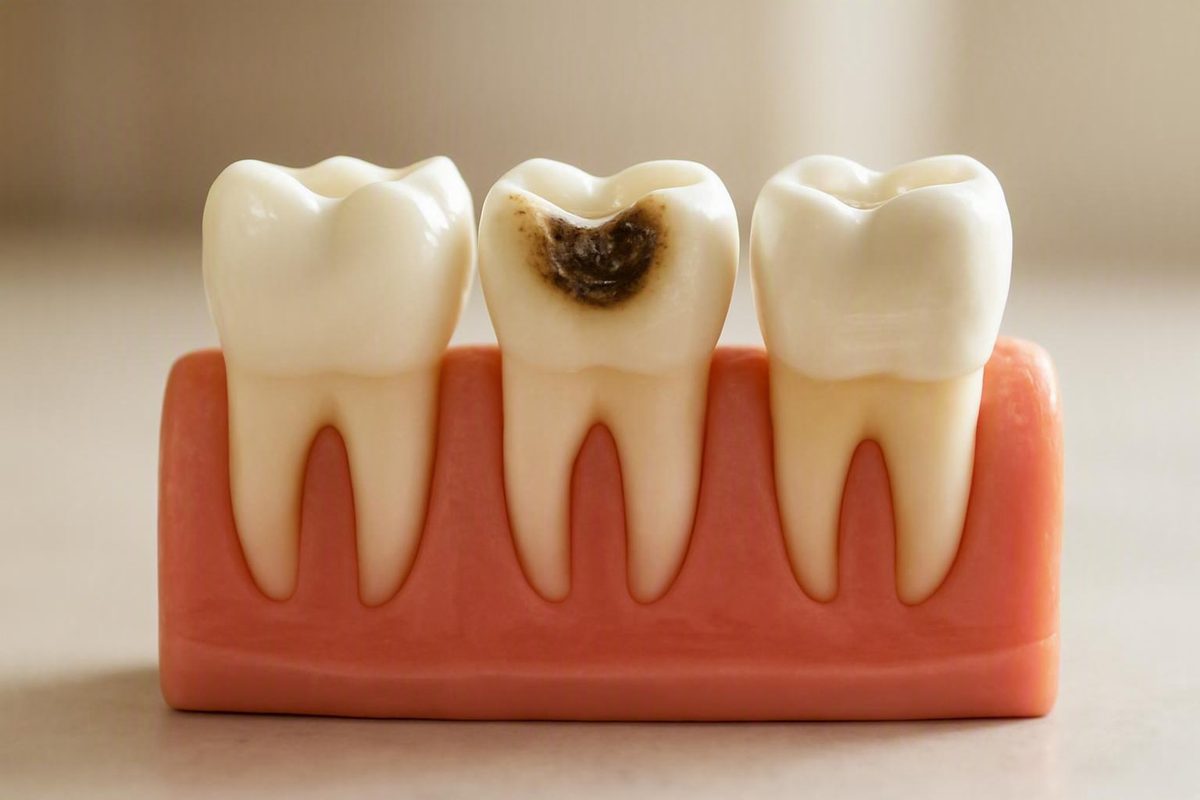
When teeth lose minerals—and when early damage can still be stopped
Teeth do not move in a straight line from “healthy” to “cavity.” Acids repeatedly remove small amounts of mineral from tooth surfaces, while saliva, calcium, phosphate, and fluoride can support mineral replacement when conditions improve. Dental decay becomes more likely when mineral loss repeatedly exceeds recovery.
The distinction between mineral loss and physical tissue loss is critical. An early lesion may sometimes be arrested or remineralized while its surface remains intact. Once enamel has collapsed into a hole, worn away, fractured, or otherwise disappeared, remineralization cannot recreate the missing tooth shape. It can strengthen a surviving mineral framework; it cannot biologically regrow a tooth.
The continuous mineral cycle inside the mouth
Demineralization is the loss of calcium and phosphate from tooth mineral under acidic conditions. Remineralization is the redeposition of those minerals onto crystals that remain after the environment around the tooth becomes more favorable.
These are recurring processes rather than isolated events. Eating, drinking, plaque activity, saliva flow, fluoride exposure, and oral hygiene can shift the balance many times. An acidic interval creates an opportunity for mineral loss, but it does not mean that every snack or drink immediately creates a cavity.
A simple model is:
- Acid challenge: Acidity rises near a tooth because plaque bacteria process fermentable carbohydrates or because dietary or gastric acid contacts the surface.
- Mineral loss: Calcium and phosphate begin moving out of vulnerable tooth mineral.
- Clearance and buffering: Saliva dilutes residues and reduces acidity.
- Mineral recovery: Calcium and phosphate can deposit onto surviving crystals, with fluoride supporting the process.
- Net result: The tooth ends the cycle with a small mineral gain, a small loss, or little lasting change.
The repeated net result matters more than any single episode. If recovery usually keeps pace, the surface may remain sound. If acidic challenges recur frequently, saliva is limited, or plaque remains in place, cumulative mineral loss can develop into an early lesion and eventually a cavity.
Enamel is a highly mineralized tissue composed mainly of biological apatite, commonly described as calcium hydroxyapatite. Unlike bone, mature enamel has little capacity for biological regeneration after development because the cells and structures that originally formed it are no longer available.
The word “repair” needs that qualification. In early demineralization, repair means returning minerals to a microscopic framework that is still present. It does not mean growing a new layer of enamel where tissue has been physically lost.
How acids pull minerals from enamel and dentin
In plaque-mediated dental caries, bacteria in the biofilm on a tooth metabolize fermentable carbohydrates, including sugars and certain starches. Their acid by-products lower the pH immediately around the tooth. As that local environment becomes more acidic, calcium and phosphate diffuse out of tooth mineral.
This is a microscopic and surface-specific process.
A pH near 5.5 is commonly used as an approximate point below which enamel demineralization becomes more favorable. It is not an exact switch or a universal threshold for every tooth. The same peer-reviewed professional review reports dentin demineralization at approximately pH 6.2 to 6.4, indicating that dentin is more acid-sensitive than enamel under comparable conditions (Decisions in Dentistry review).
That difference matters when gums have receded, roots are exposed, enamel has become thin, or a lesion has extended into dentin. Protection that may be adequate for intact enamel may be insufficient for a more vulnerable surface.
Caries and erosion are related, but not interchangeable
Both caries and erosion can remove tooth mineral, but they begin differently:
- Plaque-mediated caries involves bacterial metabolism of fermentable carbohydrates and acid production within biofilm.
- Dental erosion is direct chemical dissolution caused by acids not produced by plaque bacteria. Possible sources include acidic foods and drinks or gastric acid associated with reflux or vomiting.
A tooth can experience both processes. A sweetened acidic drink, for example, can expose enamel directly to dietary acid while supplying fermentable carbohydrate to plaque bacteria. Management still depends on identifying the important causes. Plaque disruption does not prevent recurring gastric acid from reaching the teeth, while reducing acidic drinks does not remove biofilm between teeth.
Exposure pattern also matters. Slowly sipping a sweet or acidic drink, repeatedly tasting an acidic product, or grazing on fermentable foods can create multiple challenges instead of one contained exposure. The mouth needs intervals in which saliva can clear residues, buffer acids, and support mineral deposition.
The evidence supplied here does not establish one universal recovery time after every food or drink. The useful principle is to reduce repeated exposure rather than rely on a rigid countdown.
Why saliva is the mouth’s main recovery system
Saliva is central to the natural shift away from mineral loss. Its three principal roles are:
- Clearance: It helps wash away food residues, sugars, and acids.
- Buffering: It reduces acidity and helps conditions return toward a range in which tooth mineral is more stable.
- Mineral supply: It carries calcium and phosphate that can deposit onto surviving crystals.
That deposition is natural remineralization. Minerals reinforce the structure that remains; saliva does not construct an entirely new enamel layer after the original architecture has disappeared.
Fluoride can reach tooth surfaces through saliva after exposure from toothpaste, water, rinses, or professional products. In the presence of available calcium and phosphate, it can facilitate mineral deposition and help produce mineral that is more resistant to later acid challenges. This supports recovery and future resistance, but it does not fill a physical hole or replace a missing cusp.
Saliva may be unable to keep pace when:
- Acid or carbohydrate exposure is frequent.
- Plaque remains thick and active.
- A lesion is advanced or cavitated.
- Salivary flow is reduced.
- Dentin or root surfaces are exposed.
- Protective fluoride exposure is inadequate for the person’s risk.
Dry mouth is therefore relevant to decay risk, not just comfort. Reduced flow can mean less clearance, weaker buffering, and less calcium and phosphate available at the tooth surface. A professional dental review identifies xerostomia, medications, reflux, recurrent vomiting, diet, and frequent snacking among factors that can shift the mouth toward demineralization (Dimensions of Dental Hygiene).
Persistent dry mouth deserves professional assessment rather than an assumption that more forceful brushing will solve it. A dentist or healthcare professional can consider the possible cause, the person’s decay risk, and whether saliva-focused or fluoride-based measures are appropriate.
From early mineral loss to a cavity: the reversibility boundary
The practical boundary is not simply whether someone casually describes a mark as a “cavity.” The more useful question is whether the surface remains intact and whether enough mineral structure survives to support nonoperative management.
1. Repeated mineral loss without an obvious visible change
A tooth can lose and regain mineral without looking different. At this stage, the aim is risk reduction: disrupt plaque, reduce repeated carbohydrate and acid exposure, support saliva, and use fluoride appropriately.
No single acidic episode proves that a lesion has formed. Concern arises when recurring challenges produce a net loss over time.
2. An intact subsurface or white-spot lesion
As mineral loss accumulates beneath an enamel surface, an area may become more porous and appear white or chalky while the outer surface remains intact.
This is the principal window in which an early lesion may sometimes be arrested or remineralized. If the contributing conditions are controlled, calcium and phosphate can accumulate on the remaining crystals. The lesion may harden or stop progressing.
A successfully arrested white spot may remain visible. Disease control and cosmetic disappearance are different outcomes.
3. Surface breakdown or cavitation
Once the surface has collapsed into a clinically detectable hole, mineral deposition cannot reconstruct the lost anatomy. Toothpaste and other remineralizing products should not be expected to fill the defect.
A cavitated lesion requires professional assessment. Management depends on factors an article cannot determine, including the lesion’s location, depth, activity, surface condition, and the person’s wider risk profile. Some lesions may be candidates for professional arrest strategies; others may require restoration.
4. Missing tooth structure
Enamel lost through advanced decay, erosion, fracture, or wear does not naturally grow back. The remaining surfaces can still benefit from protection against additional mineral loss, but the missing anatomy may need restorative evaluation.
Four terms are often confused:
- Mineral replacement: Calcium and phosphate strengthen an existing microscopic scaffold.
- Lesion arrest: Progression stops or substantially slows.
- Biological regeneration: New mature enamel and its architecture would be created.
- Restoration: Dental material replaces missing tooth structure.
Current remineralization strategies concern mineral replacement and lesion arrest. They are not substitutes for restoring anatomy that has already been lost.
Possible signs—and why appearance cannot diagnose a lesion
A white or chalky spot can occur with early mineral loss, especially where plaque collects. Demineralization can also exist without an obvious visual change, and not every white mark represents active decay.
Other findings that may accompany enamel damage include:
- Sensitivity to cold, heat, sweets, or touch
- Discoloration
- A rough-feeling area
- Thinning or translucent edges
- A visible defect
- Food repeatedly catching in one place
These findings are nonspecific. Sensitivity can be associated with exposed dentin, recession, erosion, cracks, decay, or recent dental treatment. Discoloration may reflect staining, normal variation, developmental changes, inactive disease, or active decay. Roughness and translucency can likewise have more than one cause. Dental-practice educational material lists several of these as possible concerns but also acknowledges that established cavities require professional care; it does not establish that any one appearance is diagnostic (Hilltop Dental Studio overview).
A mirror or photograph cannot reliably establish whether an area is:
- Active or arrested
- Limited to enamel or extended into dentin
- Intact or cavitated
- Caused by caries, erosion, development, trauma, or another process
- Improving, stable, or progressing
Reduced sensitivity is not proof of remineralization. Neither is a smoother texture, less obvious discoloration, or a change in the appearance of a white spot. Those observations may be encouraging, irrelevant, or misleading depending on the cause.
Professional assessment can evaluate the area in the context of surface integrity, location, progression, saliva, diet, fluoride exposure, previous decay, restorations, and other findings. The evidence supplied here does not support a do-it-yourself diagnostic test.
Arrange a dental assessment for an uncertain or persistent white spot, visible surface breakdown, broken tooth structure, pain, worsening sensitivity, repeated food trapping, or a change that appears to be progressing.
What shifts the balance toward mineral loss
People can develop demineralization despite brushing consistently. That does not automatically mean they are brushing incorrectly. Mineral balance reflects the interaction of exposure, biology, surface vulnerability, and protective factors.
Frequent fermentable carbohydrates
Plaque bacteria can metabolize sugars and certain starches. Repeated snacking creates repeated opportunities for local acid production. Consuming a carbohydrate-containing snack or drink over several hours can therefore produce recurring challenges.
This does not mean that all carbohydrates must be avoided. Frequency, retention on teeth, plaque conditions, saliva, fluoride, and the tooth surface involved all matter.
Sugary and acidic drinks
A sweet drink can supply fermentable carbohydrate. An acidic drink can contact enamel directly. Some drinks do both.
Prolonged sipping, swishing, or holding a drink in the mouth extends opportunities for contact. Water avoids adding another sugar or acid challenge and can help clear residues, although rinsing does not replace plaque removal.
Plaque accumulation
Plaque keeps bacteria and their acid products close to the tooth. Brushing disrupts biofilm on accessible surfaces, but toothbrush bristles do not adequately clean every contact area. Interdental cleaning is intended to disrupt plaque in spaces the brush cannot reach effectively.
Brushing harder is not a solution. Greater pressure does not make inaccessible areas clean and may injure soft tissues or contribute to wear.
Reduced saliva
Dry mouth weakens clearance, buffering, and mineral delivery at the same time. This can make a diet or hygiene routine that seems reasonable insufficient for the person’s actual risk.
Persistent dry mouth should be assessed rather than managed indefinitely with frequent sugary sweets or acidic drinks. The cause may require dental, medical, or medication-related review.
Limited fluoride exposure
Fluoride is not the only factor in remineralization, but it is the most established product-based aid within the supplied evidence. Inadequate exposure may leave a vulnerable surface less supported during recovery, particularly when other risks are elevated.
Appropriate products and use vary with age, swallowing ability, total exposure, lesion status, and individual risk. The supplied evidence does not justify one universal fluoride concentration or dosing rule for every reader.
Reflux and recurrent vomiting
Gastric acid can erode teeth without bacterial involvement. Recurrent reflux or vomiting may repeatedly expose the teeth to acid and overwhelm ordinary preventive measures.
Dental protection cannot correct the underlying medical source. Recurrent exposure may warrant medical as well as dental evaluation.
Exposed dentin and roots
Receding gums, exposed roots, wear, and previous treatment can reveal surfaces more acid-sensitive than enamel. These areas may require a different level of prevention and monitoring.
Overall risk reflects the combined effect of lesion stage, exposure frequency, plaque, saliva, fluoride, tooth surface, health factors, and protective habits. It is not a moral judgment about effort and cannot be reduced to whether someone brushes twice a day.
A practical routine that supports the favorable side of the cycle
Home care can reduce future mineral loss and support an intact early lesion. It cannot identify lesion depth, fill a cavity, resolve severe dry mouth, or remove an ongoing source of gastric acid.
1. Brush twice daily with an appropriate fluoride toothpaste
Use a soft-bristled brush and gentle, systematic technique on accessible surfaces. Fluoride toothpaste is the best-established product foundation in the supplied evidence because it repeatedly delivers fluoride to the tooth–saliva interface.
The appropriate formulation and amount depend on factors such as age, swallowing ability, total fluoride exposure, and caries risk. Those considerations require product instructions and, where necessary, professional advice rather than a universal rule from this article.
2. Clean between teeth regularly
Use an interdental method suited to the spaces and the person’s needs. The purpose is to disrupt plaque where toothbrush bristles do not clean adequately.
Interdental cleaning does not add minerals directly. It supports the favorable side of the cycle by reducing sheltered bacterial activity and local acid production.
3. Reduce exposure frequency
Focus on how often teeth encounter fermentable carbohydrates and acids, not only the total quantity consumed.
Practical options include:
- Keep sugary or acidic items to contained occasions rather than prolonged grazing.
- Avoid slowly sipping sweetened or acidic drinks for hours.
- Choose water between meals when practical.
- Do not rely on constant sugary sweets or acidic drinks to manage dry mouth.
- Remember that sweetened acidic drinks may contribute to both caries and erosion.
The aim is not a perfectly acid-free diet. It is to create longer intervals in which saliva can clear residues, buffer acidity, and support mineral recovery.
4. Support saliva
Stay adequately hydrated. Sugar-free gum may stimulate saliva when it is suitable for the individual, but it should be understood as an adjunct rather than a direct enamel-regeneration treatment. Consumer oral-health guidance identifies hydration and sugar-free gum among possible saliva-support measures while advising professional discussion of persistent dry mouth (Colgate oral-health guidance).
Ongoing dry mouth should be discussed with a dentist or healthcare professional. Do not stop prescribed medication solely because dry mouth began after it was started.
5. Use caution after acidic exposure
After an acidic drink, food, reflux episode, or vomiting:
- End the exposure rather than continuing to sip.
- Rinse gently with water.
- Avoid aggressive immediate scrubbing.
- Use a soft brush and gentle pressure when brushing.
Dental-practice guidance commonly recommends allowing time before brushing an acid-exposed surface, but the supplied source is not a formal guideline and does not establish one waiting period for every exposure (Oldham Family Dentistry explanation). The defensible principle is to avoid forceful abrasion immediately after substantial acid exposure—not to impose a universal 20- or 30-minute rule.
If reflux or vomiting is recurrent, rinsing and gentle oral care do not address the underlying cause. Seek medical and dental guidance.
6. Treat food as nutrition, not lesion-filling medicine
Calcium- and phosphate-containing foods can support nutrition and the normal mineral environment. They should not be described as directly rebuilding a particular white spot or filling a cavity.
Tooth-surface remineralization depends on local mineral availability, saliva, plaque, fluoride, lesion stage, and whether the causal exposures continue.
Editorial note: This article provides general information, not an individualized diagnosis or treatment plan. Decay Guide is an informational publisher rather than a dental practice and does not determine whether a particular lesion can be remineralized or requires restoration (about Decay Guide). Personal concerns should be assessed by a qualified dental professional.
Fluoride, hydroxyapatite, CPP-ACP, and other remineralizing approaches
“Remineralizing” is used broadly in product descriptions. It can mean facilitating mineral deposition, delivering calcium-phosphate material, depositing particles on a laboratory specimen, changing plaque conditions, stimulating saliva, or attempting scaffold-like mineral growth. These outcomes are not interchangeable.
The evidence labels below are deliberately limited:
- Established: Consistently presented in the supplied professional evidence as a foundation or accepted option for the stated use.
- Promising: A plausible mechanism with favorable findings, but insufficient comparative long-term clinical evidence for broad claims.
- Conditional or adjunctive: May have a role in selected circumstances but should not replace established care automatically.
- Preliminary or insufficient: Evidence is mainly laboratory-based, indirect, formulation-specific, inconsistent, or clinically incomplete.
| Agent or approach | Proposed mechanism | Evidence position | Limitations | Professional-use considerations |
|---|---|---|---|---|
| Fluoride | Facilitates calcium and phosphate deposition and supports mineral that is more resistant to later acid attack | Established foundation for caries prevention and remineralization of suitable early lesions (peer-reviewed professional review) | Cannot fill a hole, replace missing enamel, or remove the cause of repeated acid exposure | Product, amount, age, swallowing ability, total exposure, and lesion risk matter |
| Nano-hydroxyapatite | Supplies apatite-like particles that may deposit on enamel or enter pores in demineralized areas | Promising; laboratory and material studies support deposition and penetration (peer-reviewed materials review) | Long-term comparative evidence is insufficient for universal equivalence or superiority to fluoride; formulation and particle aggregation matter | Consider the complete formulation and individual risk rather than assuming all products are interchangeable |
| CPP-ACP | Casein phosphopeptide stabilizes amorphous calcium phosphate, helping keep calcium and phosphate available near enamel | Conditionally useful; variable evidence (professional evidence overview) | Findings vary by formulation and clinical context | Casein-derived CPP-ACP should not be used by people with milk-protein casein allergy |
| Tricalcium phosphate | Delivers calcium and phosphate and may be incorporated with fluoride | Plausible adjunct | Its presence does not prove superiority over a suitable fluoride product | Formulation affects ion availability and compatibility with fluoride |
| Arginine | Intended to support alkali-producing pathways and a less acidic plaque environment | Promising adjunct; positive findings do not establish universal superiority (professional remineralization overview) | Some favorable evidence is laboratory-based or formulation-specific | Evaluate the complete product rather than attributing all effects to arginine |
| Xylitol | May stimulate saliva when delivered in sugar-free gum and may support broader caries management | Possible adjunct | Not a direct enamel-regeneration material and not a replacement for plaque control or fluoride | Suitability depends on the person and product form |
| Silver diamine fluoride | Professionally delivers fluoride and silver components to arrest selected carious lesions | Professional arrest option for selected dentin or root lesions | Does not restore missing anatomy and commonly darkens treated carious tissue (SDF overview) | Requires diagnosis, consent, controlled application, and discussion of staining |
| Peptides, polymers, chitosan and silver nanoparticles | Proposed effects include scaffold-like mineral growth, mineral delivery, or antimicrobial activity | Preliminary or insufficient for routine clinical claims (review of advanced remineralization materials) | Much of the evidence is laboratory-based or formulation-specific, with limited durable clinical outcomes | Safety, allergy, tolerability, and interaction with established care require product-specific assessment |
| Probiotics and propolis | Aim to modify biofilm or local acidity rather than directly supply enamel mineral | Promising but clinically insufficient | Evidence is limited, inconsistent, or indirect; effects may depend on specific strains or formulations | Allergy and product-specific risks must be considered |
| Lasers and ozone | Intended to modify tooth surfaces or microbial activity | Insufficient for routine remineralization claims | Protocols and endpoints vary; neither is established as a method of regrowing enamel | Professional procedures do not eliminate the need for diagnosis |
| Oil pulling and herbal approaches | Usually proposed to alter bacteria or support general oral hygiene | Insufficient as remineralization therapy | No adequate basis for presenting them as replacements for fluoride or methods that rebuild enamel | They should not displace brushing, interdental cleaning, or indicated treatment |
Fluoride: the established reference point
Fluoride works within the existing mineral cycle. When calcium and phosphate are available, it facilitates remineralization and supports mineral that is more resistant to later acid attack.
Its role is preventive and arrest-oriented. It cannot turn a cavitated lesion into an anatomically complete tooth. Someone may still need a restoration even when fluoride is helping protect the surrounding structure.
Nano-hydroxyapatite: plausible delivery, unresolved comparisons
Hydroxyapatite resembles enamel’s principal mineral. Nano-sized particles are intended to deposit on demineralized surfaces or enter microscopic pores.
Favorable laboratory or short-term findings do not establish that every hydroxyapatite toothpaste is equal or superior to fluoride for every population and lesion type.
No single hydroxyapatite concentration can be treated as a universally established threshold from the supplied evidence.
CPP-ACP and other calcium-phosphate systems
CPP-ACP uses a casein-derived peptide to stabilize calcium and phosphate near the tooth instead of allowing them to form less available aggregates. Some studies summarized in the supplied reviews report benefits, particularly for selected formulations or when used with fluoride, but the broader clinical evidence is variable.
Because CPP-ACP is derived from casein, people with a milk-protein casein allergy should avoid it.
Tricalcium phosphate is another mineral-delivery approach and may be included in fluoride products. The mechanism is plausible, but added calcium phosphate does not by itself demonstrate that a product outperforms an appropriate fluoride toothpaste.
Arginine, xylitol, and biofilm-focused adjuncts
Arginine is intended to encourage alkali-producing pathways in plaque, potentially creating a less acidic local environment. Favorable comparative or laboratory findings do not establish universal clinical superiority.
Xylitol is better understood as a possible saliva-stimulation and caries-management adjunct, particularly when used in sugar-free gum. It is not a material that directly reconstructs missing enamel.
Probiotics aim to change the oral microbial environment rather than add mineral. Propolis, chitosan, silver nanoparticles, peptides, and polymers have proposed mechanisms, but a laboratory increase in surface hardness or mineral deposition does not automatically translate into durable lesion arrest in everyday clinical care.
Product choice should reflect lesion stage, caries risk, saliva, age, swallowing ability, allergies, total fluoride exposure, and professional assessment. Brand rankings are less useful than determining whether a product’s mechanism and evidence fit the actual problem.
When home prevention is not enough
Home care can lower future risk and may support an intact early lesion. It cannot determine lesion depth or replace missing structure.
A cautious decision pathway is:
- Routine prevention for risk reduction: Control plaque, use an appropriate fluoride toothpaste, reduce repeated carbohydrate and acid exposure, and support saliva.
- Professional assessment for a suspected intact lesion: Determine whether the area is intact, progressing, inactive, erosive, developmental, or cavitated.
- Dentist-supervised preventive or arrest care: Use targeted treatment and monitoring for selected lesions.
- Restorative assessment: Address cavitation, fracture, or missing structure that cannot be predictably managed through prevention alone.
A dentist may monitor an intact early lesion instead of immediately placing a filling. Monitoring can include documenting the area, addressing risk factors, applying preventive treatment, and reassessing for change. This is active management, not necessarily neglect.
Depending on individual findings, professional care may include fluoride products, sealants for suitable surfaces, saliva-focused management, lesion monitoring, or restoration. The supplied evidence does not support presenting that list as a complete protocol or predicting which option a particular reader needs.
Silver diamine fluoride may be used professionally to arrest selected dentin or root caries lesions. It does not replace missing tooth shape, and treated carious tissue commonly becomes dark or black. That staining tradeoff requires discussion and consent.
Seek dental evaluation for:
- A visible hole or surface collapse
- Broken or missing tooth structure
- Persistent or worsening pain
- Increasing sensitivity
- A spot or defect that appears to be progressing
- Suspected decay around an existing restoration
- Significant or persistent dry mouth
- Repeated food trapping in one location
This article does not provide an emergency assessment.
Medical as well as dental evaluation may be appropriate when recurrent reflux, vomiting, an eating disorder, medication effects, or systemic illness may be contributing. Dental measures can help protect tooth surfaces, but they cannot resolve the underlying source of gastric acid or reduced salivary flow.
The defensible summary is stage-based: mineral loss is common and may be reversible while the surface and mineral scaffold remain intact. Remineralization means preservation, hardening, and possible lesion arrest—not biological regrowth. The strongest foundation is to limit repeated acid challenges, control plaque, support saliva, use fluoride appropriately, and have uncertain, progressing, painful, or cavitated areas professionally assessed. Newer mineral-delivery products may have a role, but their claims should be matched to the strength of the evidence.
Can tooth remineralization reverse a cavity?
It depends on what “cavity” means. An early, intact, noncavitated caries lesion may sometimes be arrested or remineralized because mineral can return to the surviving framework.
If the surface has collapsed into a hole, remineralization cannot regrow the missing anatomy. A dentist must assess the lesion before determining whether arrest, restoration, or another approach is appropriate.
Can a white spot remineralize even if it does not disappear?
Yes. An intact white-spot lesion may become harder and inactive while remaining visible. Arrest and cosmetic blending are different outcomes.
A persistent white spot is not automatically active decay, but appearance alone cannot prove that it has arrested. Professional assessment is needed if the area is uncertain or appears to be changing.
Is hydroxyapatite toothpaste as effective as fluoride toothpaste?
Hydroxyapatite is promising, and some formulations have produced favorable findings. The supplied evidence does not establish that all hydroxyapatite toothpastes are equivalent or superior to fluoride across ages, formulations, lesion types, and long-term outcomes.
Fluoride remains the more established reference point. Product selection should account for risk, lesion stage, formulation, fluoride exposure, swallowing ability, and professional advice rather than a universal brand or concentration ranking.
How long does it take to remineralize teeth?
There is no guaranteed timeline. The outcome depends on whether the surface is intact, how much mineral has been lost, saliva flow, plaque control, exposure pattern, fluoride availability, tooth location, and whether the causes continue.
Mineral exchange can occur whenever local conditions become favorable, but confirming that a lesion has hardened or stopped progressing may require monitoring. A cavitated lesion will not become structurally whole regardless of how long a remineralizing product is used.
Should teeth be brushed immediately after acidic food or drink?
Avoid aggressive brushing immediately after a substantial acidic exposure. Stop repeated sipping, rinse gently with water, and use a soft brush with light pressure when brushing.
The supplied evidence does not establish one precise waiting period for every food, drink, person, and exposure. The priorities are to contain the acid exposure, avoid forceful abrasion, maintain regular plaque control, and obtain medical and dental advice when reflux or vomiting is recurrent.