
Does a Dark Line in a Molar Groove Mean You Have a Cavity?
A line that is new, enlarging, widening, pitted, sensitive or painful is a reason to ask a dental practice about a sooner appointment.
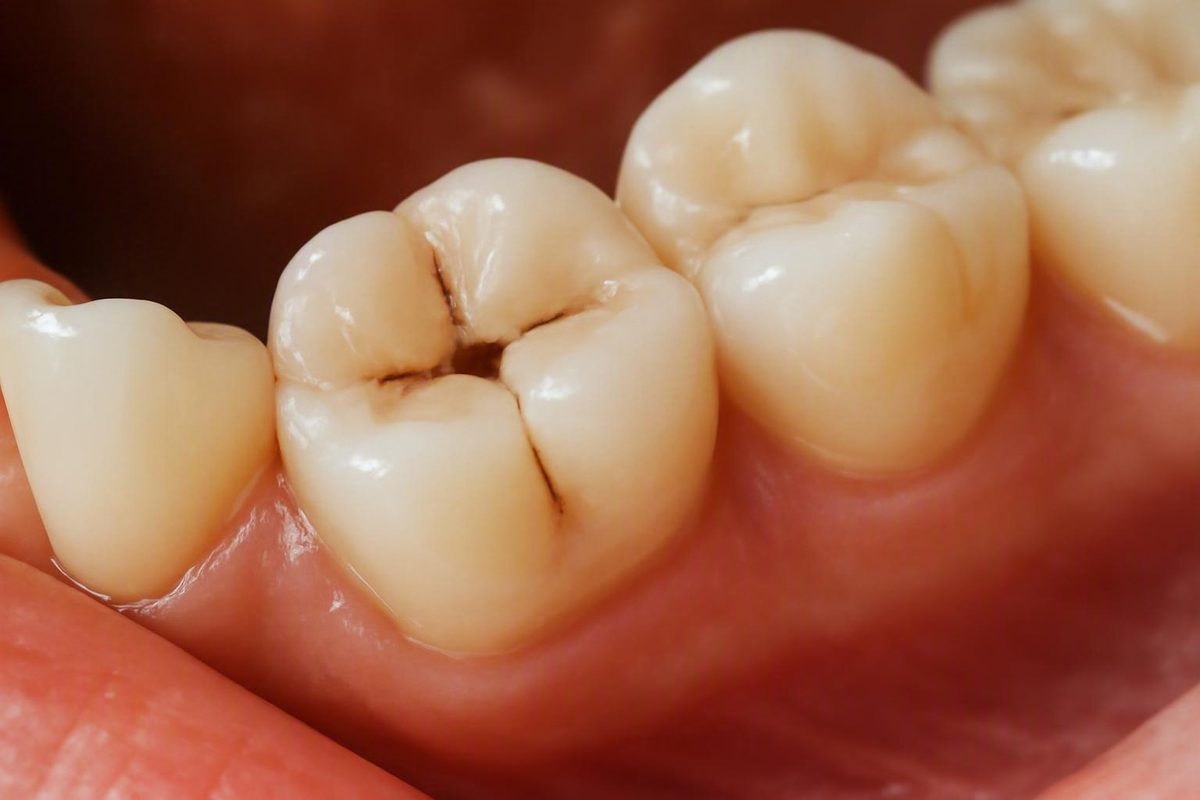
The short answer: a black molar line is not automatically a cavity
A black line in a molar groove may be pigment trapped in a sound fissure, but it can also be tooth decay. Other possibilities include plaque or hardened tartar, a naturally deep developmental groove, a fine enamel crack, or discoloration associated with a filling, sealant, or crown. These causes can look similar in a bathroom mirror.
Molars are not smooth across their chewing surfaces. They have pits and fissures—narrow grooves that help with chewing but may retain food particles, plaque, and colored material. Some fissures are difficult for toothbrush bristles to reach fully, which means the same anatomy can collect harmless pigment and create a vulnerable location for decay. Colgate’s pit-and-fissure overview explains how food and plaque can remain in these grooves.
Color alone cannot reveal whether the enamel is sound, stained, or decaying. A dark line may be surface pigment in an intact groove, while decay may appear dark, light, pitted, or difficult to see. The absence of pain is not decisive either: early decay can be painless, and sensitivity can have causes other than a cavity. A dental-practice guide comparing stains and cavities notes that both may look dark and that some cavities cause no noticeable symptoms.
As a practical, non-diagnostic guide:
- Persistent, stable, and painless line: arrange a routine dental examination.
- New, enlarging, widening, pitted, sensitive, or painful line: contact a dental practice for advice about a sooner appointment.
- Substantial or worsening pain, swelling, a broken tooth, or recent dental trauma: seek timely professional advice rather than waiting for a routine checkup.
These categories are general orientation, not a substitute for individual triage. A dental practice can advise how quickly you should be seen based on your symptoms and health history.
This article cannot diagnose the mark. Decay Guide is written by a health writer rather than a dentist, its articles have not been clinically reviewed, and its information does not replace a dental examination, as explained on the site’s About page.
Why black lines collect in molar pits and fissures
Pits and fissures are the valleys, indentations, and grooves on the chewing surfaces of premolars and molars. Their shape varies. One person may have relatively shallow grooves, while another has narrow fissures extending farther into the chewing surface.
This anatomy explains why a dark line can follow a groove so precisely. Food debris, plaque, and pigment may settle in surface irregularities. Even careful brushing may not remove material from the full depth of a narrow fissure, although brushing the chewing surfaces remains important.
Strongly colored products may contribute pigment, including coffee, black tea, red wine, dark cola, berries, dark sauces, and tobacco. That does not mean a particular drink or food caused a specific mark. Visible staining may reflect repeated exposure combined with a surface that retains pigment.
Failure to brush the line away is not a cavity test. The line may remain because:
- Pigment is embedded in a narrow but sound fissure.
- The deposit has hardened and cannot be removed by ordinary brushing.
- The discoloration is within the tooth rather than loosely on its surface.
- Decay or another structural change is present.
- The mark is associated with existing dental work.
Decay follows a different process from simple pigmentation. Plaque contains bacteria that metabolize sugars and produce acids that attack enamel. Repeated acid exposure may eventually cause loss of tooth structure. Molar fissures are vulnerable because they can retain plaque and be difficult to clean. A damaged area may absorb pigment, but darkness alone does not establish that decay is present.
Location provides context, not a diagnosis. A thin line through the center of the chewing surface follows a pit or fissure. A dark deposit along the gumline or between teeth may be more consistent with stained plaque, hardened tartar, or bacterial staining. Tartar is discussed more commonly around gum margins and between teeth than in the center of a chewing groove.
A line beside a filling, sealant, or crown belongs to another category. It may be surface stain, a material shadow, a visible margin, deterioration of the restoration, or decay nearby. A mirror cannot reliably separate those possibilities.
Possible causes of a black line on a molar
The patterns below are suggestive rather than diagnostic. A tooth may not match them neatly, and more than one factor can be present.
| Possible cause | Usual context | What home cleaning may do | Possible professional management |
|---|---|---|---|
| Extrinsic fissure staining | Pigment from foods, drinks, tobacco, or other colored products settles on or within a natural groove. The tooth may be painless and structurally sound. | Gentle brushing may remove loose material, but embedded pigment may remain. | Examination and, when appropriate, cleaning or polishing. An intact stained groove may need no restorative treatment. |
| Plaque or hardened tartar | Plaque accumulates in a difficult-to-clean area and may mineralize into tartar. Tartar is more typical near the gumline or between teeth than deep in a chewing fissure. | Soft plaque may improve with brushing and interdental cleaning. Hardened tartar generally will not brush off. | Professional scaling, with assessment of the surrounding gums. |
| Pit-and-fissure decay | Enamel in a groove has begun to break down. The area may have a dark line, visible pit, changing surface, or sensitivity, although early decay may be painless. | Brushing controls plaque but cannot rebuild missing tooth structure. | Management may include preventive care or restoration, depending on the examination. |
| Natural developmental groove | A normal fissure is deep, narrow, or shadowed and becomes stained over time. Similar grooves may appear on other molars. | The line may remain if pigment is embedded. | Documentation and observation, or consideration of a protective sealant in a selected case. |
| Fine enamel crack or craze line | A line crosses or follows part of the tooth and collects pigment. Some lines are painless; others occur with biting discomfort or damage. | Brushing may not change it. Scraping provides no dependable answer. | Assessment of symptoms, bite, and tooth structure, followed by management appropriate to the finding. |
| Staining or another issue around dental work | A dark edge appears beside an old filling, sealant, or crown. Materials and margins may stain or cast shadows, but deterioration or nearby decay is also possible. | Cleaning may remove nearby plaque but cannot show what is beneath a restoration. | Observation, polishing, repair, or replacement may be discussed according to the condition of the tooth and restoration. |
| Intrinsic discoloration | Color originates within the tooth because of trauma, developmental factors, or dental materials. It is often broader than a thin fissure stain but may create a localized shadow. | Surface cleaning is unlikely to remove internal color. | Evaluation of the cause before cosmetic or restorative treatment is considered. |
These causes cannot be ranked by frequency from the supplied evidence.
Extrinsic fissure staining
An extrinsic stain is color on the outer surface of the tooth or within its surface irregularities. Deep grooves may retain pigments from coffee, tea, wine, cola, berries, dark sauces, or tobacco. The result can be a sharply defined brown or black line following the tooth’s anatomy.
The line may be harmless if the enamel is intact, but appearance cannot confirm that. Some cavities also become pigmented and follow the same groove.
Plaque and tartar
Plaque is a soft bacterial film. If it remains in place, it can mineralize into tartar, also called calculus. Tartar may absorb dark pigment and generally requires professional removal rather than harder brushing. A dental-practice explanation of black tooth lines distinguishes staining and hardened plaque from decay while emphasizing the need for examination.
A dark deposit beside the gum or between teeth may be more suggestive of tartar than a fine line confined to a chewing fissure. Location is still only a clue.
Pit-and-fissure decay
Decay can begin where plaque remains in a groove. A dark mark may occur with enamel breakdown, a visible pit, or a changing surface. Sensitivity to sweets, temperature, or pressure may increase concern, but it is not required and does not prove that decay is present.
Once tooth structure has physically broken down, brushing, polishing, or whitening cannot rebuild it. Treatment depends on the actual structure and extent of the lesion rather than how black it appears.
Grooves and cracks
A natural developmental groove can resemble a crack after it absorbs pigment. Conversely, an enamel crack may collect stain and become easier to see. Not every dark groove is damaged, and not every visible line is a harmless anatomical feature.
A line associated with pain when biting, a recent injury, or a broken edge deserves professional assessment. Do not try to classify it by pushing a pin or another object into the groove.
Existing fillings, sealants, and crowns
A dark margin around dental work does not automatically mean the restoration has failed. It may be superficial staining, a material shadow, a visible metal edge, or discoloration of an otherwise serviceable margin. It may also reflect a gap, fracture, deterioration, or decay beside the restoration.
Because appearance cannot distinguish these causes, the dentist must assess the restoration and surrounding tooth before recommending observation, polishing, repair, or replacement.
Stain or cavity? What clues can—and cannot—tell you
There is no reliable mirror, photograph, color, or brushing test that can diagnose a black molar line at home. Stained fissures and early cavities may look alike, especially under bathroom lighting or in a magnified phone image.
A photo can document the visible appearance, but it cannot assess tooth structure or texture or reveal what lies beneath a restoration.
Clues that justify a sooner appointment
Contact a dental practice about a sooner assessment if:
- The line is new or appeared suddenly.
- It is becoming longer, wider, darker, or more noticeable.
-
A visible pit or indentation has developed.
-
The tooth becomes sensitive to sweet, hot, or cold items.
- There is pain when biting.
- A toothache develops.
- The tooth or a nearby restoration appears chipped or broken.
- The nearby gum bleeds or swells.
- Persistent bad breath or an unpleasant taste seems associated with the area.
These findings increase the reason for assessment but do not prove a cavity. Dental-practice guidance on black tooth lines similarly identifies enlargement, indentation, sensitivity, and other changes as reasons for more prompt evaluation while cautioning that stains, tartar, and decay may look alike.
Terms such as “soft,” “sticky,” or “rough” sometimes appear in descriptions of professional dental examinations. They are not instructions to test your tooth with a sharp object. A dentist interprets texture alongside the tooth’s appearance, symptoms, history, and other findings.
What if the line is flat, stable, and painless?
A flat, consistent line may be compatible with staining in an intact groove, particularly if similar lines have remained unchanged on other molars. That pattern is not a dependable rule for declaring the tooth healthy.
Likewise, lack of pain does not exclude decay.
A simple decision path
- Persistent, stable, and painless: continue normal cleaning and arrange a routine dental review.
- New, enlarging, widening, pitted, food-catching, sensitive, or painful: contact a dental practice about being seen sooner.
- Substantial or worsening pain, swelling, a broken tooth, or recent trauma: seek timely professional advice and explain the symptoms when requesting care.
- Symptoms that appear to be a medical emergency: use the emergency-care system where you live rather than relying on an online dental article.
The purpose of assessment is to determine whether the line is pigment in a sound groove or a condition requiring treatment—not to assume that every dark fissure needs drilling.
How a dentist evaluates a dark molar groove
The dentist may ask when you noticed the line, whether it has changed, whether the tooth is sensitive, whether food catches there, and whether the tooth has previously been restored or injured.
The examination may involve:
- Looking at the groove under suitable lighting.
- Cleaning and drying the surface.
- Comparing it with nearby grooves and teeth.
- Inspecting the surrounding enamel for pits or structural changes.
- Checking the nearby gum for inflammation, bleeding, or tartar.
- Examining any filling, sealant, or crown in the area.
- Assessing the tooth for cracks, broken edges, or tenderness.
- Using dental instruments as part of the overall examination.
Texture can contribute information, but roughness, softness, or an instrument catching should not be treated as stand-alone proof of decay. Findings must be interpreted together.
When an X-ray may be used
A dentist may recommend an X-ray when decay, infection, leakage, or a problem beneath a restoration is suspected. Imaging can add information about areas that cannot be inspected directly, but it is used alongside the clinical examination rather than as a substitute for looking at and assessing the tooth. A commercial dental-clinic guide describes examination and possible X-ray use when decay or a restoration problem is suspected.
Do not expect a photograph or X-ray result, considered in isolation, to classify every dark line. The dentist’s decision is based on the combined findings rather than a single image or color threshold.
Possible findings after examination
The outcome may be:
- No active disease and no treatment required.
- Pigment in an intact fissure.
- Removable surface stain.
- Hardened tartar requiring scaling.
- A groove suitable for observation.
- A selected groove for which a sealant may be considered.
- Tooth decay requiring restorative treatment.
- A crack or restoration problem requiring individualized care.
This list describes possible outcomes, not rules for choosing among them. The supplied evidence does not establish a universal darkness, depth, or symptom threshold at which a groove must be monitored, sealed, or restored.
Treatment depends on what caused the line
Treatment should not be selected from color alone. Whitening does not repair decay, while restorative treatment should be based on examination of the tooth rather than the presence of pigment by itself.
| Diagnosis or finding | Possible management | Important limitation |
|---|---|---|
| Loose or removable surface stain | Professional cleaning or polishing may improve its appearance. | Embedded fissure pigment may remain even when the enamel is sound. |
| Hardened tartar | Professional scaling, sometimes followed by polishing. | More forceful brushing and whitening do not safely remove mineralized deposits. |
| Intact stained fissure | No treatment, observation, polishing, preventive advice, or consideration of a sealant. | Darkness alone does not establish a need for a filling. |
| Selected decay-prone groove | A dentist may discuss a dental sealant. | A sealant is not a universal treatment for every black line. |
| Confirmed structural decay | Removal of decayed tissue and placement of a filling; more extensive damage may require another restoration. | Cleaning and whitening cannot rebuild missing tooth structure. |
| Dark restoration margin | Observation, polishing, repair, or replacement according to the findings. | A dark edge does not by itself prove failure or decay underneath. |
| Crack or structural defect | Management according to its location, symptoms, and significance. | Whitening does not seal or strengthen a crack. |
| Intrinsic discoloration | Evaluation of the cause before cosmetic or restorative options are considered. | Surface polishing may not alter color originating within the tooth. |
Cleaning and polishing
Professional polishing may improve removable extrinsic staining. It can make a dark groove less noticeable when pigment is on an accessible surface, but it is not guaranteed to remove color embedded in an irregular yet sound fissure.
If polishing does not remove the line, that does not prove decay. Embedded pigment, internal discoloration, material shadowing, and structural changes can all persist after surface cleaning.
Scaling for tartar
Hardened tartar generally requires professional scaling. Pressing harder with a toothbrush is not an effective substitute and may irritate the surrounding tissues. If the deposit is near the gumline, the dental professional can also examine the nearby gum.
Whitening
Whitening may affect some superficial discoloration, but it does not:
- Remove hardened tartar.
- Repair a cavity.
- Replace missing enamel.
- Seal a crack.
- Correct a defective restoration.
- Diagnose the cause of a dark groove.
A localized mark of uncertain cause should therefore be assessed before cosmetic whitening is chosen.
Monitoring and sealants
If examination shows an intact groove without decay requiring restoration, observation may be one possible outcome. This does not support a universal review interval; follow-up depends on the individual findings.
Dental sealants are protective coatings placed over pits and fissures to help block food and plaque from collecting in them. They may be considered for selected teeth, but the presence of a black line alone is not a selection rule.
Fillings and other restorations
Confirmed structural decay may be treated by removing decayed tissue and placing a filling. More extensive damage may require another type of restoration. The decision depends on the tooth’s condition, not the intensity of the discoloration.
An old filling or crown should likewise be assessed rather than replaced solely because its margin looks dark. Depending on the findings, the restoration may be observed, polished, repaired, or replaced.
What to do at home—and what not to try
While waiting for an appointment, focus on ordinary plaque control rather than trying to erase the line.
Continue gentle daily cleaning
Brush twice daily with fluoride toothpaste, including the chewing surfaces of the back teeth. Clean between the teeth daily with floss or another suitable interdental method. These measures help control plaque, although floss does not clean the center of every molar fissure.
Normal cleaning may remove loose debris and superficial deposits. It may not remove embedded pigment, hardened tartar, internal discoloration, or a material shadow, and it cannot repair missing tooth structure.
You can note whether the line:
- Changes in length, width, or darkness.
- Develops a visible pit.
- Begins catching food.
- Becomes sensitive or painful.
- Appears beside a chipped restoration or broken tooth.
- Occurs with gum swelling, bleeding, or an unpleasant taste.
A dated photograph taken under similar lighting may help you describe visible change, but it should not be used as a diagnosis.
Do not scrape or probe the groove
Do not use pins, needles, metal dental tools, knives, or other sharp objects to test or remove the line. Commercial dental guidance warns that scraping with sharp objects can damage enamel or gums. Avoid repeatedly picking at the groove with a fingernail or toothpick as well.
If food appears to be lodged there, rinse and brush gently rather than forcing an object into the fissure.
Avoid acidic and abrasive remedies
Do not apply lemon juice, vinegar, charcoal powder, abrasive whitening powder, or homemade baking-soda mixtures in an attempt to erase the mark. A dental-clinic article on unsafe black-line removal methods warns against acidic mixtures, abrasive powders, and scraping because of the potential for enamel or gum damage.
Do not rely on mouthwash, oil pulling, peroxide, or frequent toothbrush replacement to remove tartar or treat decay. The supplied evidence does not establish those methods as treatments for either condition.
Professional cleanings and dental examinations can remove appropriate deposits and identify changes. A dentist may also discuss sealants for selected grooves.
When to book routine, prompt, or faster dental care
The following categories are a general way to communicate urgency to a dental practice, not a validated self-triage protocol. If you are uncertain, describe the mark and any symptoms when you call so the practice can advise you.
Routine assessment
Arrange a routine dental appointment if the line:
- Has been present for some time.
- Appears stable.
- Causes no pain or sensitivity.
- Has not brushed away with normal gentle cleaning.
- Cannot confidently be identified as loose food or debris.
- Is beside an older restoration but has not noticeably changed.
A stable, painless mark is generally less concerning than one that is changing or symptomatic, but it still merits examination because early decay may be painless.
Prompt appointment
Ask the dental practice whether you should be seen sooner if the line:
- Appeared suddenly.
- Is darkening, spreading, widening, or enlarging.
- Has developed a visible pit or indentation.
- Repeatedly catches food.
- Appears rougher or structurally different.
- Is accompanied by sensitivity to sweets, heat, or cold.
- Causes pain when biting.
- Is associated with toothache.
- Appears beside a chipped, loose, or changing restoration.
- Occurs with gum bleeding, localized swelling, persistent bad breath, or a change in tooth shape or texture.
These features do not establish the diagnosis. They indicate that the change should be described to a dental professional rather than watched indefinitely.
Faster or urgent care
Seek timely professional advice rather than waiting for a distant routine appointment if you have:
- Substantial or worsening tooth pain.
- Swelling of the gum, jaw, or face.
- A broken tooth.
- Recent dental trauma.
- Symptoms that are worsening quickly or otherwise appear urgent.
This article cannot determine the appropriate emergency response for an individual. If symptoms seem life-threatening or extend beyond a routine dental problem, use your local emergency-care service.
Assessment is still worthwhile because it can identify whether the groove is merely stained or needs treatment.
Frequently asked questions
Can a black line on a molar be harmless?
Yes. A black line may be pigment trapped in an intact natural groove, a surface stain, or a shadow associated with tooth anatomy or dental material. A university-affiliated Penn Dental Family Practice article likewise notes that a dark molar mark is not necessarily a cavity.
“Potentially harmless” does not mean the cause can be confirmed from a photograph. A persistent line should be examined so the dentist can assess the enamel and surrounding tooth.
Can a molar have a cavity even if the black line does not hurt?
Yes. Early decay may cause no noticeable pain, particularly when it is in a groove or another difficult-to-see area. Pain is therefore not a dependable dividing line between staining and decay.
Conversely, pain or sensitivity does not prove a cavity because cracks, exposed tooth surfaces, restoration problems, and other conditions may also cause symptoms.
Why will the black line not brush off?
Pigment may be embedded in a narrow fissure rather than sitting loosely on the surface. The mark could also be hardened tartar, internal discoloration, a natural shadow, a stained crack, a restoration margin, or decay.
Do not respond by brushing harder or scraping the groove. Professional polishing may improve removable stain, while scaling is used for tartar. Persistence alone does not establish which treatment is appropriate.
Will an X-ray always show whether a black molar groove is a cavity?
Do not treat an X-ray as a stand-alone answer. A dentist may use imaging when decay or a problem beneath a restoration is suspected, but the result is interpreted together with the clinical examination, symptoms, history, and condition of any existing dental work.
A photograph is more limited still: it records visible color and shape but does not let the dentist directly assess the tooth’s surface or restoration.
Can a dark line beside an old filling or crown mean decay?
It can, but other explanations include surface staining, a material shadow, a visible crown or filling margin, or harmless discoloration at the edge. A gap, fracture, deterioration, or decay beside the restoration is also possible.
Appearance alone cannot determine which explanation applies. Depending on the examination and any indicated imaging, the restoration may be observed, polished, repaired, or replaced.
Key takeaway
A black line in a molar groove may be pigment in a sound fissure, but it may also be decay, hardened plaque, a crack, or discoloration associated with existing dental work. Color, photographs, brushing, and the absence of pain cannot settle the diagnosis.
Continue gentle twice-daily brushing with fluoride toothpaste and daily interdental cleaning. Avoid scraping the groove or using acidic and abrasive remedies. Arrange an examination for any persistent mark; contact a dental practice sooner if the line is changing or accompanied by sensitivity, pain, swelling, damage, or other significant symptoms.