
How Gum Disease Progresses Through Its Common Stages – And What the Evidence Shows
Pocket depth, bleeding, tooth mobility and imaging are more informative together than any single sign when assessing how far it has progressed.
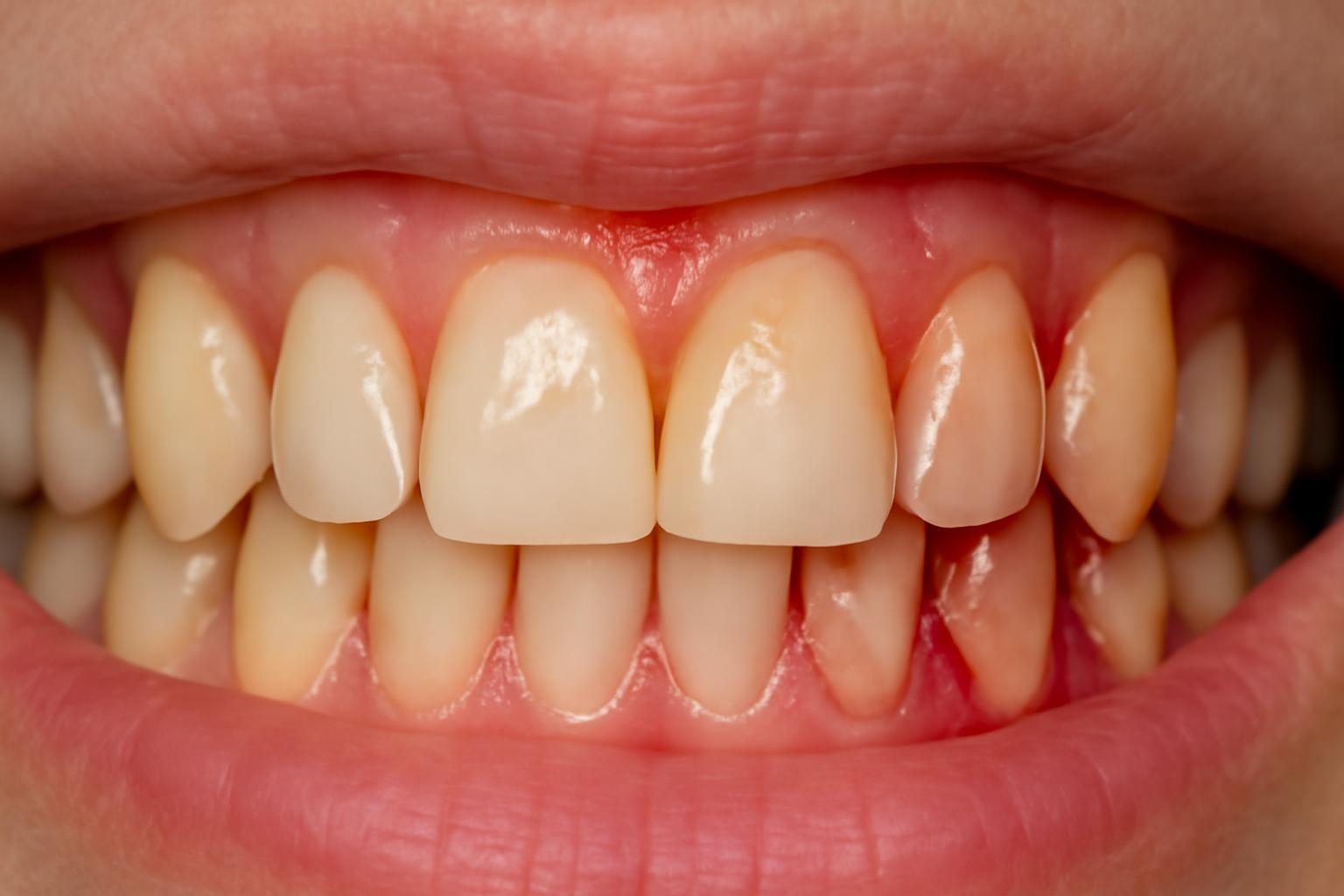
If you have noticed bleeding gums, puffiness, bad breath, or gums that seem to be shrinking even though you brush regularly, the hard part is often not naming the symptom. It is figuring out where that symptom fits. Some guides describe gum disease in two stages. Others use four. A few stretch it to five.
The broad picture is consistent enough to be useful. Gum disease often begins as gingivitis, where inflammation is limited to the gums, and may progress into periodontitis, where the problem extends deeper and can involve the tissues and bone that support the teeth. That framework can help you notice warning signs earlier, but it is still only an orientation tool. A home article can explain the path; it cannot tell you your exact place on it.
That distinction matters because gum disease is not staged by appearance alone. What a dentist does in an exam is more specific than what a mirror can show: measure, compare, and look for structural change over time.
What Is Gum Disease and Why Understand Its Stages?
Gum disease, or periodontal disease, is inflammation and infection of the tissues around the teeth. It usually begins with plaque, the bacterial film that forms on teeth every day.
One reason readers get mixed answers about the stages is that different sources are simplifying the same progression in different ways. Public-health and professional summaries often emphasize two broad categories: gingivitis and periodontitis. The CDC describes gingivitis as inflammation of the gums and periodontitis as the form that also involves bone loss around the teeth. It also describes periodontitis by severity, such as mild, moderate, or severe, rather than insisting on one consumer-facing four-stage script (CDC).
A few consumer articles then expand that severity progression further and turn it into a five-step learning model: gingivitis followed by several progressively worse forms of periodontitis. That does not make the two-stage or four-stage versions wrong.
A practical way to line the models up is this:
| Simplified model | What it usually means |
|---|---|
| Two-stage model | Gingivitis, then periodontitis |
| Four-stage model | Gingivitis, early/mild periodontitis, moderate periodontitis, advanced periodontitis |
| Five-stage model | Gingivitis, then periodontitis split into more sub-levels |
For readers at home, the point of learning stages is not to self-diagnose with false precision. It is to understand the direction of change: from superficial inflammation that may be reversible to deeper structural damage that usually is not. That matters partly because gum disease is often quiet. The ADA says it is usually painless and may produce no warning signs, and it reports that chronic periodontitis affects 47.2% of U.S. adults over age 30, which helps explain why these symptoms are common enough to deserve attention rather than dismissal (ADA MouthHealthy).
That last part is easy to miss. People often wait for pain before they take gum symptoms seriously. Gum disease does not reliably reward that strategy.
Stage 1: Gingivitis – The Reversible Early Stage
Gingivitis is the earliest stage of gum disease and the one most consistently described as reversible. In this stage, inflammation is limited to the gums themselves rather than the deeper support around the teeth. Common signs include red or swollen gums, puffiness, bleeding with brushing or flossing, bad breath, and tenderness. A central distinction is that gingivitis is described as occurring without bone loss, which is why this stage is treated differently from periodontitis in both public-health and clinical explanations (Cleveland Clinic).
“Reversible” is worth understanding precisely. It does not mean the gums are merely a little irritated or that nothing important is happening. It means the inflammatory process has not yet crossed into the deeper tissue and bone destruction that defines periodontitis. Because that deeper attachment loss has not yet occurred, there is still a realistic path back to gum health if plaque is disrupted consistently and built-up deposits are professionally removed when needed.
In real life, gingivitis can be easy to rationalize away. A little bleeding may be blamed on flossing too hard. Mild puffiness may be written off as temporary irritation. A bad taste may come and go. The problem is that early gum disease often looks and feels ordinary enough to ignore.
The good news is that this is also the stage most responsive to straightforward care. Better daily cleaning and professional cleaning when plaque or tartar is already present are the usual first steps. When gingivitis improves, what people often notice first is less bleeding and less swelling; the gums then gradually look firmer and calmer. That improvement does not prove every case was severe enough to be called disease, but it does fit the basic pattern of plaque-driven gingival inflammation settling once the irritant is removed.
Healthy gum support is also associated with shallow pocket measurements, though pocket depth by itself is not a complete diagnosis. In simplified educational guides, the shallow end of the range is generally the one associated with healthy support, while deeper pockets become more relevant once disease extends below the gumline. Those numbers make more sense in the context of later stages, so they are easier to understand after the progression is mapped out.
Stage 2: Early or Mild Periodontitis – Pockets Begin Forming
When gingivitis is not controlled, the process can move deeper. In the common four-stage teaching model, the next step is early or mild periodontitis. The change is not simply “more inflammation.” Bacteria and inflammation extend below the gumline, the gums begin to pull away from the teeth, and periodontal pockets form. Consumer staging charts commonly use pockets around 4 to 5 millimeters as shorthand for this stage, but those numbers are best read as educational benchmarks rather than universal diagnostic rules. The important idea is that the space around the tooth has deepened enough to trap bacteria more easily and become harder to clean normally at home (Hometown Dental).
This is also the point where the language around reversibility changes. Once sources describe the condition as periodontitis, they generally stop describing it as fully reversible. Early periodontitis is still treatable and often stabilizable, but the problem is no longer limited to inflamed gum tissue on the surface. At this stage, sources aimed at patients begin to talk about deeper infection, periodontal pockets, and effects on bone or jaw support, which is why the goal becomes control and preservation rather than a simple return to baseline through better brushing alone (North View Dental).
Symptoms in this stage often sound familiar because they overlap with gingivitis: bleeding, persistent bad breath, tenderness, and visible puffiness may all still be present. The difference is that recession may start to become easier to see, teeth may look slightly longer, and the earliest bone changes may appear on dental imaging before the patient feels anything dramatic. That mismatch between what is happening and what is felt is one of the reasons early periodontitis can keep advancing quietly.
This is also where many people become confused about brushing. Someone may brush every day and still hear that pockets are forming. That can feel unfair until you understand the mechanism. Once plaque has been left in place long enough to harden into tartar, and once bacteria have established themselves in deeper pockets, the issue is no longer just the visible film on the tooth surface. The anatomy of the pocket now helps the problem persist.
Stage 3: Moderate Periodontitis – Tissue and Bone Erosion
Moderate periodontitis is where the structural consequences become harder to ignore. Patient-facing descriptions of this stage commonly include more obvious recession, worsening bad breath, increased bleeding, teeth that begin to feel loose or shift slightly, pain in some people, and pus between the teeth and gums in some cases. The underlying point is not just that the pockets are deeper than before, but that more of the tissue and bone supporting the teeth has been damaged over time (Premier Dental Care).
In educational staging charts, this middle part of progression is often paired with deeper pocket measurements than early periodontitis, commonly in the 6 to 7 millimeter range in consumer guides. That should still be read cautiously. The number is a shorthand used in public explainers, not a standalone verdict. Two people with similar-looking symptoms can have different pocket patterns, different bleeding patterns, and different amounts of bone loss on imaging.
What makes moderate periodontitis meaningfully different from the early stage is accumulated destruction. The infection has had more time to damage the attachment around the tooth, so the consequences are not only biological but mechanical. Teeth may shift. A bite may feel “off.” Spaces may open where they were not before. Some people notice smell or taste changes before pain; others notice movement before swelling. A symptom checklist can suggest seriousness, but it cannot tell you exactly how far the process has gone.
This is the stage where home observation becomes especially unreliable. A person may feel almost nothing and still have substantial support loss. Another may feel soreness early but have less structural damage than expected.
Stage 4: Advanced Periodontitis – Risk of Tooth Loss
Advanced periodontitis is the far end of the same progression: deeper pockets, more recession, more extensive bone loss, and a greater risk that teeth will loosen enough to shift or be lost. Consumer descriptions of advanced disease commonly include severe recession, chewing pain, very loose teeth, pus or a bad taste from the gums, bite changes, sensitivity, and actual tooth loss. At this point, the clinical picture is less about one exact pocket number than about major attachment loss and instability (Premier Dental Care).
This is also why advanced cases can look different from one another. One person may present with repeated swelling around a single tooth. Another may mainly notice mobility. Another may only discover the severity after an exam and X-rays. The end stage is not defined by one symptom everyone shares. It is defined by the degree of damage to the support system that keeps teeth stable.
Descriptions of advanced disease can sound discouraging because they stop talking about reversal and start talking about management, preservation, and tooth-loss risk. But that wording is not the same as saying nothing can be done. It means the treatment goals have changed. Earlier on, the aim is to settle inflammation and interrupt progression. Later, the aim is to reduce infection, preserve as much support as possible, and decide which teeth can predictably remain functional.
That shift in goals is part of what stage language is supposed to communicate. The names are not there to dramatize the disease. They are there to distinguish superficial inflammation from structural loss, and structural loss from instability.
How Dentists Measure Gum Disease Progression
The measurement readers hear about most often is pocket depth. Dentists and hygienists use a periodontal probe to measure the space between the tooth and surrounding gum tissue. In common charting methods, measurements are recorded at six areas around each tooth and tracked over time. In consumer-friendly educational guides, 0 to 3 millimeters is commonly described as the shallow range associated with healthy support, 4 to 5 millimeters as a range often associated with early periodontitis, and 6 to 7 millimeters as a common shorthand for more advanced disease than the early stage. Those ranges are useful for understanding what is being measured, but they are not universal stand-alone diagnostic thresholds (Northwell Health).
Pocket depths are only part of the picture. They tell you how deep the spaces are, not why they are that deep or how much bone support has been lost. Imaging helps fill that gap.
This is also why recession can mislead people. Pocket depth, bleeding, tooth mobility, and imaging are more informative together than any single sign is by itself.
So when public articles list millimeter ranges, the fairest way to read them is as orientation points. They explain what dentists mean when they talk about “deep pockets.” They do not let you stage yourself with confidence at home.
Risk Factors and Common Causes Across Stages
Plaque buildup and inadequate plaque removal are the main thread running through all stages of gum disease, but they are not the whole story. The ADA lists several recurring risk factors that can increase the chance of gum disease or make progression harder to control, including smoking or chewing tobacco, genetics, pregnancy, diabetes, certain medications, and teeth that are difficult to keep clean. The same source also notes that changes in the way teeth fit together, loose teeth, and gums that pull away from the teeth can all be warning signs that the disease is no longer limited to simple irritation (ADA MouthHealthy).
That helps explain a very common frustration: “Why do I have gum problems if I brush every day?” Sometimes the answer really is technique, timing, or inconsistency. Sometimes the problem is that brushing alone does not fully clean between teeth. Sometimes tartar has already formed and needs professional removal.
Good brushing still matters. It lowers plaque levels and helps reduce the chance of gingivitis. It is just not a complete explanation for who does and does not progress. Gum disease is partly about hygiene and partly about susceptibility. That is why simple “brush better” advice can be both true and incomplete.
Population patterns fit that picture too. The CDC summary cited above reports that periodontitis becomes more common with age, and it has also reported sex differences in prevalence among adults over 30. Those numbers do not mean individuals are destined to develop disease. They show that gum disease is shaped by both daily habits and the conditions that make those habits more or less protective.
Prevention and Early Action for All Stages
Across patient-facing sources, prevention advice is strikingly consistent: brush thoroughly, clean between the teeth daily, keep regular dental appointments, and avoid tobacco. A periodontics overview for patients puts prevention in almost exactly those terms and pairs home care with routine cleanings and checkups, emphasizing that catching disease in the gingivitis stage offers the best chance of reversing it before support is lost.
What changes by stage is not the value of those habits, but what those habits can realistically achieve. In gingivitis, improved home care plus professional cleaning may be enough to return the gums to health. Once periodontitis has developed, home care is still essential, but it becomes ongoing control rather than complete repair. Patient guides that divide gum disease into early, moderate, and advanced forms commonly move from routine cleaning to deeper professional treatment such as scaling and root planing because plaque, tartar, and bacteria are no longer limited to easy-to-reach surfaces along the visible gumline.
For a worried reader, the most useful response is usually not to memorize labels but to act on persistent signs: repeated bleeding, chronic bad breath, gum recession, tenderness, swelling that returns, pus, shifting teeth, or a bite that feels different. Earlier action does not guarantee a simple fix, but it improves the odds that the disease can be stopped before more support is lost.
And one final boundary matters. This kind of article is best used as a map, not a verdict. Decay Guide publishes general reference information and does not provide individual diagnosis or treatment advice. If you think you may have gum disease, the step that actually clarifies things is a dental exam.
Is gingivitis the only reversible stage of gum disease?
In the evidence reviewed here, that is the clearest consensus. Gingivitis is the stage described as reversible because inflammation is limited to the gums and has not yet crossed into the bone-loss stage of disease. Once the process is described as periodontitis, patient-facing sources generally shift to language such as manageable, treatable, or stabilizable rather than fully reversible.
That does not mean later treatment accomplishes little. Periodontitis treatment can reduce infection, calm inflammation, and help preserve teeth. The limit is different: it is the expectation that lost support will not simply return to its original condition through ordinary cleaning alone.
What pocket depth signals periodontitis?
In consumer-facing staging guides, the most common shorthand is that 0 to 3 mm is the shallow range associated with healthy gum support, while 4 to 5 mm begins to suggest early or mild periodontitis. Deeper measurements are commonly used as shorthand for more advanced disease than the early stage. Those figures are educational landmarks, not a complete diagnosis by themselves (Northwell Health).
How common is gum disease?
It is common, and the exact wording matters. The most careful way to say it is that periodontitis specifically—not every possible form of gum inflammation—affected about 4 in 10 U.S. adults age 30 or older in 2009–2014, according to CDC reporting, and it became more common with age; about 60% of adults age 65 or older had periodontitis in that same period (CDC).
That is enough to make one practical point clear: bleeding gums are not rare, and they should not be treated as too trivial to mention at a dental visit.
Does gum disease always cause pain?
No. One of the most repeated warnings across public explanations is that gum disease may cause little or no pain, especially early on, and pain may still be absent in some advanced cases. That is why bleeding, swelling, bad breath, recession, looseness, or bite changes matter even when nothing hurts.
Lack of pain is one of the main reasons gum disease progresses further than people expect before they seek care.
Can brushing alone prevent progression?
Not usually. Brushing is central because it disrupts plaque, and that makes it highly effective against gingivitis risk. But brushing does not reach every surface between teeth, does not remove tartar once plaque has mineralized, and does not rebuild bone lost to periodontitis. Decay Guide’s explainer on what daily brushing cannot fix makes that distinction plainly.
That is why later-stage gum disease is managed professionally even when home brushing improves. Better brushing helps. It is not the whole treatment.