
How to Choose a Filling Material Without Assuming One Is Always Best
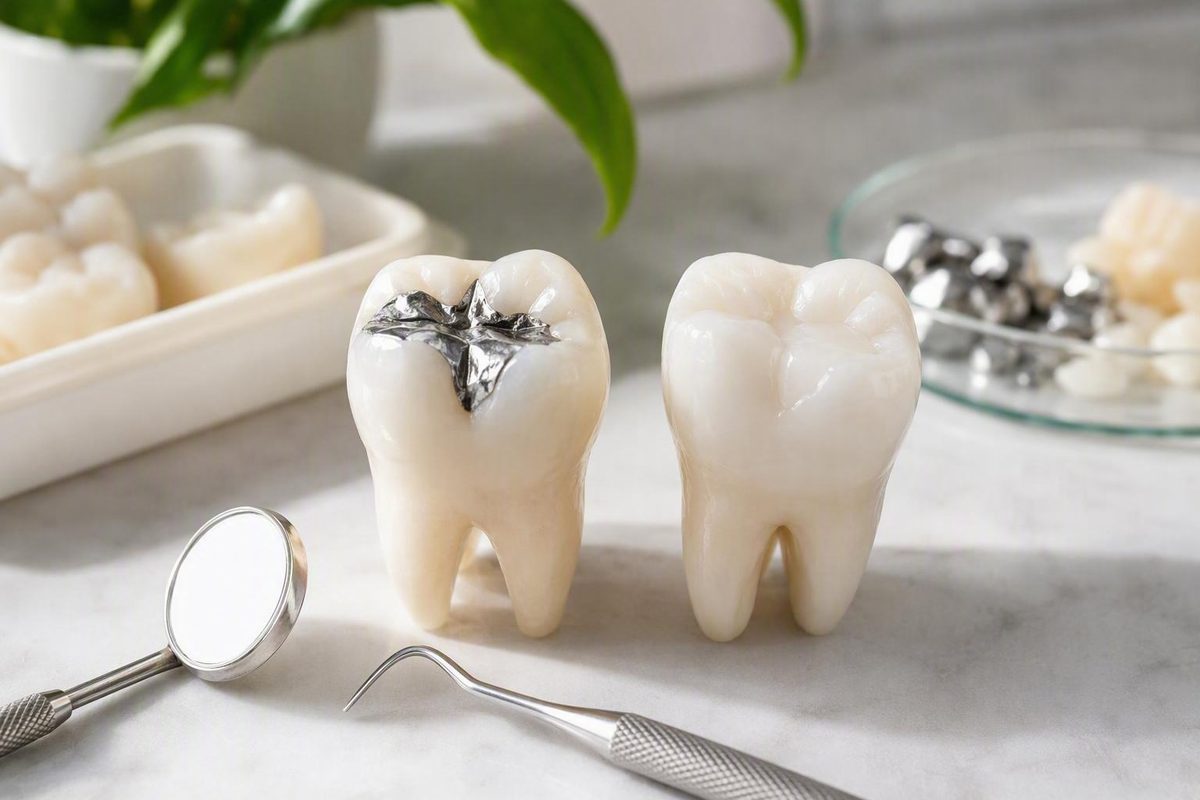
The short answer: the better filling depends on the tooth
Neither silver amalgam nor composite resin is better in every situation.
Amalgam generally offers a lower initial cost in the Canadian analysis, greater tolerance when moisture control is difficult, and stronger comparative evidence for longevity in permanent back teeth. Composite offers the clearest cosmetic advantage because it can be matched to the tooth, and adhesive placement may allow a more conservative preparation in suitable cavities. A Canadian health-technology assessment reached broadly similar conclusions while emphasizing shared decision-making rather than naming a universal winner (CADTH assessment of composite resin versus amalgam).
The practical question is not simply, “Which material is best?” It is, “Which material fits this tooth, this restoration, and this patient’s priorities?”
A visible cavity in a front tooth, a small cavity in a molar, and a large restoration carrying substantial chewing pressure are different clinical problems. So are a new cavity and an old filling that is still functioning but looks unattractive. The choice can change with:
- The cavity’s size, depth, location, and number of involved surfaces
- How much sound tooth structure remains
- The forces placed on the tooth during chewing
- Grinding or clenching
- Whether saliva and blood can be kept away during placement
- How visible the restoration will be
- Initial cost and insurance reimbursement
- Relevant health or allergy considerations
- The patient’s preference after discussing the trade-offs
Here is the comparison in compact form:
| Feature | Silver amalgam | Composite resin |
|---|---|---|
| Basic composition | Metallic restorative material containing elemental mercury mixed with an alloy commonly containing silver, tin, and copper | Resin matrix containing glass or similar inorganic filler particles |
| Color | Silver-gray and readily visible | Can be shade-matched to the surrounding tooth |
| How it stays in place | Generally relies on the mechanical shape of the prepared cavity | Uses an adhesive bonding system |
| Sensitivity to moisture during placement | More tolerant when ideal isolation is difficult | Requires reliable control of saliva and blood |
| Comparative longevity evidence | Generally lasted longer in the limited evidence reviewed for permanent posterior teeth | Had a higher failure risk in the principal pooled comparison, although the evidence was sparse and may not represent the newest materials |
| Initial cost | Lower in the reviewed Canadian economic analysis | Often higher because placement is more involved, although actual fees vary |
| Common reasons to consider it | Large load-bearing posterior restoration, difficult isolation, or sensitivity to initial cost | Visible tooth, appearance priority, or a cavity suited to adhesive placement |
This table is a starting point, not a treatment recommendation. A dentist still needs to determine how far the damage extends, whether the tooth can support a direct filling, and whether another kind of restoration would be more appropriate.
This article provides general reference information. It cannot diagnose a failing restoration or determine which material is suitable for an individual tooth.
What amalgam and composite are—and how they stay in a tooth
Dental amalgam is a metallic restorative material. Approximately half of it by weight is elemental mercury, which is combined with an alloy commonly containing silver, tin, and copper (overview of amalgam and composite composition). The term “silver filling” describes its metallic appearance; it does not mean the restoration is made only—or even mainly—of silver.
Composite is a tooth-colored material made from a resin matrix reinforced with glass, quartz, or similar inorganic filler particles. Dentists can select and sometimes combine shades to make the restoration less noticeable against the surrounding enamel. The match may be close, although no artificial material is guaranteed to remain visually indistinguishable from a natural tooth under every kind of lighting or throughout its service life.
The materials also rely on different retention strategies. Amalgam generally needs a prepared cavity shape that mechanically holds the hardened filling in place. Composite is placed with an adhesive system that bonds the restoration to prepared enamel and dentin.
This distinction is one reason composite may permit a more conservative preparation in a suitably shaped cavity. It does not mean composite always requires less drilling. Decay, cracks, an old restoration, inaccessible margins, or unsupported tooth structure may determine how much tissue must be removed regardless of the replacement material.
Composite placement involves more than putting a tooth-colored paste into a cavity. The dentist isolates and prepares the tooth, applies the bonding materials according to the selected system, places the resin—often in controlled portions—and hardens it with a curing light before shaping, checking the bite, and polishing it. Amalgam is instead condensed into a mechanically retentive preparation and shaped before it fully hardens. A dentist-authored comparison explains these bonding and retention differences, although its preference for composite reflects that practice’s treatment philosophy (overview of composite and amalgam placement).
Isolation matters because composite bonding takes place at an interface between the tooth, the adhesive, and the resin. Saliva or blood contamination during critical steps can interfere with that interface.
Amalgam is less sensitive to moisture during placement, so it may remain practical where consistently dry adhesive conditions cannot be achieved. That does not make amalgam immune to poor technique, nor does it mean composite is unsuitable whenever a cavity approaches the gum. It means access and isolation are legitimate material-selection factors rather than minor procedural details.
The bonding distinction should not be stretched into unsupported promises. Adhesive placement does not prove that composite always strengthens a tooth, prevents future fractures, seals better in every cavity, or lasts longer. Those outcomes depend on the restoration’s size and design, the condition of the remaining tooth, the placement process, and the forces the tooth later experiences.
Durability and failure: what the comparative evidence actually shows
The strongest independent comparative source supplied for this question is a Canadian health-technology assessment created in March 2018. It concluded that amalgam restorations in permanent posterior teeth generally lasted longer than composite restorations (2018 comparative assessment).
Within that assessment, a 2014 systematic review pooled two studies covering 3,010 restorations. It found greater relative risks of restoration failure and secondary caries—new decay associated with a restored tooth—with composite than with amalgam. A later randomized trial involving only 40 restorations found no difference in failure or secondary caries, but its small sample limited how broadly the result could be applied. The assessment also cautioned that few comparative studies were available.
This is useful evidence, but it has clear limits. It is dated, sparse, and not a complete account of every composite formulation, adhesive system, isolation method, or placement technique used today. The pooled result gives a relative comparison, not a dependable personal forecast for one filling.
Consequently, “amalgam generally lasted longer in the reviewed evidence” does not mean every amalgam filling will outlast every composite filling. It also does not establish that contemporary composite will perform equally well in every small or moderate cavity. Both interpretations go beyond the available evidence.
The supplied evidence does not establish current absolute five-, ten-, or fifteen-year failure rates for otherwise comparable modern restorations. Lifespan ranges published on individual dental-practice pages should not be treated as guarantees or universal averages, particularly when the comparisons do not involve the same tooth type, restoration size, number of surfaces, operators, or follow-up period.
Several variables can change how long either material remains serviceable:
- Restoration size: A small filling surrounded by substantial sound tooth structure is not equivalent to a large restoration replacing multiple walls or cusps.
- Number of surfaces: A one-surface cavity presents a different structural problem from a restoration extending between teeth and across the chewing surface.
- Tooth position: Front teeth and molars experience different movements, wear patterns, and cosmetic demands.
- Bite pressure: The forces on a restoration depend on its location and how the teeth meet.
- Grinding or clenching: Repetitive non-chewing loads can increase stress on the restoration and the remaining tooth.
- Remaining structure: Thin, cracked, or unsupported cusps may fail even when the filling material remains intact.
- Decay risk: New decay can develop at or near either type of restoration.
- Moisture control: This is especially consequential for an adhesive composite restoration.
- Placement technique: Cavity preparation, bonding protocol, curing, shaping, contact formation, and bite adjustment all matter.
- Daily conditions: Hygiene, diet, dry mouth, and follow-up care affect the restored tooth. Decay Guide’s discussion of what daily brushing cannot fix provides broader context on why home care cannot diagnose or correct structural restoration problems.
This explains why two apparently conflicting statements can both contain some truth: amalgam showed better posterior survival in the limited comparative review, while composite can still function successfully in many back teeth. Evidence describes average comparative outcomes in selected groups. It cannot guarantee what will happen to one restoration.
A tooth-by-tooth decision matrix
A material decision becomes more useful when it begins with the clinical problem rather than a rule such as “white for front teeth, silver for molars.”
The six inputs below should be considered independently. The entries in one row are not intended to describe a standard patient or imply that, for example, a visible cavity is necessarily small or lightly loaded.
| Visibility | Restoration size | Chewing load | Moisture control | Remaining structure | Budget |
|---|---|---|---|---|---|
| Highly visible: Appearance may strongly favor shade-matched composite | Small: Composite may suit a conservative adhesive preparation | Low or moderate: Either material may be workable if other conditions are favorable | Reliable: Supports adhesive composite placement | Substantial sound structure: A direct filling may be reasonable | Flexible: Appearance and preservation priorities may carry more weight |
| Partly visible: Appearance remains relevant but may not dominate | Moderate: The surfaces involved and available support become increasingly important | Moderate: The dentist should assess actual bite contacts rather than relying on the tooth’s name alone | Manageable with appropriate isolation: Composite may remain practical | Some weakened walls: Preparation design and support become more important | Limited: Compare the complete fees and verified insurance benefits |
| Not normally visible: Cosmetics may be a lower priority | Large or multi-surface: Amalgam’s comparative durability may favor it in some posterior cases | High: Size, force distribution, and grinding require close assessment | Unreliable or repeatedly contaminated: Amalgam may be easier to place predictably | Extensive loss or cracked cusps: Another restoration may need consideration | Initial cost is decisive: Amalgam may have an advantage where available and clinically appropriate |
Visible front tooth
Composite is commonly favored when a restoration can be seen during speech or smiling because it can be matched to the tooth. This is its clearest practical advantage.
Even here, the decision can be affected by the damage’s depth, access, gum position, bite, and whether the tooth can be restored with a direct filling. “Composite is often preferred” is not the same as “composite is mandatory.”
Small or moderate molar cavity
A molar location alone does not rule out composite. When the defect is appropriately sized, sufficient structure remains, and the tooth can be isolated reliably, composite may be considered.
The dentist still needs to assess the surfaces involved, cavity margins, bite contacts, remaining cusps, and feasibility of completing every adhesive step correctly.
Large posterior restoration
Amalgam may be favored in some large, load-bearing cavities because of its moisture tolerance and documented comparative durability. This is not an automatic rule.
A very large cavity may leave too little remaining structure for either direct material. Conversely, a smaller, well-isolated posterior restoration may be suitable for composite.
A cavity that is difficult to keep dry
If decay or damage extends to a margin repeatedly exposed to saliva or blood, composite bonding can become less predictable. A dental-practice overview describes amalgam as less moisture-sensitive and identifies contamination as a practical concern for composite in deep or difficult-to-isolate areas (clinical comparison of moisture control and cavity location).
That source is practice guidance rather than a comparative trial. It supports the procedural consideration, not a universal rule that every deep cavity requires amalgam.
Grinding or clenching
Neither material can be declared categorically best for every person who grinds or clenches. Restoration size, remaining cusps, where the tooth contacts its opposing tooth, force distribution, and management of the habit may matter more than the material label alone.
A dentist may also need to consider whether either direct filling can withstand the expected forces.
Extensive structural loss
When much of the tooth is missing or its cusps are weakened, the central decision may no longer be amalgam versus composite. An inlay, onlay, crown, or another restoration may need to be considered instead.
These alternatives have their own preparation requirements, costs, materials, and risks. Their consideration does not mean that one is automatically necessary.
An examination is needed to identify the restoration’s actual dimensions, remaining support, margin location, and bite contacts. A reader’s description of a “small” or “large” cavity cannot establish its clinical extent.
Mercury and safety: what can and cannot be concluded
Dental amalgam contains elemental mercury at approximately half its weight. That fact should be stated plainly, but mercury content alone does not prove that a filling causes clinical harm.
Elemental mercury in amalgam is chemically different from methylmercury, the form commonly discussed in connection with seafood. Treating all mercury-containing substances as interchangeable obscures differences in chemistry, exposure source, and the basis on which health guidance is developed.
The 2018 CADTH assessment found no clinically important safety difference between amalgam and composite in the outcomes it reviewed. Children with amalgam restorations had higher urinary mercury levels than children with composite restorations, but the measured levels did not approach known toxic levels in the cited evidence. The reviewed studies also found no difference in neurological symptoms or immune function between the materials.
That distinction matters. Conversely, a review finding no clinically important difference does not prove that amalgam is completely risk-free for every person under every circumstance.
Composite should not automatically be called safer simply because it does not contain elemental mercury. It is a different material with different ingredients, technique requirements, failure patterns, and uncertainties. The supplied evidence does not support a blanket hierarchy in which one material is harmless and the other is dangerous.
Regulations and recommendations vary by country and can change. Where pregnancy, nursing, childhood, impaired kidney function, neurological disease, or a suspected allergy to a material component is relevant, current primary guidance for the patient’s jurisdiction should be checked. A dental-practice summary discusses these considerations and the distinction between elemental mercury and methylmercury, but it is not itself a regulator document (summary of amalgam safety considerations).
The supplied evidence is not sufficient to give individualized advice for a medical condition, confirm an allergy, or reproduce one jurisdiction’s precautions as universal rules. Material selection in these circumstances requires current local guidance and assessment by a qualified dentist, with medical input where appropriate.
Cost, appointment time, and environmental trade-offs
The 2018 Canadian economic analysis found that amalgam restorations in permanent posterior teeth had a lower cost and a longer average life than composite restorations. According to the CADTH assessment cited above, however, the economic model required assumptions because the comparative and natural-history evidence was limited. Its results may not transfer directly to another country, fee system, insurance arrangement, or present-day practice.
Composite generally takes longer to place because isolation, adhesive steps, controlled resin placement, light curing, shaping, and finishing add complexity. One dental-practice page estimates that composite placement takes approximately 10–20 minutes longer than amalgam placement, depending on the cavity’s size and location (practice estimate for composite placement time). That is an illustrative estimate from one source, not a promise about an individual appointment.
Actual fees depend on the jurisdiction, practice, tooth, number of surfaces, restoration size, procedural difficulty, and any associated services. A simple filling on an accessible tooth cannot be assumed to cost the same as a large restoration extending beneath the gum.
Insurance treatment also varies. Rather than assuming that one material is covered or excluded, patients should verify benefits directly with the dental office and insurer. Useful questions include:
- What is the complete fee for each proposed option?
- What billing code or description will be submitted?
- What reimbursement has the insurer estimated?
- What amount is likely to remain the patient’s responsibility?
- Does the estimate include imaging, liners, buildup procedures, or other associated work?
Initial price is only one part of cost. However, “lifetime cost” should not be presented as a precise figure unless the comparison uses credible data for equivalent cavities, materials, and follow-up periods.
Environmental comparisons also resist a simple winner. Requirements and waste-control systems may differ elsewhere.
The same assessment identified no direct studies comparing the environmental risks of amalgam and composite.
Amalgam’s mercury-waste issue is real, but it does not by itself prove that composite is categorically greener. Composite’s resin-based ingredients likewise do not prove the reverse.
Replacing an existing silver filling is a separate decision
Choosing a material for a new cavity and deciding whether to disturb a restoration already in service are not the same decision.
A serviceable amalgam filling should not be presented as requiring replacement solely because it contains mercury. Removing an existing restoration means operating on the tooth again and may sacrifice additional healthy tooth structure (discussion of when existing amalgam may be replaced).
Reasons to evaluate an old filling for repair or replacement can include:
- A crack in the filling or surrounding tooth
- Substantial wear or loss of material
- A broken edge or fractured cusp
- Recurrent decay at or near the restoration
- Loss of seal, contact, support, or function
- Pain or sensitivity that warrants investigation
- A restoration that no longer supports the tooth adequately
- An informed cosmetic preference after considering the trade-offs
It can still be a valid cosmetic concern. A person may reasonably decide that improved appearance is worth another procedure, but that preference should be weighed against further tooth preparation, cost, and the beginning of a new restoration cycle.
Symptoms require interpretation.
Repair may sometimes be considered instead of complete replacement, but the supplied evidence does not establish which defects can be repaired predictably.
If replacement is proposed, the most useful question is not merely, “Is this filling old?” It is, “What objective finding makes intervention appropriate now?” A dentist should be able to explain what was observed, whether repair or monitoring is reasonable, and what could happen if treatment is deferred.
Questions to ask before agreeing to a filling
A focused consultation can turn a generic silver amalgam versus composite resin discussion into a tooth-specific decision. Consider asking:
-
How large is the proposed restoration, and how many tooth surfaces are involved? Ask whether the cavity is limited to one surface or extends between teeth, toward the gum, or across a cusp.
-
How much sound tooth structure will remain? This helps clarify whether either direct filling can be supported adequately.
-
Can the tooth be kept reliably dry for composite placement? If isolation may be difficult, ask how that affects the predictability of bonding.
-
How do chewing forces affect this tooth? The dentist can explain where the restoration falls in the bite and whether it will carry substantial load.
-
Does grinding or clenching change the recommendation? Ask whether the habit, restoration size, or remaining structure creates a concern and whether load management should also be discussed.
-
What do you expect each material to do in this specific tooth? Request a comparative explanation while recognizing that no dentist can guarantee an exact lifespan.
-
Could a small future defect be repaired? Repairability may depend on where the defect occurs, the material, access, and the surrounding tooth.
-
Should an inlay, onlay, crown, or another material be considered? Why? Ask what problem the alternative would address and what additional preparation, cost, or appointments it would involve.
-
What is the complete fee for each option? Obtain the expected insurance reimbursement and likely out-of-pocket difference before treatment.
-
If this is an existing filling, what objective finding makes intervention necessary? Ask whether the concern is decay, a crack, loss of support, a defective margin, wear, symptoms, or appearance.
-
What would monitoring involve? If immediate replacement is not essential, ask what changes should prompt treatment and when the tooth should be reassessed.
-
Is repair possible instead of complete replacement? The answer may be no, but it is useful to understand why.
The decision comes down to the tooth
The evidence does not support a universal winner.
Amalgam retains documented advantages in initial cost within the reviewed Canadian analysis, tolerance of difficult moisture conditions, and comparative survival in permanent posterior restorations. The strongest independent review supplied here is limited, however, and dates to 2018.
Composite has the clearest aesthetic advantage. Its adhesive placement may also preserve more tooth structure in suitable cases, but success depends heavily on case selection, isolation, and technique.
Available studies describe average comparative outcomes. The final recommendation also depends on clinical findings that cannot be obtained from a general article: the restoration’s actual size, chewing load, isolation, remaining structure, alternatives, expected cost, and—when an existing filling is involved—the objective reason for intervening.
Decay Guide is an independent general-information publisher, not a dental provider.
Its About page explains that it does not diagnose, treat, or select filling materials for individual readers. Only a qualified dentist examining the tooth can recommend a material or diagnose a failing restoration.
Frequently asked questions
Is composite resin durable enough for a molar?
It can be. Composite is used in many back teeth, and molar location alone does not make it unsuitable. A small or moderate restoration that can be isolated reliably may be a reasonable candidate.
Uncertainty increases as the restoration becomes larger, replaces more surfaces, carries heavier bite forces, or extends into an area that is difficult to keep dry. The limited comparative evidence reviewed in 2018 generally favored amalgam for survival in permanent posterior teeth, so it would be inaccurate to promise that composite will match amalgam in every molar restoration.
The dentist should assess the cavity’s size, remaining cusps, bite, grinding or clenching, and the feasibility of adhesive placement. If too much structure has been lost, neither direct filling may be the best option.
Are silver amalgam fillings safe for most people?
The supplied comparative assessment found no clinically important safety difference between amalgam and composite in the outcomes it reviewed. That does not mean amalgam is completely risk-free for every individual, and it does not establish that composite is categorically safer.
A recent practice summary describes amalgam as acceptable for many people while noting that health guidance may identify circumstances requiring additional consideration (amalgam safety overview). Because recommendations can vary by country and change over time, anyone with relevant medical, pregnancy, age, or allergy concerns should consult current primary guidance in their jurisdiction and discuss it with a qualified dentist.
Does composite require less removal of healthy tooth structure?
It may in suitable cases. Because composite is adhesively bonded, the dentist may not need to create the same mechanical retention form used for amalgam. That can permit a more conservative preparation.
It is not guaranteed. The amount removed is also dictated by decay, cracks, unsupported enamel, an existing restoration, access, margin location, and the need to create a maintainable restoration. “Composite may permit less removal” is more accurate than “composite always requires less drilling.”
Should a sound silver filling be replaced because it contains mercury?
Not as an automatic rule. A sound, functioning amalgam restoration should not be portrayed as requiring replacement solely because mercury is one of its components. Removing it means operating on the tooth again and may remove additional healthy structure.
Replacement may still be considered for a crack, substantial wear, recurrent decay, loss of seal or support, fracture, investigated symptoms, or an informed cosmetic preference. A qualified dentist should identify the restoration’s condition and explain the objective reason for intervention.
When might a crown, inlay, or onlay be better than either filling?
An indirect restoration may deserve consideration when extensive decay, a large existing filling, fractured or weakened cusps, or substantial structural loss leaves too little tooth to support another direct filling reliably.
A description or photograph alone cannot determine whether one is needed. Only a qualified dentist examining the tooth—and using imaging where considered appropriate—can recommend composite, amalgam, an inlay, an onlay, a crown, or another treatment.