
How to Choose a Filling Material for the Tooth You Actually Have
Composite needs reliable moisture control; amalgam can suit some heavily loaded cavities. An intact silver filling should not be removed solely to prevent disease.
By the Decay Guide editorial team · Evidence reviewed August 13, 2026
The short answer: the better filling depends on the job
Neither silver fillings nor white fillings are universally better. The useful question is not “Which material wins?” but “Which material is suitable for this cavity, in this tooth, under these placement conditions?”
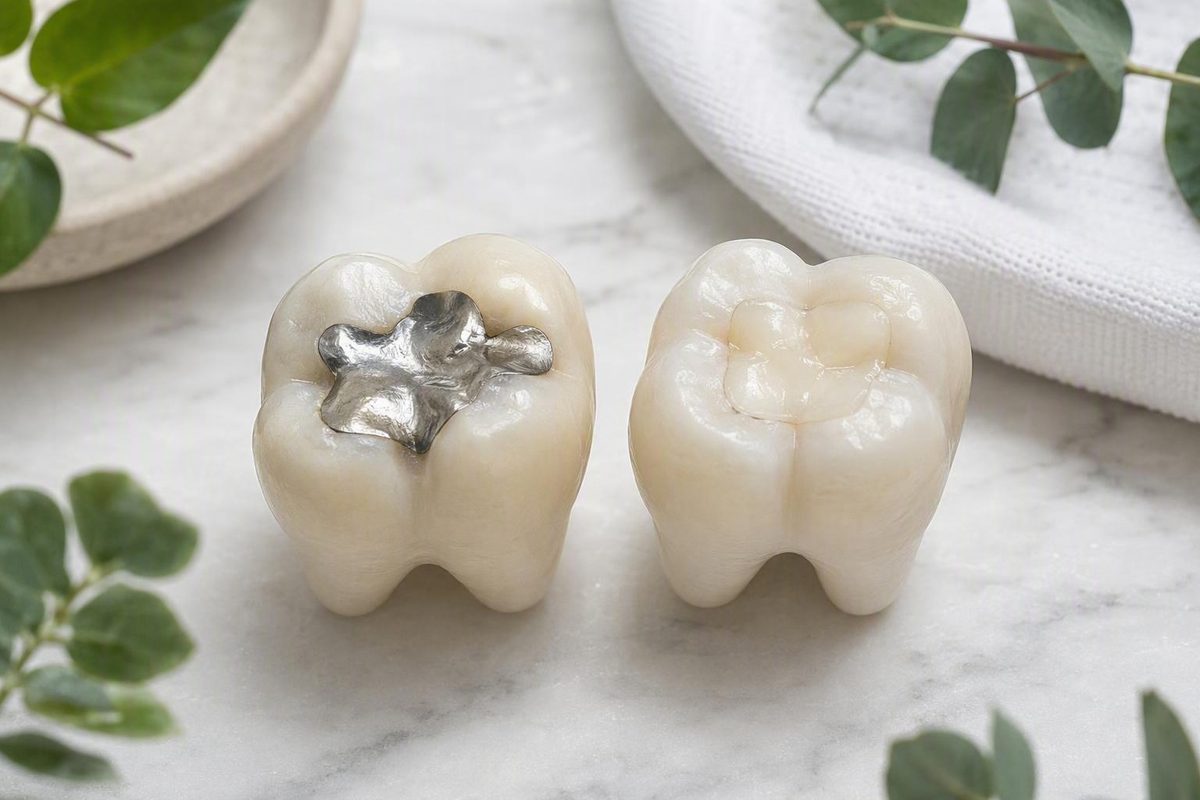
A silver filling usually means dental amalgam, a metallic restorative material. A white filling usually means tooth-colored composite resin, although not every tooth-colored restoration is composite. Glass ionomer, ceramic inlays and onlays, and crowns are separate options with different properties and uses.
Amalgam is generally durable, economical, quick to place, and relatively tolerant of difficult moisture conditions. Composite can be matched to the tooth and bonded adhesively, but placement depends more heavily on reliable isolation and careful bonding, curing, shaping, and polishing. Material choice can also be affected by cavity size, tooth location, required strength, appearance, cost, insurance, and personal health considerations (medical overview of filling materials).
| Consideration | Silver amalgam | White composite |
|---|---|---|
| Appearance | Metallic and conspicuous; may make the restored area look darker | Shade-matched and usually less conspicuous |
| Composition | Elemental mercury combined with a powdered metal alloy | Resin reinforced with glass, quartz, ceramic, or similar particles |
| Retention | Primarily held by the shape of the prepared cavity | Bonded to conditioned tooth structure with an adhesive system |
| Moisture during placement | Relatively tolerant of difficult moisture conditions | More vulnerable to contamination during bonding |
| Placement time | Generally quicker to place | Commonly takes longer because of bonding, curing, shaping, and polishing |
| Initial cost | Commonly less expensive where available | Commonly more expensive, although fees vary |
| Load-bearing use | Can offer practical advantages in some large or heavily loaded restorations | Used in back teeth, but restoration size, isolation, curing, and remaining tooth structure are especially important |
| Safety considerations | Releases low levels of mercury vapor; current guidance includes precautions for potentially susceptible groups | Avoids amalgam mercury but may still be unsuitable for someone sensitive to its components |
| Main appeal | Durability, economy, speed, and moisture tolerance | Appearance and adhesive bonding |
The balance changes with the tooth. A small cavity in a visible front tooth is not the same problem as a large restoration in a molar. Even two molars may need different approaches if one can be isolated easily while the other extends beneath the gumline.
Bite force, grinding or clenching, cavity access, health status, material sensitivities, local availability, cost, and insurance benefits may all change the realistic options.
Decay Guide publishes general reference information. It is not a dental practice and cannot diagnose, treat, or choose a restoration for an individual tooth. Its scope is explained on the About Decay Guide page.
What silver amalgam and white composite are made from
“Silver filling” is an imprecise name. Dental amalgam is not pure silver. Approximately half of it by weight is elemental mercury, while the remainder is mainly a powdered alloy containing silver, tin, and copper. The mercury reacts with the other metals and binds them into a solid restorative material. Elemental mercury in amalgam is also not the same chemical form as methylmercury associated with some food exposures (comparison of amalgam and composite composition).
Amalgam does not normally depend on an adhesive bond. The dentist removes decay, prepares the damaged area, places the mixed material, and shapes it before it hardens. The prepared cavity’s form mechanically retains the restoration.
Composite is a resin-based material reinforced with inorganic particles such as glass, quartz, or ceramic. Different products use different resin systems and filler combinations, but they can be selected or blended to approximate the color of the surrounding tooth.
At a high level, direct composite placement usually involves:
- Removing decay and preparing the damaged area.
- Isolating the tooth from saliva, blood, and other moisture.
- Conditioning the tooth as required by the adhesive system.
- Applying the bonding components.
- Placing the composite, commonly in separate increments.
- Curing the material with a dental light.
- Shaping and polishing the restoration and adjusting the bite.
Product instructions and clinical techniques vary, but composite depends on an adhesive interface. Incremental placement and light curing also help explain why composite commonly takes longer to place than amalgam (description of composite placement).
Amalgam’s relative moisture tolerance can matter when a cavity extends close to or beneath the gumline, when fluid or gum tissue interferes with access, or when a patient cannot tolerate a lengthy procedure. “More moisture tolerant” does not mean it can be placed carelessly; all restorative materials require appropriate preparation and handling.
Composition alone does not determine longevity. A composite placed well in a suitable cavity may serve effectively, while a poorly designed or poorly placed restoration of either type can fail. Conversely, the fact that amalgam is metallic does not automatically make it appropriate for every heavily loaded tooth.
The restoration is a combination of material, cavity design, remaining tooth, bite, isolation, placement technique, and future decay risk. Choosing by color alone ignores most of those variables.
Appearance, bonding and preservation of healthy tooth structure
Composite’s clearest advantage is appearance. It can be shade-matched and sculpted to make the restoration less conspicuous. That often matters for front teeth, teeth visible during speech or smiling, and patients who do not want a metallic restoration.
Amalgam remains visibly metallic. Depending on its size and position, it may also make the restored area appear gray or dark. That appearance does not, by itself, prove that either the filling or the surrounding tooth is diseased.
The more complicated question is whether composite preserves more natural tooth.
Because composite bonds to tooth structure, it may allow a more conservative preparation in some circumstances. The dentist may not need to create the same mechanically retentive shape that an amalgam restoration would require. However, this is a possible advantage rather than a universal result (comparison of preparation requirements).
The amount of tooth removed depends first on what is already wrong:
- How far the decay extends
- Whether enamel is damaged or unsupported
- Whether cracks, fractures, or old restorative material are present
- How the dentist can gain safe access
- The final restoration’s size and shape
- Whether the margins can be seen, cleaned, isolated, and sealed
- Whether an existing restoration is being repaired, partly replaced, or completely removed
A small, accessible cavity may lend itself to a conservative bonded restoration. A large cavity with weakened walls may require substantial preparation regardless of whether the final material is white or silver.
Adhesive bonding is useful, but it does not erase the effects of decay, cracks, lost tissue, or heavy loading.
The condition of the remaining tooth is often more important than the proposed filling’s color. A dentist may need to assess whether the remaining walls are supported, whether a cusp has been undermined, whether enough accessible tooth is available for a predictable bond, and where chewing forces will fall.
If substantial structure has been lost, the decision may no longer be amalgam versus composite. A dentist might instead discuss a ceramic inlay, onlay, crown, or another restorative approach. These are not oversized versions of a direct white filling: they are made and placed differently and involve distinct preparation, cost, and repair considerations.
A restoration that matches perfectly but cannot be placed predictably is not automatically the conservative choice. Conversely, a visible metallic restoration may be unacceptable to someone even when it is mechanically workable. Appearance is a legitimate priority, but it must be considered alongside the condition of the tooth.
Durability and longevity without false promises
Amalgam has a long history of use and generally performs well under substantial chewing forces. It can offer practical advantages for some large or load-bearing restorations, particularly when moisture control is difficult or placement time matters.
Composite is also used in molars. Its performance is especially dependent on restoration size and design, remaining tooth structure, reliable isolation, adaptation, bonding, and curing. A small composite in a well-isolated molar is a different restoration from one replacing several heavily loaded surfaces.
This is why fixed lifespan claims are misleading. Statements such as “white fillings last five years” or “silver fillings last 15 years” combine unlike cavities, teeth, techniques, and patients into a single estimate. They cannot predict what will happen in one particular tooth.
The survival of either material can be influenced by:
- Tooth location: Front teeth and molars face different functional demands.
- Restoration size: Larger restorations leave less natural tooth to distribute load.
- Remaining structure: Thin, cracked, undermined, or unsupported areas can change the prognosis.
- Chewing load: Force varies among patients and across the mouth.
- Grinding or clenching: Repeated non-chewing loads may stress both the restoration and the tooth.
- Isolation and placement: Composite is particularly dependent on moisture control, adhesive technique, adaptation, and curing.
- Cavity shape and access: Difficult margins may be harder to restore and maintain.
- Diet and oral hygiene: New decay can develop at the margin of either material.
- Follow-up care: Bite problems, damaged margins, or new decay may be easier to address when identified early.
- Material and operator factors: Product choice cannot compensate for an unsuitable design or poor placement.
Broad longevity figures can help researchers identify patterns, but they should not become a countdown for an individual filling. A study or database may combine different tooth positions, cavity sizes, materials, patient risks, clinicians, and definitions of failure.
Comparisons describing amalgam as durable and composite as more dependent on location and placement should therefore be read as general tendencies, not guarantees for every molar or every cavity (insurer overview of durability and placement differences).
The useful question is:
How is each feasible restoration expected to perform in this specific tooth, given the cavity size, remaining structure, isolation, bite, grinding risk, and likelihood of future decay?
A dentist can still give a reasoned prognosis, but it should be a prognosis for the proposed restoration—not a guaranteed expiry date based on its color.
Mercury safety: what the evidence says and where precautions remain
Dental amalgam contains elemental mercury and can release low levels of mercury vapor during placement, removal, and chewing. Exposure is therefore real, but exposure alone does not establish disease without considering dose, available evidence, and differences among patients.
The FDA states that available evidence has not demonstrated adverse health effects from dental-amalgam mercury exposure in the general population. That is more precise than saying amalgam is completely safe or risk-free for everyone, because current guidance retains precautions and uncertainty for potentially susceptible groups (FDA guidance on dental amalgam).
Groups identified as potentially more susceptible include:
- Women who are pregnant or nursing
- Women planning pregnancy
- Young children
- People with pre-existing neurological disease
- People with impaired kidney function
- People with heightened sensitivity or allergy to mercury or another amalgam component
For these groups, a suitable non-amalgam material should be considered when possible and appropriate for the tooth. People with a known allergy or sensitivity to mercury, silver, copper, tin, or another amalgam component should not receive amalgam.
“Suitable” is an important qualification. A non-amalgam material must still be appropriate for the tooth’s structure, location, and placement conditions. The person must also not have a relevant sensitivity to its components. Alternatives may include composite resin, glass ionomer, or an indirect restoration, depending on the clinical findings.
Long-term evidence is limited for some potentially susceptible populations, including very young children and pregnancy-related groups. That uncertainty supports individual assessment; it does not prove that amalgam has caused harm in every member of those groups.
It is also important to distinguish elemental mercury from methylmercury. Dental amalgam uses elemental mercury to bind other metals into a restorative material. Methylmercury, commonly discussed in connection with food, is a different chemical form with different exposure pathways.
Available general-population evidence does not establish that amalgam causes autism, Alzheimer’s disease, multiple sclerosis, or a broad category of systemic illness. Equally, a population-level conclusion should not be rewritten as a guarantee for every person under every circumstance.
A responsible safety discussion has three parts:
- Acknowledge the exposure: Amalgam contains mercury and releases low levels of vapor.
- Describe the evidence accurately: Adverse health effects have not been demonstrated in the general population.
- Respect current precautions: Potentially susceptible groups and people with relevant allergies should discuss suitable alternatives.
Someone concerned about pregnancy, kidney function, neurological disease, or a material allergy should discuss those factors with a dentist and, where relevant, another qualified clinician familiar with the condition.
A new filling and an existing silver filling are different decisions
Choosing material for a new cavity is not the same as deciding whether to remove an existing amalgam restoration.
For a new filling, the dentist and patient can compare currently feasible materials before one is placed. They can consider appearance, isolation, cavity size, remaining structure, health concerns, expected performance, and cost.
An existing filling creates a different starting point. The tooth has already been prepared, natural structure has already been lost, and removing the restoration generally requires sacrificing some additional tooth. The condition of the restoration and surrounding tooth—not its color alone—should guide the assessment.
The FDA does not recommend removing an intact, clinically sound amalgam filling solely to prevent disease. Removal temporarily increases mercury-vapor exposure and generally removes additional healthy tooth structure. NIDCR gives the same basic guidance on retaining intact amalgam restorations.
Neither mercury content nor metallic color proves that a restoration has failed.
Professional assessment is appropriate when there is:
- New, persistent, or worsening pain
- Sensitivity that does not settle or is becoming more severe
- Pain on biting or when releasing the bite
- A visible or suspected fracture
- A loose or missing part of the filling
- Repeated food trapping around the restoration
- Suspected new decay
- A bite that feels newly uneven
- Swelling or another sign of an acute dental problem
These findings have several possible causes.
If replacement is clinically necessary, composite is not automatically the only alternative. The appropriate restoration may be composite, another direct material, a ceramic inlay or onlay, a crown, or another option based on what remains after the old filling and any damaged tissue are removed.
If a dentist proposes limited repair rather than complete replacement, ask what defect would be addressed and why that approach is considered feasible. Whether repair is appropriate is a tooth-specific clinical judgment, not a general rule.
Cosmetic replacement is a separate preference. Someone may reasonably dislike the appearance of silver fillings, but the decision should account for the biological cost of removal, the size of the resulting cavity, the predictability of the replacement, and the possibility that an indirect restoration may become necessary.
Cost, insurance and environmental trade-offs
Composite commonly costs more than amalgam and generally takes longer to place. However, there is no responsible universal price, percentage, or multiplier.
Fees can vary with:
- The tooth being treated
- The number of surfaces involved
- The cavity’s size and depth
- Access and procedural complexity
- Whether an old restoration must be removed
- The dentist and practice setting
- Geographic location
- Whether the restoration is direct or laboratory-made
- Any additional treatment required
Insurance introduces separate rules. A plan may cover composite under its usual benefit structure, restrict coverage according to tooth location, or reimburse a posterior composite only up to its amalgam allowance. Coverage varies, so the specific policy and treatment estimate must be checked rather than inferred from general descriptions (discussion of filling costs and plan rules).
Before treatment, ask the dental office and insurer for:
- The procedure code
- The dentist’s total fee
- The plan’s allowed amount
- Any remaining deductible
- The coinsurance percentage
- Any material or tooth-location restriction
- Whether reimbursement is capped at an amalgam allowance
- The estimated out-of-pocket amount
- Whether the estimate remains subject to claim review
Confirm what is actually being priced. A direct composite filling, glass-ionomer restoration, ceramic inlay, ceramic onlay, and crown are not interchangeable versions of a “white filling.” Their fees, preparation, appointment requirements, and insurance categories can differ.
Cost is not limited to the initial bill. A lower initial fee may be a priority, while someone who strongly values appearance may accept a higher fee for composite. For a structurally compromised tooth, the relevant comparison may be between a direct filling and an indirect restoration—not simply between silver and white materials.
Environmental concerns should be separated from personal health conclusions. Mercury-containing dental waste requires controls to reduce its entry into wastewater and solid-waste streams, and dental offices use amalgam separators to capture this material. Environmental policies can therefore support reducing amalgam use without proving that an intact restoration is harming the person who has it (NIDCR explanation of amalgam waste controls).
Local availability may also change. Patients should ask which materials are genuinely available rather than assuming every dentist offers both.
Scenario guide: when each option may have practical advantages
These scenarios are discussion frameworks, not treatment recommendations. A real tooth may combine several of them.
Small cavity in a visible tooth
Composite may be favored because it can be matched to the surrounding enamel and bonded to the tooth. For a limited, accessible cavity that can be kept dry, its cosmetic and adhesive advantages may fit the problem well.
Not every front-tooth restoration is a routine composite filling. Damage near the biting edge, an existing fracture, the depth of decay, bite contact, and the available enamel can alter the plan.
Larger restoration in a load-bearing molar
Amalgam may have practical advantages when chewing load, placement speed, and tolerance of imperfect isolation matter more than appearance. It has traditionally been used for some large restorations exposed to substantial force.
That does not mean every molar should receive amalgam. Composite may be suitable for many back teeth, while a severely compromised molar may need an indirect restoration rather than either direct material.
A cavity that is difficult to keep dry
Bonded composite is harder to place predictably if saliva, blood, or other fluid repeatedly contaminates the working area. Isolation methods may help, but not every site can be controlled equally well.
Amalgam’s relative moisture tolerance can matter in this setting. Another material or restorative design may also be considered, depending on the margin location and the reason isolation is difficult.
Heavy biting forces, clenching, or suspected grinding
Color alone provides little guidance. The dentist should consider the restoration’s size, the remaining walls and cusps, where the tooth contacts its opposite, the direction of force, and whether cracks are present.
Neither amalgam nor composite should be guaranteed to withstand uncontrolled grinding indefinitely. Where clinically appropriate, the wider plan may include bite assessment or discussion of a protective appliance.
A person in a potentially susceptible group
When a new restoration is needed for someone who is pregnant or nursing, planning pregnancy, very young, living with neurological disease or impaired kidney function, or sensitive to an amalgam component, a suitable non-amalgam option may be considered where possible.
“Avoid amalgam when possible” does not mean every white material will work in every cavity. The alternative still needs to suit the tooth.
An intact existing amalgam restoration
Monitoring an intact restoration is different from selecting material for a new cavity. Automatic replacement solely because the filling is metallic or contains mercury is not recommended.
A dentist can assess the margins, surrounding tooth, bite, symptoms, radiographic findings when indicated, and evidence of fracture or new decay. If replacement is proposed, ask which clinical defect has been found.
A tooth with little healthy structure remaining
The choice may extend beyond direct amalgam and composite:
- Glass ionomer: A tooth-colored material distinct from composite. It has particular applications but is not described by NIDCR as suitable for large cavities.
- Ceramic inlay: An indirect restoration fitted within a prepared area.
- Ceramic onlay: An indirect restoration that may cover one or more weakened parts of the chewing surface.
- Crown: A restoration covering more of the tooth when the clinical findings warrant that approach.
These options differ in preparation, bonding or cementation, appointment requirements, repairability, appearance, and cost. A very large direct composite is not automatically conservative merely because it is tooth-colored.
A patient whose main priority is appearance
Composite often has the advantage, especially in visible areas. It remains reasonable to ask whether isolation is dependable, how extensive the restoration will be, and what prognosis the dentist expects.
A patient whose main priority is initial cost
Amalgam may be less expensive where it is offered and clinically appropriate. Insurance can also change the out-of-pocket difference. Written estimates should compare the actual proposed procedures rather than generic prices for “silver” and “white” fillings.
The same patient may reasonably receive composite in one tooth, amalgam in another, and an indirect restoration in a third. Material choice follows the problem rather than a universal preference.
Questions to ask before agreeing to a filling
A productive conversation begins with the condition of the tooth rather than a preferred color.
About the damage
- How large and deep is the cavity or damaged area?
- Which surfaces are involved?
- Is there a crack, fracture, old filling, or unsupported tooth structure?
- How much healthy tooth is expected to remain after preparation?
- Could the treatment plan change once the damaged area is fully visible?
About placement conditions
- Can the tooth be kept reliably dry throughout bonding?
- Does the cavity extend close to or beneath the gumline?
- Will access or moisture make composite placement less predictable?
- How long is the procedure expected to take?
About material choice
- Why does the recommended material suit this tooth’s location, restoration size, and bite forces?
- What are its main disadvantages in this case?
- Is the proposal for direct amalgam, direct composite, glass ionomer, or something else?
- If it is tooth-colored, is it composite or an indirect ceramic restoration?
- Would an inlay, onlay, or crown be considered, and why?
- Is amalgam available in this practice?
About health and function
- Does known or suspected grinding change the prognosis?
- Do clenching, bite pattern, or heavy chewing forces alter the design?
- Do pregnancy, plans for pregnancy, nursing, kidney impairment, neurological disease, or material sensitivities change the options?
- Have I previously reacted to any component of either proposed material?
About prognosis
- What is the expected prognosis for this restoration in this tooth?
- Which factors make that prognosis better or worse?
- What is most likely to prompt reassessment: wear, fracture, loss of seal, new decay, or damage to the remaining tooth?
- What symptoms should lead to a return visit?
- If a limited defect develops, would assessment for repair be reasonable before complete replacement?
- How will the bite be checked and adjusted?
Ask for a tooth-specific explanation rather than a generic claim that one material lasts longer. No fixed service-life promise can account for restoration size, isolation, placement quality, grinding, oral hygiene, diet, and future decay.
About cost and insurance
- What is the full fee?
- Which procedure code will be submitted?
- What is the plan’s allowed amount?
- How much deductible and coinsurance will apply?
- Does the policy restrict composite by tooth location?
- Is reimbursement capped at an amalgam allowance?
- What is the estimated out-of-pocket total in writing?
- How could the fee change if the treatment plan changes?
If an existing amalgam is being replaced
- What clinical defect requires treatment?
- Is there decay, a fracture, an open margin, or another specific finding?
- Is the concern functional, biological, or purely cosmetic?
- Could monitoring or limited repair be considered?
- How much additional tooth structure may be lost during removal?
- Will enough tooth remain for a direct filling?
- If not, which indirect alternatives may need to be considered?
The conditional answer to silver fillings vs white fillings is that composite often makes sense when appearance and adhesive bonding are priorities and the tooth can be isolated effectively. Amalgam can retain practical advantages for some large, heavily loaded, or moisture-compromised restorations when it is otherwise appropriate and available.
An intact existing amalgam filling is a separate decision. Ask the dentist to explain the cavity size, remaining tooth structure, moisture control, bite forces, health considerations, alternatives, prognosis, and full cost for that specific tooth.
Frequently asked questions
Are white fillings safer than silver fillings?
Not categorically. Composite avoids amalgam mercury, but that fact alone does not establish that it is universally safer or suitable for every cavity. Available evidence has not demonstrated adverse health effects from amalgam exposure in the general population, while current guidance retains precautions for potentially susceptible groups.
Material sensitivities also matter. Safety and suitability depend on the patient, the material’s components, the tooth, and the placement conditions (overview of material and safety differences).
Which filling is usually better for a back molar?
There is no single answer for every molar. Amalgam may have practical advantages for some large, heavily loaded, or difficult-to-isolate cavities. Composite may be suitable when the restoration’s size and remaining structure are favorable and the tooth can be kept reliably dry.
For a badly compromised molar, a dentist may discuss an inlay, onlay, crown, or another approach instead of an oversized direct filling.
Should old silver fillings be removed because they contain mercury?
Not if mercury content is the only reason. The FDA advises against removing an intact, clinically sound amalgam filling solely to prevent disease because removal temporarily increases mercury-vapor exposure and sacrifices additional tooth structure (FDA advice on existing amalgam fillings).
Replacement may be considered after examination identifies decay, fracture, loss of restoration, or another clinical problem. An informed cosmetic decision is also possible, but color alone does not demonstrate failure.
Do white composite fillings always require less drilling?
No. Adhesive bonding may permit a more conservative preparation in some situations, but the amount removed depends first on decay, cracks, unsupported tissue, access, any existing restoration, and the final restorative design.
Replacing a large filling may require substantial preparation regardless of the new material. A tooth-colored restoration is not automatically the least invasive option.
Does dental insurance pay for white fillings?
Some plans cover composite, but benefit rules vary. A policy may restrict coverage by tooth location or reimburse only up to the allowance for an amalgam filling, leaving the patient responsible for the difference as well as any deductible or coinsurance.
Before treatment, obtain the procedure code, total fee, plan allowance, applicable restrictions, and a written estimate of the out-of-pocket cost.
Decay Guide provides general information, not an individual diagnosis or treatment recommendation. Only a qualified dentist who has examined the tooth can determine which restorative options are clinically appropriate.