
Choosing a Filling Based on the Tooth, Not a Universal Winner
Amalgam may retain an advantage in some large multisurface back-tooth fillings, high-caries-risk cases, or sites where moisture makes bonding difficult.
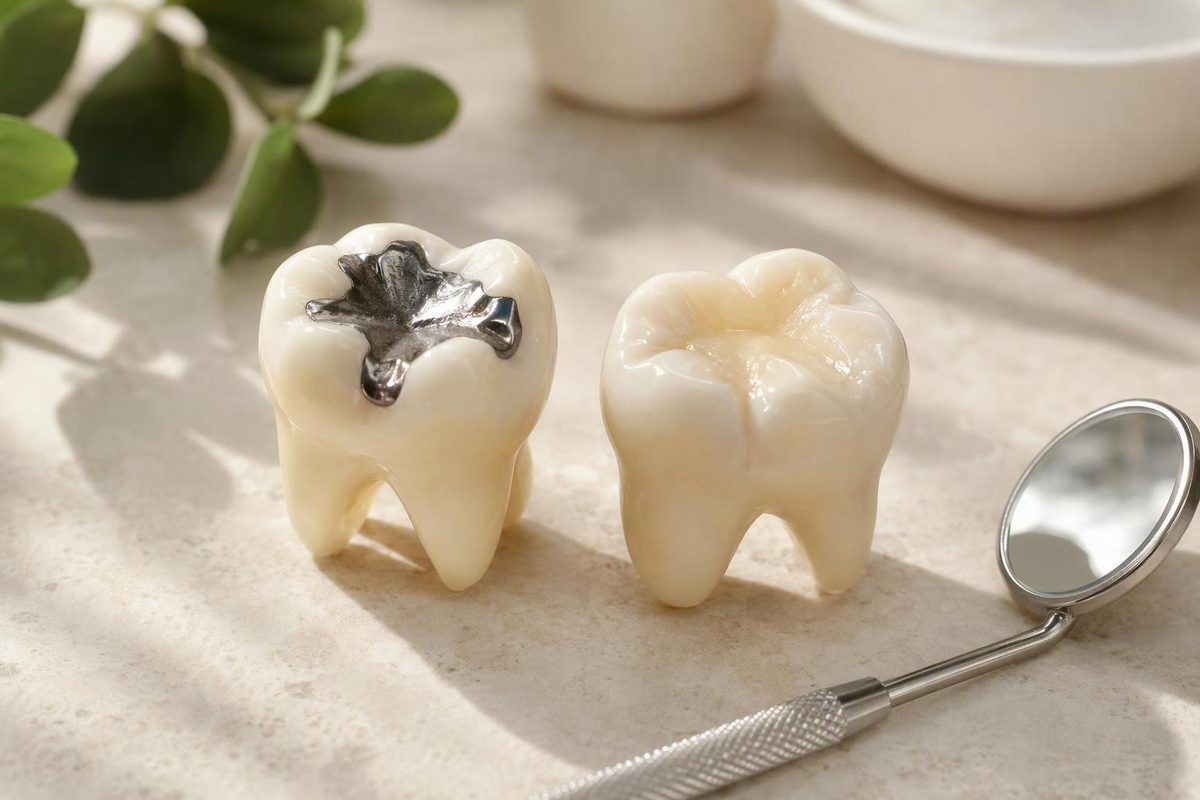
The short answer: the better filling depends on the case
Neither composite nor amalgam is the best filling material in every situation.
Composite usually has the clearest advantage when appearance matters. It can be matched to the surrounding tooth, making it an appealing option for front teeth and other visible areas. Because it is placed with an adhesive system, composite may also allow a dentist to preserve more sound tooth structure in some cases.
Amalgam retains practical advantages. It is generally less expensive, is relatively tolerant of difficult moisture conditions, and has historically performed well in large or heavily loaded back-tooth restorations. Comparative assessments have often favored amalgam for longevity and initial cost, although the result depends on the restoration and patient being studied. The ADA’s filling-material considerations include longevity, appearance, placement conditions, sensitivity, and cost rather than identifying one universal winner.
The main variables are:
- The size and shape of the cavity
- Whether one or several tooth surfaces must be restored
- The tooth’s position in the mouth
- The chewing forces expected at that tooth
- The patient’s risk of developing further decay
- Whether the site can be kept reliably dry
- The amount and condition of the remaining tooth
- The desired appearance
- Initial cost and possible future treatment burden
- Relevant health history or material sensitivity
- The patient’s priorities and preferences
These factors interact. A small, visible cavity that can be isolated easily creates a very different decision from a large, three-surface cavity in a back tooth that is difficult to keep dry. A material that looks preferable in a broad comparison may be less suitable once the dentist examines the actual tooth.
The evidence also needs context. Older and newer composite formulations do not necessarily perform alike, and studies differ in restoration size, patient risk, clinician technique, follow-up period, and clinical setting. Results for a one-surface filling cannot automatically be applied to a large multisurface restoration.
Shared decision-making is therefore the appropriate approach. The dentist evaluates the tooth and explains which options are clinically suitable; the patient weighs appearance, cost, health concerns, and willingness to accept the trade-offs.
Decay Guide is an independent information publisher, not a dental practice. Its editorial approach and limitations make clear that the site publishes general reference information and does not diagnose teeth, treat patients, or recommend individual care.
What composite and amalgam fillings are
Dental amalgam is a metallic restorative material. It is approximately 50% elemental mercury by weight; the remainder is principally a powdered alloy of silver, tin, and copper. The mercury reacts with the alloy particles to produce a workable material that hardens after placement. The resulting restoration has a silver or dark metallic appearance. The FDA describes how amalgam is mixed, placed, shaped, and allowed to harden in the prepared tooth (FDA dental amalgam information).
Composite resin is a tooth-colored material made from a resin matrix combined with glass, quartz, silica, or similar filler particles. Formulations differ in resin chemistry, filler size, handling, wear behavior, and intended use. Composite is typically hardened with a dental curing light during placement (Cleveland Clinic overview of dental fillings).
The two materials are also retained differently.
For an amalgam filling, the dentist removes decayed or damaged tissue and prepares the cavity so the set material can remain mechanically secure. The mixed amalgam is placed into the preparation, condensed and shaped, and then allowed to harden. Because conventional amalgam does not directly bond to enamel and dentin in the way an adhesive composite does, the preparation may need features that provide mechanical retention.
Composite placement uses an adhesive system. After preparing the tooth, the dentist conditions it as required by the selected bonding protocol, applies the adhesive, and places the composite. The material is commonly added in controlled increments, with each increment hardened using a curing light. The restoration is then shaped, adjusted to the patient’s bite, finished, and polished.
Adhesive placement can permit a more conservative preparation because the dentist may not need to create the same mechanical-retention form. That does not mean composite always requires less drilling.
Composite is generally more technique-sensitive. Successful bonding depends on controlling saliva and blood, following the adhesive protocol, placing and curing the material adequately, and producing appropriate contacts, contours, and margins. Amalgam is comparatively tolerant of moisture-related placement difficulties, although contamination and poor technique can still compromise the result.
Side-by-side comparison: appearance, durability, cost, and placement
The table below summarizes broad tendencies reported in comparative literature. It does not predict the outcome in a particular tooth, and the underlying evidence includes studies of different materials, patients, restoration sizes, and clinical settings (2021 critical review).
| Consideration | Composite resin | Dental amalgam |
|---|---|---|
| Color | Tooth-colored and shade-matched | Silver or dark metallic |
| Retention | Uses an adhesive bonding system | Generally relies on mechanical retention |
| Tooth preparation | May permit a more conservative preparation in suitable cases | May require a cavity form that mechanically retains the material |
| Moisture sensitivity | Reliable isolation is important for bonding | Relatively tolerant of difficult moisture conditions |
| Placement | Technique-sensitive; commonly placed and cured incrementally | Placed, condensed, shaped, and allowed to harden |
| Initial cost | Generally higher | Generally lower |
| Historical longevity | Can perform well in selected cases but has shown a disadvantage in some large posterior restorations | Comparative evidence has often favored amalgam, particularly in some demanding posterior restorations |
| Visible teeth | Usually offers the clear aesthetic advantage | Metallic appearance is often undesirable in visible areas |
| Large, loaded back-tooth fillings | Suitability depends on remaining tooth, isolation, restoration design, and patient risk | May retain a durability or practicality advantage in some cases |
| Mercury | Does not contain mercury, although it has its own resin and filler components | Contains approximately 50% elemental mercury by weight |
Composite’s principal advantages are its natural appearance, adhesive placement, and potential to avoid removing tooth merely to create mechanical retention. It can be used in front and back teeth when the restoration and placement conditions are suitable.
Its limitations include greater dependence on moisture control and correct technique, generally higher initial cost, and a possible durability disadvantage in some large, multisurface, heavily loaded posterior restorations. Placement also involves several steps that can affect the result, including bonding, incremental placement, light curing, contouring, and finishing.
Amalgam’s principal advantages are durability, wear resistance, lower initial cost, relative moisture tolerance, and a long record of use in demanding back-tooth restorations. Its limitations include metallic appearance, lack of direct adhesive bonding, mercury content, and the possible need to shape the preparation for mechanical retention.
Laboratory measurements should not be converted into promises about clinical performance. A higher compressive-strength result does not prove that every restoration made from that material will last longer. Likewise, composite polymerization shrinkage can contribute to marginal problems if it is not properly managed, but a laboratory shrinkage figure cannot forecast when an individual filling will fail.
Initial price is also not the same as lifetime cost. A less expensive filling that later requires more treatment may create additional expense, while a more expensive filling does not necessarily last longer in every tooth. Those questions cannot be reduced to a universal price or replacement schedule.
Which lasts longer—and why lifespan figures conflict
Amalgam has generally shown greater longevity and lower cost in comparative assessments, particularly for some posterior restorations. That is a broad historical finding, not a guarantee for an individual filling or a complete assessment of every current composite system.
A Canadian health technology assessment summarized a 2014 systematic review that pooled two studies involving 3,010 restorations. Composite had higher risks of restoration failure and secondary caries than amalgam in that analysis. The assessment also identified a later randomized trial involving only 40 restorations that found no difference, but the trial was too small to support broad conclusions. CADTH concluded that amalgam generally lasted longer and cost less while emphasizing the limited comparative evidence and the importance of shared decision-making (CADTH assessment).
A 2021 critical review illustrates why the answer remains qualified. Some studies discussed in the review reported comparable annual failure or survival rates, while others favored amalgam. In one cited randomized trial that followed 1,748 restorations for up to seven years, reported survival was 94.4% for amalgam and 85.5% for composite. Secondary caries was the leading reason for failure in both groups.
The same review described a retrospective dataset of 1,949 large Class II restorations in which composite survival was better overall and among low-risk patients. Amalgam performed better, however, for three-surface restorations in patients at high risk of caries. Together, these studies show how restoration size and patient risk can change the apparent winner (review of the 1,748- and 1,949-restoration findings).
The seven-year trial does not establish a fixed nine-percentage-point advantage for amalgam. Its findings reflect the materials, operators, patients, restoration designs, and treatment period involved. Current composite systems, adhesive protocols, clinical selection, and operator experience may differ.
Published lifespan figures conflict for several reasons:
- Restoration size: A small one-surface filling does not face the same structural demands as a large replacement involving several surfaces.
- Number of surfaces: Multisurface restorations have more margins and may replace a greater proportion of the tooth.
- Tooth position: Back teeth experience different chewing loads and access challenges from front teeth.
- Caries risk: A person who continues to develop new decay presents a different failure environment from someone whose disease is well controlled.
- Follow-up length: Materials can appear similar over a short period but diverge during longer observation.
- Material generation: “Composite” includes different resin systems, fillers, adhesives, and curing protocols.
- Operator technique: Isolation, bonding, curing, contact formation, contouring, and bite adjustment can affect the result.
- Clinical setting: Results from controlled trials, dental schools, public programs, and private practices may not transfer perfectly between settings.
- Definition of failure: One study may count a localized, potentially manageable defect as a failure, while another may count only complete replacement or tooth loss.
Secondary caries—new decay at or near a restoration margin—is a major failure mechanism for both materials. It is not solely a material property.
Service-life ranges are therefore best treated as context rather than promises. Conversely, amalgam may remain serviceable under conditions in which composite bonding is difficult or a large posterior restoration is highly demanding.
A scenario-based guide to the trade-offs
The following scenarios illustrate likely advantages and useful discussion points. They are not individual treatment recommendations.
A visible front tooth
Composite usually has the obvious advantage because it can be matched to the tooth. Color, translucency, surface texture, and the way the restoration meets the surrounding enamel can all matter in a visible area. Amalgam’s metallic appearance generally makes it less desirable where the filling will show.
Appearance is not the only consideration. The dentist still needs to determine whether a direct composite restoration can provide a suitable shape and margin for the particular defect.
A small or medium restoration that can be kept dry
Composite may offer a favorable combination of natural appearance, adhesive placement, and acceptable performance. Reliable isolation allows the clinician to carry out the bonding and curing steps with less risk of contamination.
This is also the type of situation in which adhesive placement may avoid removing sound tooth merely to create undercuts. How much tissue can actually be preserved depends on the extent of decay and existing damage.
A large, multisurface posterior restoration
Amalgam may retain a longevity or practicality advantage when a back-tooth restoration replaces several surfaces and must tolerate substantial chewing force. The advantage is not absolute, and composite can perform well in selected posterior cases, but comparative evidence has not eliminated the importance of restoration size and patient risk.
The remaining tooth matters as much as the filling material. Before comparing composite with amalgam, the dentist must determine whether any direct filling is appropriate. If it is not, another restorative approach may need to be discussed, but that decision requires examination rather than a rule based only on cavity size.
A site that is difficult to isolate
Composite bonding can be compromised by saliva or blood contamination. A tooth near the back of the mouth, a margin close to or below the gumline, or an area where isolation is otherwise difficult may present a challenge.
Amalgam’s relative moisture tolerance may therefore matter even when composite would look better. The question is not whether moisture is desirable—it is not—but how sensitive the selected procedure is to imperfect isolation.
A patient with high caries risk
The material label is only one part of the prognosis. Restoration size, number of surfaces, margin position, plaque and dietary conditions, fluoride exposure, and whether the underlying disease process is controlled can alter the expected result.
For a small restoration in a low-risk patient, composite may perform very well. For a large three-surface posterior restoration in a high-risk patient, amalgam may have a practical or survival advantage. This shift helps explain why studies involving different patient populations can reach different conclusions.
A patient prioritizing the lowest initial cost
Amalgam is generally the less expensive option. That may matter when several teeth need treatment or when insurance coverage and personal finances constrain the choice.
The lowest initial price is not automatically the lowest long-term cost. Future treatment needs and the effects of repeated intervention also matter, but they cannot be calculated accurately without details about the tooth, the available treatment options, and local fees.
A patient strongly opposed to a metallic filling
Patient preference is a legitimate part of shared decision-making, but it operates within clinical limits. A dentist can explain whether composite is suitable, what placement conditions are required, and whether choosing it changes the expected durability or cost for that tooth.
If neither direct material fits the situation well, the discussion should not be forced into a composite-versus-amalgam choice.
Amalgam, mercury, and what the safety evidence says
Mercury exposure is the most contentious part of the composite-or-amalgam decision. It helps to separate three questions:
- Does exposure occur?
- Has that exposure been shown to cause clinical harm in most people?
- Are there groups for whom additional precaution is appropriate?
First, exposure does occur. Dental amalgam is approximately 50% elemental mercury by weight, and amalgam restorations release low levels of mercury vapor.
Second, the majority of evidence reviewed by health authorities has not shown negative health effects from amalgam in the general population. That is reassurance based on available evidence, not a claim that exposure is zero or that every possible long-term effect has been ruled out.
Third, additional precaution is advised for potentially susceptible groups. The FDA encourages the use of a suitable non-amalgam restoration where possible and clinically appropriate for:
- Pregnant people, because of potential exposure to the developing fetus
- People planning pregnancy
- People who are nursing, because of potential exposure to the nursing infant
- Children, especially those under six
- People with neurological disease
- People with impaired kidney function
- People with a known sensitivity or allergy to mercury or other amalgam components
The qualifications matter. These categories do not constitute an absolute ban. A non-amalgam material should be considered only when the dentist believes it is suitable for the tooth’s structure and location and the patient does not have a relevant allergy or sensitivity to the alternative. Long-term clinical evidence remains limited for pregnancy, developing fetuses, nursing infants, and children under six. The ADA summarizes both the general safety evidence and the FDA’s precautionary categories (ADA overview of amalgam safety and precautions).
A 2018 CADTH assessment found no clinically important overall safety difference between amalgam and composite, although few comparative clinical studies were available. In evidence involving children, those with amalgam restorations had higher urinary mercury measurements, but the measurements did not approach levels known to be toxic, and investigators reported no differences in neurological symptoms or immune function. These findings should be interpreted in light of the assessment’s date and evidence limitations (CADTH safety assessment).
The balanced conclusion is therefore neither “amalgam contains no meaningful mercury” nor “amalgam is proven to cause systemic disease.” Amalgam contains mercury and produces measurable exposure, but demonstrated clinical harm has not been found in most people. Additional precaution is appropriate for the groups identified by the FDA because uncertainty and potential susceptibility matter.
Composite should not be described as risk-free simply because it contains no mercury. It uses resin and filler components, and any restorative material may present concerns involving sensitivity, placement quality, wear, margins, or individual reaction. The comparison is between different risk-and-benefit profiles, not between a hazardous material and a completely inert one.
Existing amalgam fillings: replacement is a separate decision
Choosing a material for a new cavity is not the same as deciding whether to remove an existing amalgam filling.
The FDA does not recommend removing an intact amalgam restoration solely to prevent disease unless a healthcare professional considers removal medically necessary. Removing a sound filling sacrifices additional healthy tooth structure and temporarily increases mercury-vapor exposure during the procedure (FDA guidance on existing amalgam fillings).
That guidance also applies to people in the FDA’s potentially higher-risk groups. Belonging to one of those groups can influence the choice of material for a new restoration, but it does not automatically mean that a sound existing amalgam filling should be removed.
The existing filling must be removed, the underlying tooth assessed, and suitable margins created for the replacement. Even careful treatment may enlarge the preparation, leaving less tooth structure for future interventions.
The condition of the restoration and tooth—not mercury content alone—should guide the evaluation. Suspected fracture, possible recurrent decay, concerns about the margins, or persistent symptoms are reasons to obtain a professional assessment. They are not conditions a reader can reliably diagnose without an examination.
After examining the tooth, a dentist may discuss continued monitoring, treatment of a localized problem, complete replacement, or another restorative approach. The appropriate response depends on what the examination shows, the amount and condition of the remaining tooth, and the available clinically suitable options.
Preventive replacement of every amalgam filling with composite is not supported by the safety guidance and can create avoidable treatment. A sound, comfortable, functional restoration is a different clinical situation from one with a suspected defect or persistent symptoms.
The material is only part of the outcome
A filling does not succeed because its label says “composite” or “amalgam.” Its outcome reflects the tooth, restoration design, clinical technique, patient risk, and care over time.
For composite in particular, several steps can affect performance:
- Isolation: The bonding area needs appropriate protection from saliva and blood.
- Adhesive technique: Conditioning, priming, and bonding must follow the selected system.
- Incremental placement: The material is commonly built in controlled portions.
- Curing: The light must deliver adequate energy to the material from an appropriate position.
- Contact and contour: The restoration needs a form that supports function and allows cleaning.
- Finishing and polishing: Roughness and excess material should be corrected.
- Bite adjustment: A restoration that contacts too heavily may be uncomfortable or experience unfavorable loading.
Amalgam is less dependent on adhesive bonding and more tolerant of moisture-related difficulties, but it still requires proper preparation, condensation, shaping, contact formation, margins, and bite adjustment. Poorly executed amalgam is not rescued by the material’s historical durability.
Margin quality matters for both materials. Rough, overhanging, or poorly positioned restorative margins can create areas that are harder to clean and may irritate nearby gum tissue. A specialist dental-practice discussion identifies overhanging and subgingival margins as potential plaque-retentive areas associated with local irritation and inflammation, although it is not a substitute for a periodontal guideline or individual examination (discussion of restoration margins and gum health).
Bleeding or inflammation around a restored tooth warrants dental evaluation if it persists. It does not prove that the material is defective or that the filling must be replaced.
Before choosing a filling, useful questions include:
- How large will the restoration be?
- How many tooth surfaces are involved?
- Can the site be kept reliably dry?
- What outcome does the dentist expect in this specific tooth?
- What material-related and nonmaterial failure risks matter here?
- How does my caries risk affect the choice?
- What will each clinically suitable option cost?
- If a localized problem develops later, what treatment might be possible?
- Is a direct filling appropriate at all?
- Does my health history place me in a group for whom a non-amalgam option should be considered?
- How much does appearance matter in this location?
- What trade-off am I making if I prioritize cost, color, or historical durability?
Population-level evidence can show tendencies, but it cannot account for the exact size of an individual cavity, the quality of isolation, the condition of the remaining cusps, or the patient’s ongoing caries activity. The useful question is not whether composite or amalgam wins in the abstract. It is which trade-offs fit the tooth being restored.
Composite usually leads on appearance and adhesive placement. Amalgam may lead on initial cost, moisture tolerance, and durability in some demanding posterior cases. Safety evidence is reassuring for most people, while current precautions support considering a clinically suitable non-amalgam option for specified potentially susceptible groups. Sound existing amalgam fillings are a separate issue and generally should not be removed solely because they contain mercury.
Frequently asked questions
Is composite better than amalgam for back teeth?
Not always. Composite can perform well in back teeth, especially for small or medium restorations that can be isolated reliably. It also provides a natural appearance and uses adhesive placement.
Amalgam may retain an advantage for some large, multisurface posterior restorations, high-caries-risk situations, or sites where moisture makes resin bonding difficult. Restoration size, the number of surfaces, remaining tooth structure, chewing load, isolation conditions, cost, and patient preference are more informative than the phrase “back tooth” alone (comparison of clinical selection factors).
How long do composite and amalgam fillings last?
There is no guaranteed service life for either material. Comparative evidence has often favored amalgam for longevity, particularly in some large posterior restorations, but composite can perform well in appropriately selected cases.
Actual lifespan depends on restoration size, number of surfaces, tooth position, caries risk, chewing forces, placement quality, margins, material generation, and follow-up care. Published ranges describe groups of restorations and should not be treated as a countdown for an individual filling (clinical overview of composite and amalgam longevity).
Are amalgam fillings safe during pregnancy or for young children?
Available evidence has not demonstrated negative health effects from amalgam in most people, but long-term evidence is limited for pregnancy, developing fetuses, nursing infants, and children under six.
The FDA encourages use of a suitable non-amalgam material where possible and clinically appropriate for pregnant or nursing people, people planning pregnancy, and children—especially those under six. This is precautionary, conditional guidance rather than an absolute ban. A dentist must still determine which material is suitable for the particular tooth (Cleveland Clinic summary of higher-risk groups).
Should a sound amalgam filling be replaced because it contains mercury?
Generally, no. Health guidance does not recommend removing an intact amalgam filling solely to prevent disease. Replacement removes additional tooth structure, so the restoration and surrounding tooth should be evaluated on their clinical condition rather than mercury content alone.
Monitoring may be appropriate if the filling is sound. Further treatment may be discussed if an examination identifies a clinical problem, but preventive replacement should not be automatic.
Does composite always require less removal of healthy tooth?
No. Adhesive bonding can permit a more conservative preparation in some cases because the dentist may not need to create the same mechanical-retention form used for amalgam.
The amount removed also depends on the extent of decay, fractures, previous restorative material, access, margin quality, and the design required for a reliable restoration. Composite has the potential to preserve more sound tissue in suitable cases; it does not guarantee less drilling for every tooth (comparison of bonding and tooth preparation).