
What You Can Try for Sensitive Teeth—and When Home Care Is Not Enough
Mild, brief, trigger-based sensitivity may justify desensitizing fluoride toothpaste, gentle soft-bristled cleaning and less acid or whitening exposure.
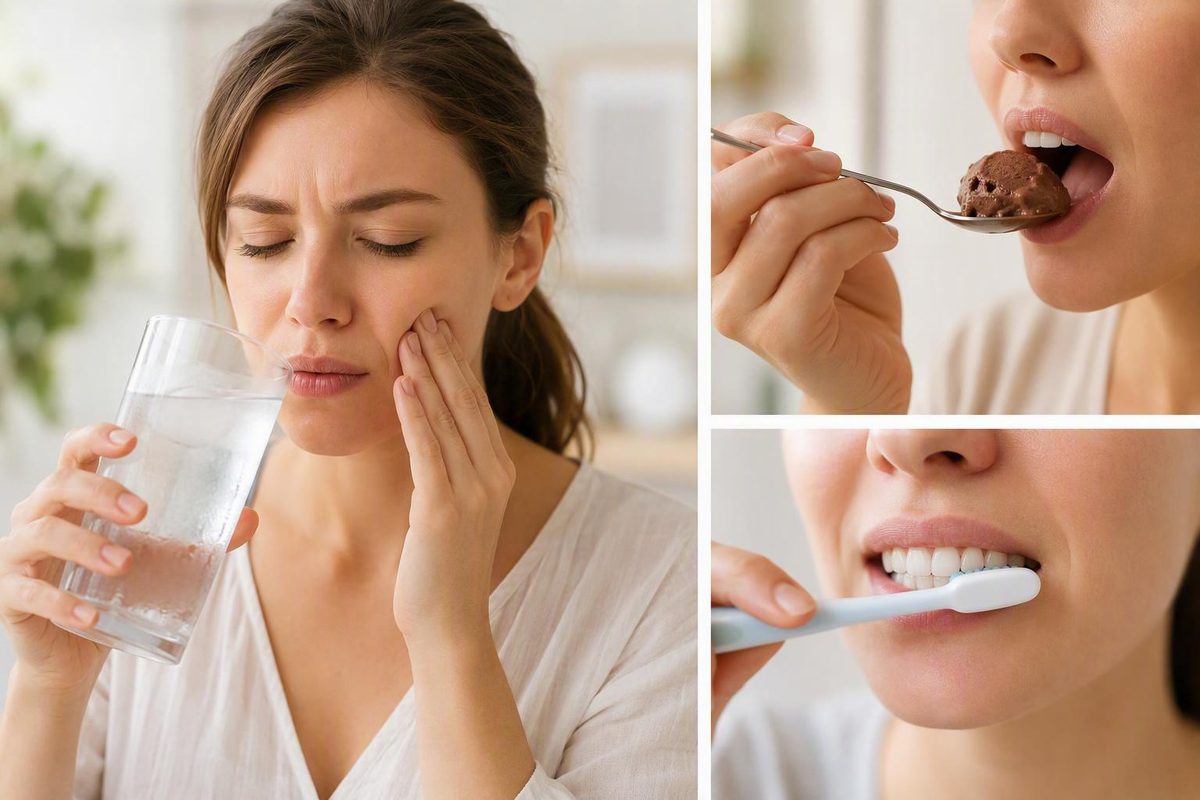
A sip of cold water, a spoonful of something sweet, or a toothbrush touching the gumline can produce a sudden jolt of tooth pain. That pattern may be compatible with dentin hypersensitivity, but “sensitive teeth” describes a symptom—not a diagnosis.
Mild, brief pain tied to an obvious trigger may justify a defined trial of conservative self-care. A practical routine combines a label-directed desensitizing fluoride toothpaste, soft bristles, gentle cleaning, and less exposure to acid, abrasion, and whitening products. It also needs a firm reassessment date.
Home care is not appropriate for every sensitive tooth. Decay, a crack, a chipped tooth, gum disease, a defective restoration, infection, or inflammation inside the tooth can cause similar symptoms. Warning signs should shorten—or eliminate—the home-care trial.
First decide whether a self-care trial is appropriate
Classic dentin hypersensitivity is defined as short, sharp pain arising from exposed dentin in response to a specific stimulus, such as temperature, air, touch, sweetness, or acidity. Formally, the term applies only when another dental defect or disease does not explain the pain. Because excluding those alternatives generally requires a dental assessment, a home routine should never be treated as a diagnostic test. A clinician-oriented review describes dentin hypersensitivity as a diagnosis reached after other causes are excluded.
Compatible triggers include:
- Cold or hot food and drink
- Sweet or acidic items
- Brushing or flossing
- Touch or pressure
- Cold air
A short self-care trial is most defensible when the discomfort is mild, brief, predictably linked to a trigger, and unaccompanied by warning signs. Even then, the goal is to reduce discomfort and avoid further aggravation—not to prove that exposed dentin is the cause.
Contact a dentist sooner if the pattern is not mild and brief
Arrange prompt dental assessment rather than continuing an extended home trial if you have:
- Severe or suddenly intense pain
- Pain that starts without an obvious trigger
- Pain that wakes you at night
- Pain that lingers after cold, heat, sweetness, or touch is removed
-
Pronounced sensitivity to heat
-
Symptoms that are becoming more frequent or intense
- Swelling or discharge
- A visible crack, chip, hole, broken filling, or other damage
These features do not establish a particular diagnosis, but they are less compatible with uncomplicated sensitivity and can occur with problems that toothpaste cannot correct. Dental guidance also recommends prompt assessment for severe or sudden sensitivity, persistent pain, biting pain, swelling, discharge, or visible damage. These warning signs are summarized in this dental sensitivity overview.
A cavity, crack, worn filling, chipped tooth, or another localized defect can produce sensitivity, although location alone does not prove any diagnosis. Cavities, cracks, chipped teeth, worn fillings, gum disease, exposed roots, and whitening products are all recognized explanations for sensitive-tooth pain. Mayo Clinic recommends dental evaluation to identify or rule out the cause.
Symptoms alone cannot reliably rule out decay, a defective restoration, gum disease, infection, or inflammation of the pulp—the living tissue inside a tooth. If you are unsure whether your symptoms fit the mild pattern, dental assessment is safer than repeatedly changing products.
Important: Decay Guide publishes general reference information. It is not a dental practice, does not diagnose or treat patients, and does not provide individualized dental advice.
Why exposed dentin can produce a sharp jolt
A tooth has several layers. Enamel forms the hard outer covering of the crown—the part normally visible above the gumline. Cementum covers the root. Beneath both lies dentin, a mineralized tissue containing microscopic channels called dentinal tubules.
When enamel is worn or eroded, or when recession exposes a root, dentin and its tubules may become accessible to the mouth. The leading explanation for the resulting pain is the hydrodynamic theory: cold, heat, air, touch, sweetness, or chemical changes cause fluid to move within open tubules. That movement stimulates a pain response. A peer-reviewed narrative review describes this fluid-movement mechanism as the most widely accepted explanation for dentin hypersensitivity.
This helps explain why the pain can feel immediate and sharp. It also explains why desensitizing treatments generally try to reduce nerve responsiveness or obstruct access to exposed tubules.
Triggers are not necessarily causes
Cold water may trigger pain, but it did not necessarily create the underlying problem. It helps to distinguish among:
- Triggers: cold, heat, sweetness, acidity, touch, brushing, flossing, pressure, or cold air
- Potential contributors to dentin exposure: enamel wear, acid erosion, gum recession, aggressive brushing, and abrasive products
- Other causes or lookalikes: decay, cracks, chipped teeth, gum disease, defective or worn restorations, and inflammation inside the tooth
Grinding or clenching may contribute to wear, fractures, or sensitivity. Whitening products may temporarily make teeth more sensitive. Sensitivity can also follow a filling, professional cleaning, whitening session, or another dental procedure. Johns Hopkins lists hard brushing, cracks, recent procedures, whitening, recession, acidic foods, grinding, and gum disease among possible contributors.
Because several problems can produce a similar sensation, symptom relief is not proof of the cause. A toothpaste might make a tooth feel better while a cavity, crack, failing filling, or recession remains present. Reduced pain does not show that an underlying lesion has healed.
Build a two-to-four-week self-care routine for mild symptoms
If the pain is mild, brief, stimulus-triggered, and free of warning signs, use a simple routine consistently rather than changing several variables at once.
The daily routine
-
Use a fluoride sensitivity toothpaste according to its label. Check the active-ingredient panel rather than relying only on front-label promises. Follow the stated amount, frequency, brushing method, rinsing instructions, and age restrictions.
-
Brush twice daily with a soft-bristled toothbrush. Use light pressure and controlled strokes. The goal is to clean the teeth and gumline, not scrub them.
-
Clean between the teeth gently each day. Use floss or another appropriate interdental cleaner without snapping it into the gums. Do not permanently avoid a painful area; note where the pain occurs and arrange assessment if it persists.
-
Reduce avoidable aggravators. Temporarily pause whitening if it appears connected to the symptoms. Reduce frequent acid exposure, and stop using a highly abrasive or whitening toothpaste if it seems to make sensitivity worse.
-
Choose a reassessment date when you start. For mild symptoms, two to four weeks of consistent use is a practical period for judging the trend—not a guaranteed time to relief and not a reason to delay care if warning signs appear.
The recommendations to brush twice daily with soft bristles and gentle strokes and to floss at least daily are consistent with institutional guidance for sensitive teeth. Mayo Clinic outlines these cleaning practices and advises using fluoride rather than abrasive toothpaste.
Desensitizing toothpaste is a relatively low-cost, noninvasive first-line option. It may reduce sensitivity, but it is not a cure and does not work equally well for everyone. A clinician-oriented review recommends beginning conservatively and reassessing persistent symptoms after approximately three or four weeks of compliant self-care.
Keep a brief symptom diary
A diary makes reassessment more useful and may help a dentist recognize the pattern if you later need an examination. Record:
- The tooth or area involved
- The trigger
- Pain intensity using the same simple scale each time
- How long the pain lasts after the trigger stops
- Whether heat causes pain
- Whether biting or releasing a bite hurts
- Whether pain occurs spontaneously or at night
- Recent whitening or dental work
- Whether symptoms are improving, stable, or worsening
You do not need to test the tooth repeatedly with ice or other painful stimuli. Record what happens during normal eating, drinking, and cleaning.
Temporary trigger avoidance may make meals and brushing more comfortable, but it does not treat the reason dentin is exposed or rule out another condition. Likewise, do not improvise by leaving toothpaste on overnight, alternating formulas, or changing rinse instructions unless the selected product’s label or a dental professional specifically directs you to do so.
Choose sensitivity toothpaste by active ingredient, not by brand promises
Sensitivity toothpastes generally use one or both of two proposed strategies:
- Reducing nerve responsiveness or pain transmission
- Obstructing, covering, or protecting exposed dentinal tubules
Formulations differ. Two toothpastes with similarly named ingredients may use different concentrations, supporting ingredients, abrasives, and delivery systems. Evidence for one formulation should not automatically be applied to every product containing the same headline ingredient.
Potassium salts
Potassium nitrate and other potassium salts are intended to reduce nerve responsiveness or interfere with pain transmission. The exact mechanism remains uncertain.
Evidence is also mixed. Some studies summarized in a narrative review reported improvement after repeated use, while others did not. The same review discusses potassium salts, strontium, arginine systems, bioactive glass, and the distinction between nerve-directed and tubule-blocking approaches. Its review of potassium-nitrate evidence found inconsistent results.
This does not mean potassium toothpaste cannot help. It means the label should not be interpreted as a guarantee, and failure of one product does not establish the cause of the pain.
Tubule-oriented ingredients and systems
Examples intended, at least in part, to obstruct or protect exposed tubules include:
- Stannous fluoride
- Strontium salts
- Arginine with calcium carbonate
- Calcium sodium phosphosilicate, sometimes described as bioactive glass
These agents do not have identical mechanisms, formulations, or bodies of evidence.
Fluoride has a separate preventive role
Fluoride helps protect against decay and can support remineralization where mineral has been lost at an early stage. That is different from rebuilding missing tooth structure. Fluoride cannot regrow enamel that has been structurally worn or eroded away, nor can it reconstruct a cavity or fracture. Dental guidance distinguishes supporting existing enamel from replacing permanently lost structure.
What a small potassium-nitrate trial can—and cannot—show
A four-week clinical trial compared two multi-ingredient products in 30 participants: a toothpaste containing 5% potassium nitrate and a mouthwash containing 3% potassium nitrate. Both groups’ pain scores improved after air and cold-water stimulation, and researchers found no statistically significant difference between groups.
The limitations are important. There were only 15 participants per group, no placebo or untreated control, and both products contained other active ingredients. The study therefore could not isolate potassium nitrate, establish that it caused the improvement, or prove that toothpaste and mouthwash were equivalent. The full trial reports the formulations, four-week follow-up, results, and design limitations.
The practical conclusion is modest: some potassium-containing formulations may help with consistent use, but a small, short-term comparison cannot determine which delivery method or active ingredient is best.
Consider abrasivity and whitening claims
While sensitivity is active, avoid a strongly abrasive or whitening toothpaste if it appears to aggravate symptoms. Whitening formulas may use abrasives to remove surface stains, and peroxide whitening can also provoke sensitivity.
If abrasivity is unclear, ask the manufacturer or a dental professional. If a product consistently worsens symptoms, stop using it rather than brushing through the pain.
Brush gently without abandoning plaque control
Gentle cleaning does not mean incomplete cleaning. Use a soft-bristled brush, light pressure, and small, controlled strokes. Avoid vigorous horizontal scrubbing and medium- or hard-bristled brushes while sensitivity is active.
Forceful brushing and abrasive toothpaste can contribute to surface wear or gum recession in some people. They are only part of a multifactorial picture, however. Recession may also relate to gum disease, anatomy, prior treatment, or other influences, while erosion can arise from repeated acid exposure. A gentler technique reduces avoidable mechanical stress but does not identify or reverse the cause.
Continue to:
- Brush twice daily
- Clean along the gumline gently
- Clean between teeth each day
- Replace a splayed or worn brush
- Reduce pressure rather than skipping painful surfaces
Leaving plaque undisturbed is not the objective. Nor will brushing harder reverse erosion, replace lost enamel, or cover an exposed root.
The relationship between plaque and dentin hypersensitivity itself is not straightforward. Published evidence about plaque as a direct cause is conflicting, and there is insufficient evidence to determine how scaling and root planing affect hypersensitivity.
If brushing or flossing one particular spot repeatedly causes a sharp jolt, record the location. Arrange an assessment if it persists, especially when the pain appears confined to one tooth. Do not repeatedly probe the spot or use more force in an attempt to clean away the sensation.
Reduce acid, whitening, and temperature triggers
Frequent acidic exposure can remove small amounts of enamel over time. Common examples include carbonated drinks, citrus, wine, and other acidic foods or beverages. Acid may also make an already exposed surface more reactive.
Use an acid-conscious sequence:
- Reduce frequency. Repeated sipping or snacking increases the number of acid exposures.
- Limit contact time. Avoid holding or swishing acidic drinks around the teeth.
- Rinse or drink water afterward.
- Wait approximately 30 to 60 minutes before brushing.
Sources vary on the delay after acidic exposure: some advise about 30 minutes, while others advise at least one hour. The evidence does not establish one universally optimal interval, so 30 to 60 minutes is best understood as a practical precaution rather than a precise biological deadline. Dental guidance supporting that approximate range also recommends rinsing with water after acidic intake.
Using a straw for an acidic drink is optional and may reduce contact with some tooth surfaces, but it is not complete protection. Frequency and total exposure still matter.
Temporarily reducing very hot, very cold, sweet, or acidic items can make eating more comfortable. This is trigger control—not a diagnosis and not repair. There is no need to provoke pain to see whether the tooth is “still sensitive.”
Pause whitening when it appears connected to the pain
Peroxide whitening and some whitening toothpastes can provoke or worsen sensitivity. If symptoms began or intensified during whitening, pausing the product while symptoms are active is reasonable.
Seek dental guidance before restarting if the pain was severe, persisted after stopping, affected one specific tooth, or involved any of the warning signs listed earlier. Whitening should not be used to test whether an unexplained painful tooth can tolerate further treatment.
Avoid substituting unsupported remedy lists for evaluation. Saltwater, green tea, clove oil, oil pulling, supplements, and similar measures have not been established by the evidence considered here as treatments for dentin hypersensitivity. Remedy lists may also distract from a cavity, crack, or another condition needing care.
Account for grinding, recent treatment, and products that may confuse the picture
Grinding or clenching may contribute to tooth wear, cracks, and sensitivity, but sensitivity alone does not establish bruxism. Record relevant observations such as:
- Morning jaw fatigue or soreness
- Known daytime clenching
- A partner reporting nighttime grinding
- Wear previously noticed by a dentist
- Nighttime dental symptoms
- Repeated chipping or damaged restorations
Discuss these observations with a dentist. A dentist should assess whether a night guard is suitable and whether another cause needs attention. An over-the-counter guard is not a universal solution for every person with sensitivity or suspected grinding. Cleveland Clinic includes grinding among several possible causes and recommends dental evaluation to determine why a tooth is sensitive.
Sensitivity after dental care
Temporary sensitivity can occur after whitening, a filling, a professional cleaning, or another dental procedure. There is no reliable universal number of days that is “normal” across all procedures, materials, teeth, and patients.
Contact the treating dental office if post-procedure pain:
- Is worsening rather than beginning to settle
- Does not begin to improve
- Disrupts eating, sleeping, or normal activity
- Starts spontaneously or wakes you at night
- Lingers after heat or cold
- Occurs when biting
- Comes with swelling, discharge, or visible damage
The office knows what procedure was performed and can advise whether the pattern is expected or needs examination. Recent dental work can cause temporary sensitivity, but persistent or sharp pain can also warrant investigation. Cleveland Clinic advises dental assessment when sensitivity persists or may reflect another dental problem.
Mouthwash is optional
A mouthwash marketed for sensitivity may be convenient for some people, but available evidence does not show that mouthwash is superior to toothpaste. Nor does it establish that adding a sensitivity rinse to an appropriate desensitizing fluoride toothpaste necessarily provides extra benefit.
The small potassium-nitrate study described earlier found improvement in both groups but was not designed to prove equivalence or added benefit from combining products. If you use a rinse, follow its label and check how it fits with the rest of your routine. Do not replace brushing and interdental cleaning with mouthwash.
Reassess the result and understand what a dentist may do next
At your chosen reassessment date, compare your symptom diary with the baseline. Do not judge the outcome only by whether the pain has disappeared completely.
Ask:
- Is the same tooth or area involved?
- Is the pain less intense?
- Does it stop more quickly?
- Are episodes less frequent?
- Are fewer triggers causing pain?
- Has heat or biting pain appeared?
- Has the pattern become clearly localized, spontaneous, or nocturnal?
- Are symptoms improving, unchanged, or worsening?
If symptoms persist after approximately three to four weeks despite consistent, label-directed care, arrange a dental evaluation. Go earlier if the pain worsens or a warning sign appears. The two-to-four-week period is a reassessment window, not a mandatory waiting period.
A dentist may examine the teeth, gums, bite, existing restorations, and possible sources of exposed dentin. Further testing or imaging may be considered depending on the pattern. Treatment is chosen for the underlying problem rather than applied as a generic escalation ladder.
Possible approaches include:
- Exposed or vulnerable surfaces: professionally applied topical fluoride or, when clinically appropriate, dentist-directed prescription fluoride
- Some exposed root surfaces: adhesives, sealants, or bonding
- Cavities, fractures, or failing restorations: fillings, crowns, or another suitable restoration
- Gum disease or substantial recession: periodontal treatment or evaluation for grafting
- Selected pulpal or severe dental disease: root canal treatment
These options are not interchangeable, and none is appropriate for every sensitive tooth. Professional treatment may include fluoride, sealants or bonding, restorations, grafting, or root canal treatment depending on the cause and severity.
Self-care may reduce discomfort and limit further aggravation. It cannot repair a cavity, join a crack, rebuild a chipped tooth, replace a defective filling, eliminate an infection, restore substantial lost gum tissue, or reverse irreversible injury inside a tooth.
Improvement is useful information, but it does not prove that the underlying cause has resolved.
Frequently asked questions
How long should I use sensitivity toothpaste before deciding it is not helping?
For mild, brief, trigger-based symptoms without warning signs, use the product consistently according to its label and reassess within two to four weeks. Relief is not guaranteed, and you should not wait for that date if symptoms worsen or warning signs develop.
A small clinical study assessed sensitivity at two and four weeks, while clinician guidance recommends reassessment when compliant self-care has not controlled symptoms after roughly three or four weeks. These are practical review points, not promises about when a product will work. The clinical trial illustrates the two- and four-week assessment periods used in short-term research.
Is potassium nitrate or stannous fluoride better for sensitive teeth?
Available evidence does not establish either ingredient as universally better. Potassium nitrate is intended to reduce nerve responsiveness or pain transmission. Stannous fluoride is intended in part to protect or obstruct exposed tubules and also supplies fluoride.
The formulation, abrasivity, consistency of use, location of exposed dentin, and actual cause of the pain can all affect the result. Choose a fluoride sensitivity toothpaste you can use as directed, then reassess rather than repeatedly switching formulas.
Should I wait 30 minutes or a full hour to brush after acidic food or drink?
Guidance varies from about 30 minutes to at least one hour, and no exact interval has been established as best for every exposure. Waiting approximately 30 to 60 minutes is a reasonable precaution. The practical range and water-rinsing advice are summarized in this dental guidance.
Meanwhile, rinse or drink water, avoid holding the acidic item against the teeth, and reduce how often teeth are exposed. Delaying brushing is only one part of acid control; it does not undo existing erosion.
Is sensitivity mouthwash necessary if I already use desensitizing fluoride toothpaste?
No. Sensitivity mouthwash is optional. Evidence does not show that it is superior to desensitizing toothpaste or that adding it necessarily provides extra benefit.
If you choose to use one, follow its label and do not let it replace brushing or interdental cleaning. Ask a dental professional or pharmacist if product instructions or ingredient combinations are unclear.
Can self-care repair enamel loss, a cavity, a cracked tooth, or an exposed root?
No. Self-care cannot regrow structurally lost enamel, fill a cavity, join a crack, replace a defective restoration, or restore missing gum tissue over an exposed root. Fluoride can support early remineralization and help protect against decay, while desensitizing products may reduce pain from an exposed surface.
Structural problems require diagnosis and cause-specific care. Depending on the finding, treatment may involve bonding, a filling or crown, periodontal care, graft evaluation, or another procedure. Symptom improvement is useful, but it is not proof that damage has been repaired.
The practical boundary is straightforward: mild, brief, trigger-based sensitivity may justify a defined trial of desensitizing fluoride toothpaste, soft-bristled gentle cleaning, and reduced acid or whitening exposure. Set a reassessment date, but seek care sooner for severe, spontaneous, lingering, heat-triggered, biting-related, nighttime, or worsening pain, or for swelling, discharge, or visible damage. Persistent sensitivity confined to one tooth also deserves earlier assessment.
Relief is possible but variable. Home care can manage symptoms and reduce aggravating exposure; it cannot repair decay, cracks, failed restorations, infection, substantial recession, or irreversible injury inside a tooth.