
How to Ease Tooth Pain Tonight—and Know When It Cannot Wait
Covers head elevation, cold compresses and salt-water rinses, plus the breathing, swelling, fever and eye signs that require urgent help.
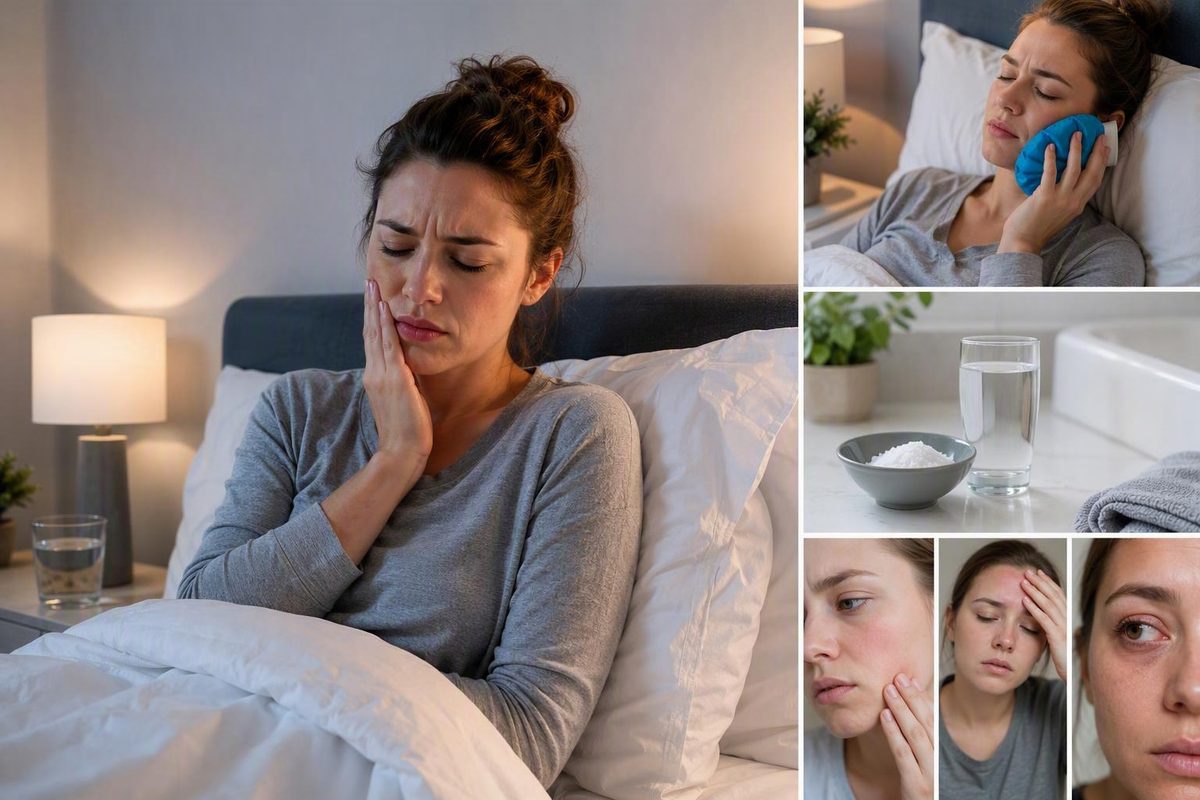
For temporary relief tonight, avoid chewing on the sore tooth, choose soft foods, and ask a pharmacist about suitable pain medicine. First check for emergency symptoms below: trouble breathing or swallowing, eye involvement, substantial swelling, or difficulty opening your mouth needs emergency care. Relief does not treat the underlying dental problem.
First, decide how urgently you need help
Use the highest level that matches your symptoms. If you are uncertain—especially about swelling, breathing, trauma, or bleeding—seek urgent professional advice rather than waiting.
| Level | Warning signs | What to do |
|---|---|---|
| Emergency medical care now | Trouble breathing, swallowing, or speaking; significant or spreading swelling of the mouth, face, neck, or area around an eye; eye pain or vision changes; difficulty opening your mouth; serious facial trauma; or uncontrolled bleeding | Contact your local emergency service or go to an emergency department. Do not wait for a dental office to open. |
| Urgent dental care | A suspected abscess; localized cheek or jaw swelling; fever with dental pain; pus, drainage, or a bad taste; severe pain that remains uncontrolled | Contact an emergency or after-hours dentist as soon as possible. A dental abscess requires urgent treatment and should not be expected to clear without care. |
| Temporary self-care while arranging an appointment | Tooth pain without the emergency signs above, particularly when it is mild enough to manage temporarily | Use the overnight measures below and arrange a dental assessment. Escalate if the pain worsens or new warning signs appear. |
The airway, eye, substantial swelling, restricted-mouth-opening, and abscess warnings above follow NHS dental-abscess guidance.
Serious facial trauma and uncontrolled bleeding also warrant immediate professional attention, while significant or worsening facial swelling requires urgent assessment, according to NHS trust dental guidance.
Arrange a dental assessment if pain lasts longer than one or two days, does not improve with suitable pain relief, or occurs with fever, biting pain, a bad taste, or cheek or jaw swelling. Assessment is also sensible sooner if pain repeatedly returns, worsens, becomes severe, or prevents sleep. These thresholds are consistent with NHS toothache guidance.
An emergency department is appropriate for airway threats, serious facial injuries, uncontrolled bleeding, and potentially spreading medical complications. Stabilizing an immediate danger does not usually repair the affected tooth, so dental treatment will generally still be needed.
This guide is general information. It cannot diagnose the cause of your toothache or determine the right treatment for your individual circumstances.
What to do for a toothache tonight
After checking for urgent warning signs, work through these measures:
- Elevate your head. Use an extra pillow or modestly raise your upper body rather than lying completely flat. Patient guidance recommends this as a temporary comfort measure for nighttime dental pain.
- Apply a wrapped cold compress. Place a cold pack or bag of frozen vegetables inside a clean towel and hold it against the outside of your cheek.
- Choose soft foods. Foods requiring little chewing are less likely to aggravate the painful area.
- Chew on the unaffected side. Avoid putting pressure on the sore tooth.
- Avoid common triggers. Very hot, very cold, and sweet foods or drinks can intensify sensitivity.
- Consider a warm salt-water rinse. An adult who can rinse and spit safely can dissolve half a teaspoon of salt in a glass of warm water, rinse, and spit it out rather than swallowing. Children should not use this rinse because they may swallow it.
The salt-water method, soft-food advice, trigger avoidance, and child restriction are set out in the NHS guidance on managing toothache.
Ibuprofen or paracetamol—also called acetaminophen in some countries—may provide temporary relief when suitable for the person taking it. Follow the product label and ask a pharmacist or clinician if you are unsure which medicine or formulation is appropriate.
Medication safety
- Do not exceed the labeled dose. Taking more may be dangerous and does not make a pain medicine work better.
- Children under 16 should not take aspirin.
- Caregivers should obtain age-appropriate advice and use a product formulated and labeled for the child.
- Pregnancy, allergies, other medicines, and medical conditions can affect whether a medicine is suitable; ask a pharmacist or clinician if any of these apply.
- Do not combine or alternate pain medicines unless a pharmacist or clinician has explained how to do so safely for you.
The warning not to exceed the recommended painkiller dose is included in NHS guidance for dental-abscess pain.
Even if the pain becomes manageable tonight, its cause may remain.
What not to do
Avoid actions that may cause harm or delay appropriate treatment:
- Do not take more pain medicine than the label recommends. A larger dose may be dangerous without providing better relief.
- Do not apply heat to facial swelling. Use a wrapped cold compress instead; NHS trust guidance warns that heat can worsen facial swelling.
- Do not give aspirin to a child under 16.
- Do not give a salt-water rinse to a child or anyone else who may swallow it.
- Do not treat topical remedies as universally safe. Products such as clove oil or benzocaine may not be appropriate for every age or circumstance. Ask a pharmacist or dentist before using one.
- Do not assume that relief means healing. Pain medicine can suppress discomfort, and drainage can occur without establishing that decay, damage, or infection has resolved.
If the pain disappears by morning but later returns—especially at night—arrange a dental examination rather than repeatedly relying on home care.
Why tooth pain may feel worse after you lie down
Public-health guidance recognizes that toothache can worsen at night, particularly while lying down. Nighttime timing does not identify the cause: decay, inflammation inside a tooth, a crack, a damaged filling, infection, or referred pain can all produce symptoms after bedtime.
One plausible explanation is attention. Daytime activity, conversation, and other sensations compete with pain. In a quiet room with fewer distractions, the same discomfort may become harder to ignore. This is a possible explanation, not a proven mechanism for every nighttime toothache.
Some dental sources propose that lying flat changes circulation or pressure around inflamed tissue. That explanation cannot identify the cause of an individual toothache. A specialist dental practice nevertheless recommends head elevation as a temporary comfort measure while emphasizing evaluation for recurrent or sleep-preventing pain in its nighttime toothache guidance.
Grinding or clenching is a more specifically sleep-related possibility. Mention it to a dentist if the tooth discomfort occurs with jaw tightness, facial muscle soreness, or a headache on waking. Those symptoms overlap with other conditions, however, and cannot confirm grinding by themselves.
Bedtime may therefore amplify an existing problem rather than create a separate nighttime condition.
Possible causes, organized by accompanying symptoms
The table below is for orientation, not diagnosis. Symptoms overlap substantially, and pain timing alone cannot establish the cause.
| Pattern | Possible explanations | Appropriate next step |
|---|---|---|
| Pain or sensitivity with hot or cold foods and drinks | Decay, exposed sensitive tooth structure, a crack, damaged filling, or inflammation inside the tooth | Avoid triggers temporarily. Arrange an assessment if the problem persists, worsens, or returns. |
| Pain when biting or releasing a bite | A crack, damaged restoration, inflammation, or infection | Stop chewing on that side and arrange dental care. Biting pain does not prove one particular cause. |
| Constant or throbbing pain | Deep decay, pulp inflammation, structural damage, or infection | Seek prompt dental assessment, particularly if the pain is severe or prevents sleep. |
| Throbbing pain with swelling, fever, pus, drainage, or a bad taste | Possible dental abscess or another infection | Seek urgent dental care. Use emergency medical care if swelling becomes significant or affects breathing, swallowing, speech, the neck, or an eye. |
| Morning jaw soreness or headache | Possible nighttime grinding or clenching; muscle or jaw-joint problems may also contribute | Tell the dentist when the symptoms occur and whether anyone has noticed grinding. |
| Pressure in the upper back teeth with congestion or other sinus symptoms | Possible referred pain from the sinuses | Consider medical advice for the sinus symptoms, but arrange dental care if tooth pain is localized, persistent, or recurrent. |
| Sore, swollen, or bleeding gums | Gum inflammation, gum disease, or infection around a tooth | Arrange a dental examination; seek urgent care for accompanying pus, facial swelling, fever, or severe pain. |
| Pain around a partially erupted tooth | An erupting or impacted tooth, sometimes with inflamed surrounding gum tissue | Arrange dental assessment, urgently if swelling, fever, a bad taste, or difficulty opening the mouth develops. |
| Pain around the jaw joint, ear, or chewing muscles | A jaw-joint condition, muscle strain, clenching, or pain referred from a tooth | Arrange assessment if it persists because the apparent location may not reveal the source. |
These symptom associations and the overlap among decay, cracks, damaged fillings, pulp inflammation, abscesses, gum disease, erupting teeth, sinusitis, and jaw-joint conditions are described in NHS inform’s toothache guidance.
A dentist may need to examine your teeth, gums, restorations, bite, and jaw before determining the source. Temperature sensitivity, biting pain, and throbbing can each occur with more than one condition.
Why a dental check is still needed if the pain improves
Temporary improvement does not establish that decay, structural damage, pulp disease, or infection has resolved. Pain medicine can reduce discomfort without treating its cause, and a fluctuating toothache may quiet down before returning.
Arrange a dental assessment if the pain:
- lasts longer than one or two days;
- repeatedly returns, particularly at night;
- becomes more frequent, intense, or difficult to control;
- does not improve with suitable pain relief; or
- disrupts sleep, eating, or normal activities.
A dentist must identify the cause before selecting treatment because similar symptoms can come from different conditions. Depending on the findings, treatment may include a filling or replacement restoration, drainage of an abscess, root-canal treatment, tooth removal, gum treatment, or management of grinding such as a night guard. Dental-practice guidance describes fillings, root-canal therapy, gum treatment, and night guards among the possible cause-specific treatments for nighttime tooth pain, while emphasizing that professional evaluation is necessary.
When calling a dentist, be ready to describe:
- when the pain started and how severe it is;
- whether it is constant, intermittent, worsening, or disrupting sleep;
- any gum, cheek, jaw, neck, or eye-area swelling;
- fever, pus, drainage, or a bad taste;
- pain triggered by biting, hot, cold, or sweet foods;
- any recent injury or dental procedure; and
- medicines and doses already taken.
Antibiotics may be used for some serious dental infections, but they are not a universal cure for toothache and do not replace treatment of the source.