
When a Tooth Keeps Hurting but No Dental Cause Is Found
A normal X-ray does not confirm it. See what must be ruled out and why reassessment or specialist referral should precede irreversible treatment.
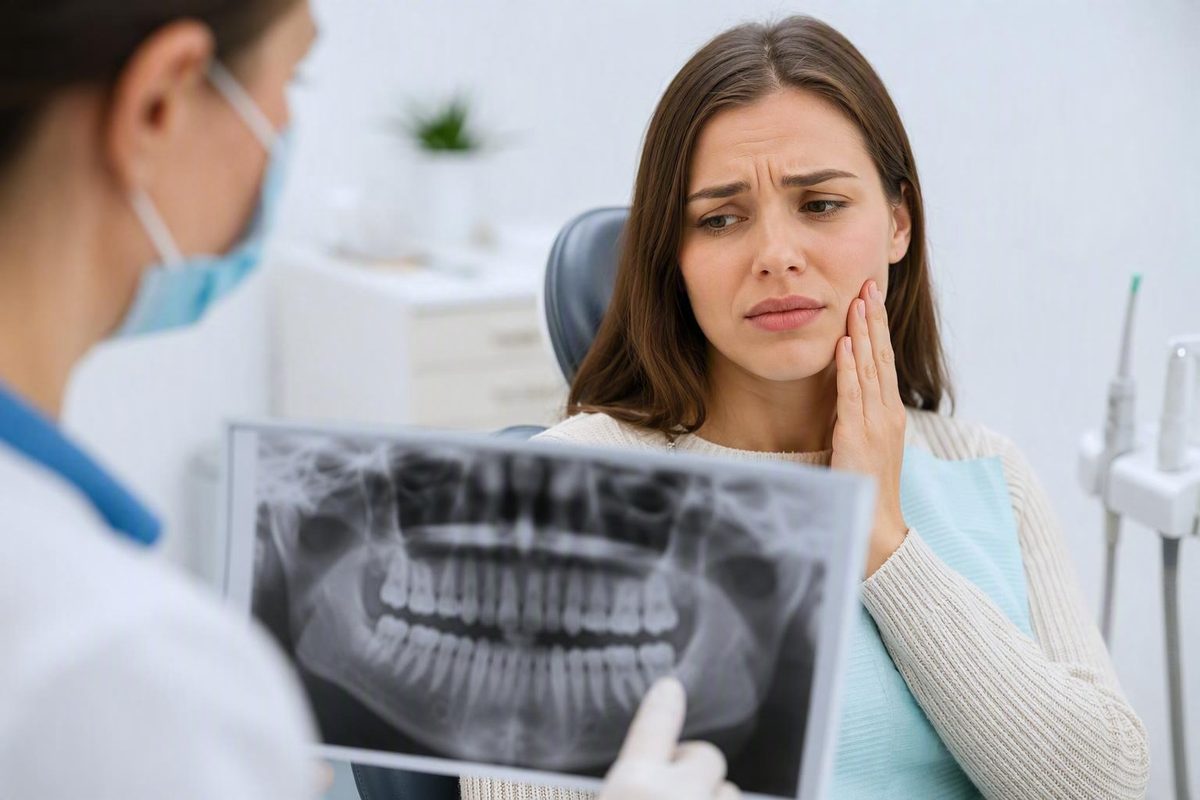
“Phantom tooth pain” is a historical term for persistent pain felt in a tooth, a root-filled tooth, a healed extraction site, or nearby tissue when evaluation has not found a sufficient dental cause. The pain is real, but its location does not prove that the tooth itself is generating it. Normal imaging alone cannot establish the diagnosis. The safest practical rule is to identify a demonstrable, treatable target before proceeding with another irreversible dental procedure.
The short answer: what phantom tooth pain means
Phantom tooth pain commonly refers to continuing dentoalveolar pain—pain in a tooth, its supporting bone and tissues, or a site where a tooth once was—without an identifiable local problem sufficient to explain it. More formal labels include atypical odontalgia, persistent dentoalveolar pain disorder (PDAP), and persistent idiopathic dentoalveolar pain (PIDAP), although their definitions are not identical. The American Academy of Oral Medicine describes atypical odontalgia as persistent tooth or extraction-site pain for which a thorough history, clinical examination, and radiographic assessment have not identified a cause in its patient information on atypical odontalgia.
A person can accurately point to one tooth and still have pain originating elsewhere. Pain may be referred from jaw or neck muscles, projected along a nerve, or associated with a headache or another facial-pain disorder. Persistent pain also does not necessarily indicate continuing tissue damage. Proposed explanations for unexplained dentoalveolar pain include peripheral nerve dysfunction, central sensitization, and other altered pain-processing mechanisms, but no single mechanism has been proved for every case.
Crucially, this is a diagnosis of exclusion. It is not diagnosed simply because an X-ray appears normal or because an earlier treatment failed. Assessment requires a history, examination, suitable imaging, review of previous care, and consideration of both dental and non-dental explanations.
General-information note: Do not self-diagnose phantom tooth pain or assume that infection, fracture, failed treatment, or another dental or medical condition has been excluded. Persistent, changing, worsening, or unusual symptoms require professional reassessment.
Why the condition has several names
The language has changed as clinicians have tried to describe the pain without assuming an unproved cause.
| Term | How it is generally used | Important limitation |
|---|---|---|
| Phantom tooth pain | Historical or popular label for persistent unexplained tooth-area pain | Can imply a mechanism that has not been established |
| Atypical odontalgia | Older clinical label for persistent pain in a tooth or extraction area | Definitions have varied |
| Persistent dentoalveolar pain disorder (PDAP) | Broader research term for persistent dentoalveolar pain without sufficient pathology | Depending on the framework, may include presentations associated with treatment or trauma |
| Persistent idiopathic dentoalveolar pain (PIDAP) | More strictly defined idiopathic diagnosis | Strict criteria exclude a preceding causative event |
These terms describe overlapping presentations, but they should not be treated as exact synonyms. Strict PIDAP is narrower than many historical descriptions of phantom tooth pain.
A referral-practice study applying International Classification of Orofacial Pain criteria defined PIDAP as unilateral intraoral dentoalveolar pain—only rarely affecting multiple sites—that recurs daily for more than two hours per day, has continued for more than three months, and has no preceding causative event. Those are important elements of the applied criteria, not a self-diagnosis checklist as described in the study.
The absence of a preceding causative event distinguishes strict PIDAP from post-traumatic trigeminal neuropathic pain. The latter category requires evidence of a causative injury to a peripheral trigeminal nerve. Pain beginning after a root canal, extraction, injection, or other procedure does not by itself establish such an injury; sequence alone is not proof of causation.
Terminology and diagnostic criteria have varied substantially across studies. Research conducted under one label may therefore describe a different group of patients from research using another. The disagreement also limits comparisons of symptoms, treatment results, and prevalence.
What the pain can feel like—and what symptoms cannot prove
Reported descriptions include persistent aching, throbbing, pressure, pulling, dragging, or burning. Some people experience a continuous daily background of pain with occasional stronger flares. The pain is often well localized to one tooth, the surrounding bone, or an extraction site, although it can spread across a wider part of the jaw or face.
Temperature, chewing, or biting may influence this pain less predictably than they influence a conventional toothache. That is not a universal distinction: some people report pain aggravated by chewing, touching the area, or other contact. Pain quality and triggers cannot by themselves distinguish unexplained dentoalveolar pain from a crack, inflammation, failed treatment, nerve injury, or referred pain.
Mechanical allodynia means pain caused by contact that would not ordinarily hurt, such as light pressure against the gum. It was common in one specialist referral cohort, but that finding does not make allodynia a diagnostic test or indicate how common it is in the general population.
| Pattern | Possible category | Why evaluation is still needed |
|---|---|---|
| Pain linked to cold, heat, sweets, biting, or chewing, with demonstrable pathology | Conventional dental disease | The affected tooth and specific condition must be identified |
| Persistent localized pain without sufficient visible pathology | Persistent dentoalveolar pain | Hidden dental disease and non-dental sources must first be considered |
| Burning, tingling, numbness, or altered sensation after documented nerve injury | Post-traumatic neuropathic pain | The location and causal nerve injury require assessment |
| Tooth-focused pain associated with muscle, sinus, headache, or neuralgic symptoms | Referred or non-dental pain | Treatment needs to address the source rather than only the perceived tooth |
Age, sex, sleep pattern, pain description, touch sensitivity, or response to local anesthetic cannot confirm the diagnosis. Such features can inform an assessment, but none replaces the search for a sufficient cause.
Pain after a root canal or extraction is not automatically phantom pain
Persistent dentoalveolar pain may start after dental treatment, may have been present before treatment, or may arise spontaneously. Timing does not prove that a root canal, filling, extraction, injection, or other procedure caused nerve damage.
Consider a root-filled tooth that continues to ache for months despite apparently adequate treatment. The next question is not automatically whether the root canal should be repeated. It is whether the assessment has adequately considered:
- a crack or fracture;
- disease in an adjacent tooth;
- persistent endodontic or periodontal disease;
- a technical or biological treatment failure;
- pain referred from jaw or neck muscles;
- trigeminal neuralgia or another neuropathic condition;
- a headache disorder;
- sinus disease; or
- another local or medical explanation.
Persistent pain after endodontic treatment is an outcome with several possible diagnoses, not a diagnosis in itself. Dental failures, muscular referral, neuropathic conditions, headache disorders, and other causes can all be represented within post-treatment pain figures. Phantom tooth pain accounts for only a subset, so percentages for all persistent post-root-canal pain should not be presented as its prevalence.
What clinicians assess before using this diagnosis
There is no single scan, sensory response, or chairside test that confirms phantom tooth pain. Evaluation commonly proceeds through several connected steps:
- Detailed symptom history: location, quality, daily pattern, triggers, flares, associated symptoms, and effects on eating, sleep, work, and activity.
- Timeline of onset and care: whether pain preceded or followed treatment, which procedures were performed, and how symptoms responded.
- Dental and oral examination: assessment of the painful area, gums, bite, soft tissues, jaw structures, and adjacent teeth.
- Appropriate radiographic assessment: imaging selected for the suspected problem rather than treated as a stand-alone exclusion test.
- Reassessment of previous treatment: whether a treated tooth has healed as expected and whether another tooth could be responsible.
- Consideration of non-dental sources: guided by the history, pain pattern, examination, and associated symptoms.
Possible alternatives include caries, fracture, periodontal or endodontic disease, failed treatment, sinus or salivary disease, temporomandibular or myofascial pain, trigeminal neuralgia, headache disorders, tumors, and other neuropathic conditions. A 2024 clinical review emphasizes that pain can remain focused on a tooth even when its source is nonodontogenic and recommends a workup that considers both dental and non-dental explanations before further treatment is chosen.
Sensory assessment may compare light touch, pin-prick, and cold sensation on the painful and unaffected sides. Findings can include allodynia, increased sensitivity, reduced sensation, or complete loss of sensation. These observations may help clinicians distinguish possible diagnostic categories, but they do not independently confirm PDAP or PIDAP.
| Assessment result | What it supports | General direction |
|---|---|---|
| Demonstrable dental pathology sufficiently explains the pain | A condition-specific dental diagnosis | Treat the identified pathology |
| Findings are uncertain or do not fully explain persistent pain | Diagnosis remains unresolved | Reassess before irreversible care |
| A causative trigeminal nerve injury is documented | A post-traumatic neuropathic category | Consider specialist neuropathic-pain evaluation |
| No sufficient local cause remains after broad assessment | Possible idiopathic dentoalveolar pain | Consider oral-medicine or orofacial-pain referral |
The available evidence does not establish a universally standardized minimum workup or one definitive diagnostic test. The necessary assessment depends on the history, previous procedures, examination findings, and plausible alternatives.
Why another irreversible dental procedure may not help
The practical rule is straightforward: establish a demonstrable, treatable target before more irreversible dental work.
A filling, repeat root-canal treatment, extraction, or surgery can address an identified dental problem. It generally cannot resolve pain arising from a muscular, headache-related, neuropathic, or other nonodontogenic mechanism. When several technically adequate procedures have failed to change the same pain, that pattern should prompt broader reassessment rather than automatic retreatment.
This is not a blanket argument against further dental care. If reassessment demonstrates infection, fracture, failed treatment, periodontal disease, or another treatable condition, condition-specific treatment may be appropriate. The caution applies when a proposed procedure is based mainly on where the pain is felt rather than evidence that the tooth is generating it.
A major review found that diagnostic definitions and protocols were inconsistent and that the treatment literature consisted largely of case reports and narrative reviews. Only seven open-label studies and two randomized controlled trials were identified, so confidence in treatment comparisons remains limited. The authors emphasized establishing the correct diagnosis before intervention because patients can otherwise undergo unnecessary procedures according to the review in the Journal of Endodontics.
Management focuses on pain control and function, not a guaranteed cure
If specialist assessment concludes that the pain is persistent and nonodontogenic, management is individualized. Depending on the suspected contributors, care may involve oral medicine, orofacial pain, headache medicine, neurology, pain medicine, physiotherapy, or psychological pain support.
Clinician-directed medication classes discussed in the literature include:
- tricyclic antidepressants;
- gabapentinoids; and
- serotonin-norepinephrine reuptake inhibitors.
Some antidepressants are used for their effects on pain processing, not because the pain is imaginary or necessarily caused by depression. Evidence for medication in persistent dentoalveolar pain is limited, however, and the comparative effectiveness and long-term benefits of different options remain uncertain as summarized in a literature review of persistent idiopathic dentoalveolar pain.
This article does not provide doses, rank medications, or advise starting, stopping, or changing a prescription.
Broader persistent-pain strategies may support coping and daily function. Depending on the individual plan, these can include maintaining valued activities where possible, relaxation, social connection, stress management, and reducing muscle tension. Stress, anxiety, low mood, and muscle tension can intensify persistent pain without proving that psychological factors caused it. NHS guidance presents self-management and multidisciplinary support as parts of individualized persistent-pain care, not as established cures for phantom tooth pain in its guidance on persistent orofacial pain.
Realistic goals may include lower pain intensity, fewer disruptive flares, improved eating or sleep, and better participation in work and social activity. Some cases improve or resolve, while others persist.
Symptoms that change, worsen, or become unusual deserve renewed evaluation rather than a continuing assumption that the pain is idiopathic. For persistent unexplained tooth or extraction-site pain, an oral-medicine or orofacial-pain specialist can review the dental findings while considering nerve, muscle, headache, and other non-dental sources.
Unexplained tooth pain is genuine, but a normal-looking X-ray does not make it phantom pain. The useful next step is a broad reassessment—and, when appropriate, specialist referral—before another irreversible procedure. Treatment may reduce pain and restore function, but the underlying mechanism, best therapy, prevalence, and prognosis remain uncertain.
Will local anesthetic stop phantom tooth pain?
It may or may not. The available clinical description indicates that local anesthetic can relieve the pain in some cases but not in others. That variability means anesthetic response should be interpreted with the history, examination, imaging, and assessment of dental and non-dental causes rather than used alone to establish or exclude the diagnosis according to the American Academy of Oral Medicine.
How common is phantom tooth pain?
Reliable general-population prevalence is unknown. Specialist clinics see selected patients with unusually persistent or complex symptoms, so their figures cannot be applied to the wider population. Studies of persistent pain after root-canal treatment also include dental failures, muscular referral, neuropathic conditions, and other diagnoses—not only phantom tooth pain. Differences in terminology and diagnostic criteria make the available estimates still harder to compare.