
Tell Tartar Buildup From Possible Tooth Decay
Compare tartar and cavities by texture, location, symptoms and tooth damage, and learn when a suspicious spot needs prompt dental examination.
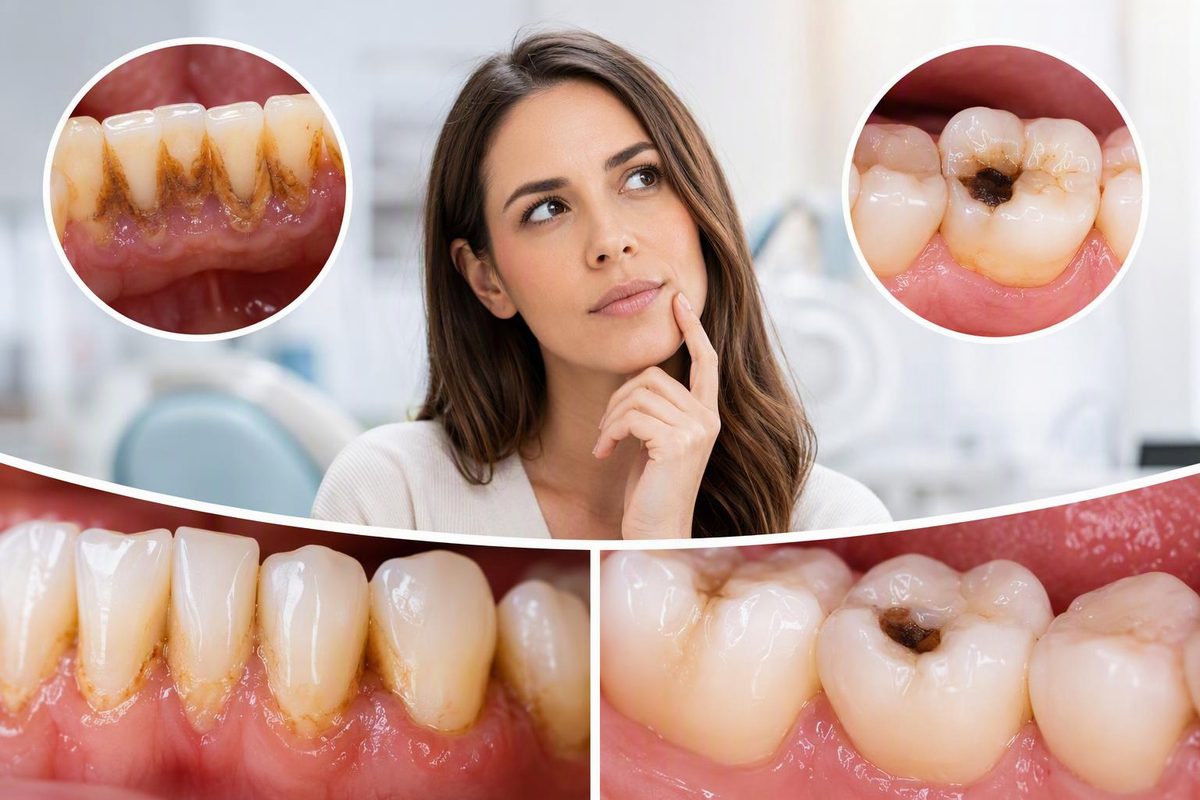
Tartar is a hardened deposit attached to a tooth; a cavity is damage within the tooth itself. A hard, fixed yellow or brown buildup near the gumline suggests tartar, while a visible hole, broken area or persistent sensitivity raises concern about a cavity. Both can occur on the same tooth, and color, pain or texture alone cannot confirm which one you have.
Choose the closest clues; the result shows which condition is more concerning, not a diagnosis.
Clue Check
The clues do not distinguish them yet
Color or uncertainty alone cannot identify tartar or a cavity. A dentist can examine a persistent deposit, mark or damaged area.
This check cannot diagnose decay. Tartar and a cavity can occur on the same tooth, and early cavities may have no symptoms.
Sources: Cleveland Clinic, NIDCR, NHS and American Dental Association guidance cited in the article.
Tartar and Cavities Have Different Structures
| Clue | Tartar | Cavity |
|---|---|---|
| What it is | Hardened plaque | Tooth structure destroyed by decay |
| Position | Attached on top of a tooth | Damage within the tooth |
| Typical feel | Hard, crust-like or shell-like | May feel pitted, rough or broken |
| Common location | Along or below the gumline; between teeth | Grooves, between teeth, near the gumline or on an exposed root |
| Color | Often yellowish at first; may darken or stain | May look white, brown or black; can also be hidden |
| Symptoms | Often none; nearby gums may swell or bleed | Often none early; later sensitivity or toothache is possible |
| Treatment | Professional cleaning removes it | Early mineral loss may be reversed; a formed hole requires repair |
Tartar—also called dental calculus—forms when soft plaque hardens. Unlike plaque, which normal brushing and interdental cleaning can disrupt, tartar remains firmly attached. Cleveland Clinic describes it as a hard, shell-like deposit that may start yellowish and darken over time. A dentist or hygienist must remove it (Cleveland Clinic).
A cavity is not material stuck to the tooth. Decay can begin with mineral loss beneath an intact enamel surface, sometimes producing a white spot. At this early, non-cavitated stage, the process may still be stopped or reversed. If decay continues until the enamel breaks down and a hole forms, the damage is permanent and must be repaired by a dentist (National Institute of Dental and Craniofacial Research).
For more detail about the deposit itself, see plaque versus tartar. If the concern is a visible mark rather than buildup, stain versus cavity explains why pigment alone is not proof of decay.
Location and Texture Provide the Strongest Clues
Tartar commonly accumulates along the gumline, below it and between teeth. It can feel like a hard ledge or crust that does not move with normal brushing or flossing. Its surface may be rough, but it remains material attached to the tooth.
A cavity may appear as a pit, hole, chipped-looking section or rough edge where tooth structure has broken down. Cavities can develop in chewing-surface grooves, between contacting teeth, near the gumline or on an exposed root. Some cannot be seen or felt at home, particularly when they are between teeth or beneath an apparently intact surface.
A rough spot is therefore not enough to separate the two. Tartar, a damaged filling, a chipped tooth and a cavity can all feel irregular to the tongue.
Color and Pain Cannot Confirm the Cause
Both conditions can appear yellow, brown or dark. Tartar can absorb stains, while decay can cause white, brown or black changes. Stained grooves, old fillings and surface pigment can also resemble decay.
Pain is not a dependable divider. Tooth decay may cause no symptoms at first. As it progresses, it can produce a hole, toothache or sharp sensitivity to hot, cold or sweet foods and drinks (NHS).
Tartar commonly causes no tooth pain. Plaque and tartar around the gumline can, however, be associated with swollen or bleeding gums (American Dental Association).
These findings do not settle the diagnosis:
- No pain does not rule out a cavity.
- A dark mark does not prove there is a cavity.
- Bleeding at the gumline does not establish that tartar is the only problem.
- A smooth-looking surface does not rule out decay between teeth.
Check the Area Without Scraping It
Use good light to see whether the change appears to sit on the surface or whether part of the tooth seems to have broken down. Brush and clean between the teeth normally, without forcing floss or scrubbing the area aggressively.
Material that remains hard, fixed and crust-like may be tartar. A persistent rough area could instead be a damaged tooth or restoration. Normal cleaning cannot remove tartar, but failure to remove a spot does not prove that it is tartar.
Do not use a metal tool, pin or home scaler to scrape it. Picking cannot establish the cause and may injure the gum or tooth. Leave any fixed deposit or suspicious defect for a dental professional to assess.
A Dental Examination Can Separate Buildup From Damage
A dentist can inspect the area, assess the surrounding gums and determine whether the finding is a deposit, stain, restoration or damaged tooth structure. The examination may also show that tartar and a cavity are present together.
When needed, dental X-rays can reveal some decay that is difficult to see directly, particularly between contacting teeth. FDA and ADA guidance says radiographs should follow a clinical examination and review of the patient’s history and risk rather than being used as automatic screening (FDA).
Plaque is involved in both conditions. Plaque that remains can harden into tartar. Plaque bacteria also release acids after exposure to sugars, and repeated acid attacks can eventually break down enamel (American Dental Association). Finding tartar therefore does not explain away a suspicious hole, mark or symptom.
Arrange a dental examination for a new or changing spot, a suspected hole, persistent sensitivity, toothache or a fixed deposit that normal cleaning does not remove.
Seek urgent dental care if you think you may have an abscess, particularly with intense pain, fever, a bad taste or facial or jaw swelling. Difficulty breathing, speaking or swallowing, a swollen or painful eye, or extensive mouth swelling requires emergency care (NHS).