
Why a Tooth Can Decay Without Sending a Pain Signal
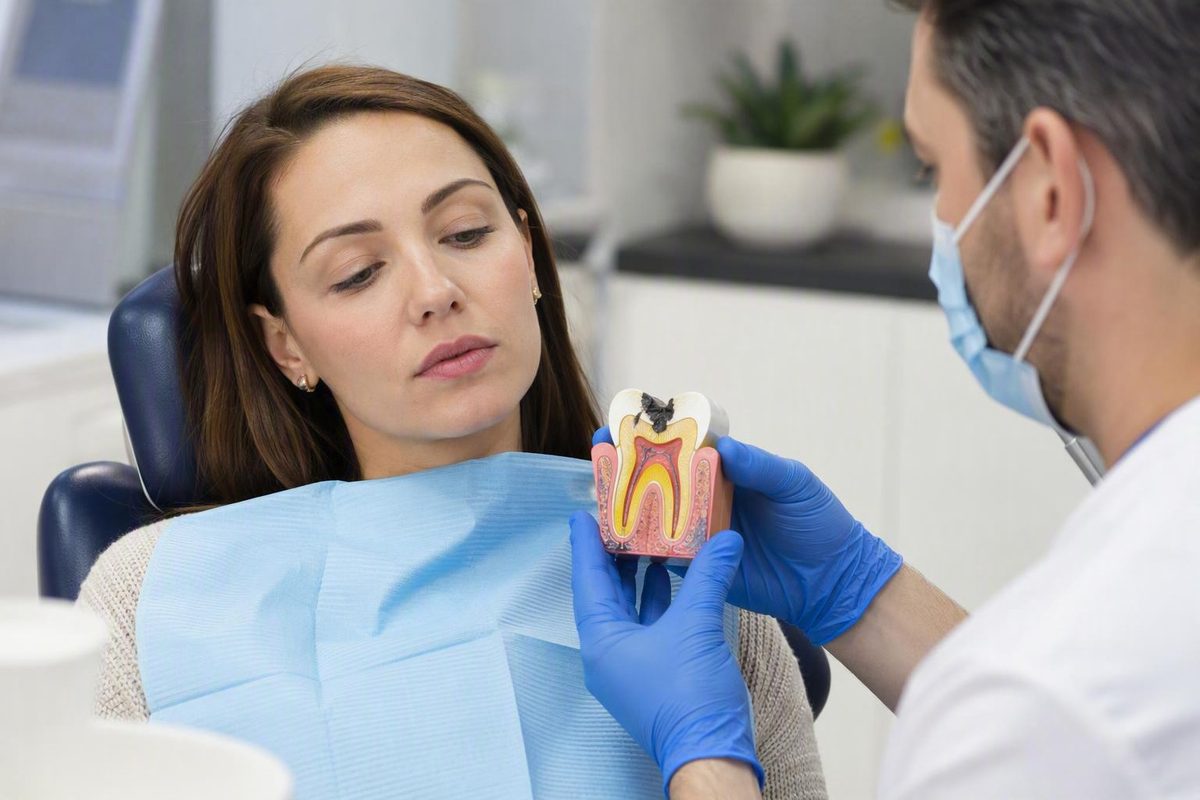
Why a tooth can decay without sending a pain signal—and why waiting for a toothache can be misleading.
The short answer: a cavity can exist without pain
No, cavities do not always hurt. A tooth can feel completely normal while decay is developing, especially when the damage is limited to the outer enamel. A cavity may cause no symptoms when it is beginning, and symptoms can vary according to its location and extent (Mayo Clinic).
That makes “it doesn’t hurt” a poor test of whether a tooth is healthy. Pain is an inconsistent alarm, not a dependable cavity detector. Some people notice sensitivity relatively early, while others have little or no discomfort despite more substantial damage.
A painless cavity should not automatically be described as:
- small;
- early;
- harmless;
- reversible; or
- safe to postpone.
It would also be wrong to say that every painless cavity will inevitably become painful. Symptoms vary with the location of the decay, the tooth structures affected, and the individual. A cavity between two teeth may behave differently from one on a chewing surface, and two people with similar decay may report different sensations.
The practical conclusion is simple: absence of pain does not rule out decay, and pain intensity does not reliably show how serious the problem is. A suspicious spot, hole, rough area, or recurring food trap can justify assessment even when the tooth feels fine.
Why early tooth decay may be silent
A cavity is an area of tooth damage that may develop into an opening or hole. Three tooth layers help explain why that damage can remain painless:
- Enamel is the hard outer layer.
- Dentin lies beneath the enamel.
- Pulp is the central soft tissue containing nerves, blood vessels, and connective tissue.
Enamel does not provide an early pain signal
Enamel contains no nerves. Mineral loss and decay limited to this outer layer may therefore occur without any sensation. A person cannot rely on the tooth to “announce” that its enamel is weakening.
This silent phase may involve an intact but demineralized surface, or decay may already have produced an opening. Feeling nothing cannot distinguish between those conditions. Cleveland Clinic notes that a person may not feel a cavity until it reaches the dentin or pulp (Cleveland Clinic).
Dentin may produce sensitivity
Dentin is softer than enamel and contains microscopic tubules that communicate with the tooth’s nerve. Once decay reaches this layer, sensitivity may become more likely. Cold water, hot drinks, sweets, or pressure might produce a brief response.
Dentin involvement does not guarantee pain. Nor does brief sensitivity prove that decay has reached dentin. Exposed roots, enamel wear, cracks, and other dental conditions can produce similar sensations.
Pulp irritation may cause stronger symptoms
If decay approaches or affects the pulp, symptoms may include lingering sensitivity, spontaneous aching, throbbing, or stronger pain with heat, cold, chewing, or biting. Infection may cause persistent pain, swelling, or pus.
This is a possible pattern, not a fixed sequence experienced by everyone. A tooth does not necessarily pass through neat symptom stages, and there is no universal point at which discomfort begins. Sensation alone cannot establish how deeply decay extends.
What a cavity may feel or look like before a toothache
A silent cavity may have no clues that you can detect at home. When changes do occur, they often fall into four broad groups.
Triggered sensations
Possible triggered sensations include:
- brief sensitivity to cold water or air;
- discomfort after a hot drink;
- a short, sharp response to sweet food or drinks; or
- a localized twinge that appears only with a particular trigger.
These sensations are clues, not a diagnosis. Tooth sensitivity can result from exposed dentin, gum recession, enamel wear, cracks, or other dental conditions. A cavity is only one possibility.
It can be useful to notice whether a sensation is new, localized to one tooth, recurring, or worsening. That information may help a dentist investigate the cause, but it cannot assign a stage to the tooth at home.
Biting or chewing changes
A decayed tooth may feel uncomfortable when biting or chewing. You might notice tenderness with firmer foods or discomfort when pressure falls on a particular point.
Biting pain is nonspecific. It can occur with decay or another dental problem and does not reveal the treatment required. Toothache, sensitivity to temperature or sweets, and pain when biting are all possible cavity symptoms, but they may be absent when decay begins (Mayo Clinic).
Visible or tactile changes
Possible visual changes include:
- a chalky white area;
- brown or black discoloration;
- a small pit;
- an irregular surface; or
- an obvious hole.
A white area can reflect early mineral loss while the enamel surface remains intact, although not every white spot represents active decay. A brown or black area may be decay, staining, or another change. A dark mark is not automatically a cavity.
You might also feel a rough edge or depression with your tongue. What a spot looks or feels like at home cannot confirm whether the tooth is decayed.
Recurring food or floss problems
Food repeatedly lodging in the same place may indicate a change in tooth shape, decay, or a problem with existing dental work. Floss that consistently catches, tears, or shreds at one location can also be a clue. Food trapping, rough spots, discoloration, pits, and floss catching are among the possible signs described in a dental-practice overview, but each can have other causes (Bailey Family Dental).
None of these observations confirms tooth decay; they identify a place to mention during a dental examination.
Why the amount of pain does not reveal the amount of decay
Pain intensity does not reliably measure a cavity’s size, depth, or urgency. Symptoms vary according to:
- where the decay is located;
- whether enamel, dentin, or pulp is affected;
- how the tooth responds to temperature and pressure;
- whether another dental condition is present; and
- the individual’s sensitivity and perception of pain.
Substantial decay can occasionally produce little discomfort, while a smaller or differently positioned problem may cause noticeable sensitivity. Pain is real and important, but it is not a measuring instrument.
Severe pain does not select the treatment
A severe toothache does not, by itself, prove that a tooth needs root-canal treatment or extraction. Pain may suggest that deeper structures are irritated, but a dentist still has to identify the cause and assess the pulp, surrounding tissues, remaining tooth structure, and whether the tooth can be restored.
A painful tooth is not automatically beyond saving. Conversely, a painless tooth is not automatically suitable for a small filling.
No pain does not mean a small filling
Some decay remains hidden between teeth, around or beneath existing dental work, or in another location that produces few symptoms. By the time it is found, more tooth structure may be involved than the person expected.
Treatment decisions depend on findings such as:
- the location and depth of decay;
- whether the enamel surface remains intact or has broken down;
- how much sound tooth structure remains;
- the condition of the pulp and surrounding tissues;
- the condition of existing fillings or crowns; and
- imaging findings when imaging is clinically appropriate.
There is no reliable countdown from “decay begins” to “the tooth starts hurting.” Waiting for a particular sensation can delay assessment without providing useful information about the tooth’s condition.
How dentists find cavities that cannot be felt or seen
A dental assessment separates possible clues from an actual diagnosis. It may combine a symptom history, visual inspection, examination of the tooth and surrounding tissues, and imaging when indicated.
During an examination, a dentist may assess:
- unusual white, brown, or dark areas;
- pits and rough surfaces;
- weakened or missing tooth structure;
- areas where food accumulates;
- changes near the gumline;
- the margins of existing restorations; and
- the tooth’s response to pressure or other clinical tests.
A dark spot may prove to be stain rather than active decay. A sensitive tooth may have exposed dentin or another cause. A rough edge may be associated with existing dental work. The purpose of the examination is to resolve those possibilities rather than match one symptom to one disease.
Decay can be hidden
Locations that can be difficult to inspect at home include:
- between adjacent teeth;
- near the gumline;
- in deep grooves on back teeth;
- around the edges of fillings and crowns; and
- beneath or beside existing dental work.
These locations help explain why a tooth may look normal in a mirror and feel normal during daily use while decay is present.
X-rays may reveal otherwise hidden decay
Dental X-rays may reveal some cavities before they are visible or symptomatic, particularly decay between teeth. They can also help a dentist evaluate areas that cannot be inspected directly.
Not every suspected cavity or dental visit requires an X-ray. Imaging should be selected according to the examination findings, symptoms, dental history, previous images, and individual risk.
Early mineral loss versus a formed cavity
The word “cavity” is often used loosely for every stage of tooth decay, but there is an important difference between early mineral loss with an intact surface and a structural hole.
Early demineralization
Repeated acid exposure can remove minerals from enamel before the surface physically collapses. This may appear as a dull, opaque, or chalky white area, although white marks can also have causes unrelated to active decay.
When the enamel surface remains intact, some very early demineralization may be arrested or remineralized. Professionally guided management may include fluoride-based measures and changes intended to reduce repeated acid exposure.
That possibility should not be interpreted as “all early cavities heal.” A dentist must assess whether the surface is intact and whether the area appears to represent active decay.
A formed hole is different
Once tooth structure has broken down and an established hole has formed, the missing structure does not naturally grow back or close. Home care may help reduce the chance of further decay, but it cannot rebuild the lost part of the tooth.
Very early decay may be managed with fluoride, while established cavities may require a filling or another procedure depending on their severity (Cleveland Clinic). Lack of pain does not move a formed hole back into the potentially reversible category.
What treatment may involve—and why symptoms cannot choose it
Treatment is selected after professional assessment. It cannot be assigned solely from whether the tooth hurts or from a self-described symptom stage.
Remineralization support
If mineral loss is very early and the enamel surface remains intact, management may focus on fluoride-based measures, oral hygiene, dietary frequency, and reducing repeated acid exposure. This supports mineral balance in an intact surface; it does not regrow missing tooth structure.
A filling
Once a hole has formed, a filling is commonly used when the decayed tissue can be removed and the remaining tooth can support that restoration. The material and design depend on the tooth, location, extent of damage, and clinical circumstances.
A painless cavity may need a filling, but symptoms cannot establish whether a filling will be sufficient.
A larger restoration or crown
More extensive loss of tooth structure may require a larger restoration or crown when a conventional filling would not adequately restore the tooth. The deciding factor is the tooth’s condition, not whether the person reports mild, severe, or no pain.
Root-canal treatment
If decay has significantly affected or infected the pulp, root-canal treatment may be considered. Pain can occur with pulp involvement, but pain alone cannot confirm it. Examination findings, clinical tests, imaging, and the tooth’s overall condition all matter.
Extraction
Extraction may be considered when a tooth cannot appropriately be restored or other clinical findings support removal. It is not the default response to severe pain, and a painless tooth is not automatically restorable.
The central tradeoff is that symptoms can signal a need for attention but cannot choose the procedure. A painful tooth may still be treatable, while a painless tooth may require more extensive care than expected. Comfort, tooth preservation, cost, and outcomes cannot be guaranteed from symptoms described online.
When a painless change, toothache, or swelling should be assessed
The following framework offers general triage information. It is not a diagnosis or a substitute for contacting a dental professional familiar with your circumstances.
Routine assessment for a painless localized change
Arrange a dental assessment rather than waiting for pain if you notice:
- a persistent white, brown, or black area;
- a rough spot;
- a visible pit;
- food repeatedly trapping in one location;
- floss repeatedly catching or shredding; or
- a suspected painless hole.
“Routine” does not mean “ignore indefinitely.” Mention it when arranging care so the dental office can advise on timing.
Prompt assessment for new symptoms
Seek prompt dental attention for:
- new localized sensitivity;
- pain when biting;
- toothache or mouth pain;
- a visible hole; or
- symptoms that persist, recur, or worsen.
These symptoms may arise from decay or another condition requiring evaluation. Do not try to determine cavity depth from whether sensitivity is brief, sharp, dull, or intermittent.
Urgent assessment for severe symptoms or possible infection
Severe or persistent pain, facial swelling, fever, pus, drainage, or swelling accompanied by a bad taste warrants urgent dental assessment. These can be signs of infection or an abscess. Untreated deep decay can lead to infection, an abscess, structural damage, or tooth loss.
Prevention helps, but it cannot rebuild a hole
Measures that can help reduce decay risk include:
- brushing with fluoride toothpaste;
- cleaning between teeth;
- limiting frequent exposure to sugary foods and drinks; and
- receiving professional care at intervals based on individual risk.
These measures support prevention and may assist with the management of very early mineral loss. They cannot repair an established hole or determine why a particular tooth has changed.
The practical rule is not to use pain as the test for whether decay exists or how serious it is. A painless spot, hole, recurring food trap, or other localized change can justify routine assessment. New pain or sensitivity merits prompt attention. Severe or persistent pain with swelling, fever, pus, or drainage calls for urgent dental care.
Only a professional evaluation can distinguish decay from staining, exposed dentin, damaged dental work, or another cause—and determine whether the tooth needs remineralization support, a restoration, or more extensive treatment. Decay Guide publishes general dental information and does not diagnose, treat, or provide individualized advice.
Frequently asked questions about painless cavities
Can a cavity be completely painless?
Yes. A cavity can cause no noticeable pain or sensitivity, especially while decay is limited to enamel. More substantial decay may also produce little discomfort. Feeling normal does not confirm that the tooth is healthy or that any decay present is minor.
At what stage does a cavity usually start hurting?
There is no universal stage or timeline at which every cavity begins to hurt. Sensitivity may become more likely when decay reaches dentin, and stronger or lingering pain may occur if the pulp is irritated or infected. The depth of decay cannot be determined from sensation alone.
Does tooth sensitivity always mean I have a cavity?
No. Sensitivity can result from decay, but it may also be associated with exposed dentin, gum recession, enamel wear, cracks, or other dental conditions. A dentist must examine the tooth to identify the cause. New, localized, persistent, or worsening sensitivity deserves prompt assessment.
Can an early cavity go away without a filling?
Very early mineral loss may sometimes be remineralized if the enamel surface remains intact. That may involve professionally guided fluoride-based care and changes that reduce repeated acid exposure. Once tooth structure has collapsed into a formed hole, it does not naturally grow back, and dental treatment is generally required.
How can a dentist find a cavity that does not hurt?
A dentist can inspect the tooth for color changes, pits, roughness, weakened structure, food traps, and changes around fillings or crowns. Clinically appropriate X-rays may reveal decay that is difficult to see directly, particularly between teeth. Not every case requires imaging; the decision depends on examination findings and individual risk.