
How thick is tooth enamel? From a thin margin to about 2.5 mm
Tooth enamel can reach about 2.5 mm in thick crown areas but is much thinner near the crown’s neck. See how it varies by tooth and surface.
How this site is written
Decay Guide is written by a health writer, not by a dentist, and no article here has been reviewed by a clinician. We work from public patient-education sources — the NHS, the CDC, the American Dental Association and hospital patient guides — and link to them so you can check what we say. Figures such as pocket depths are quoted as the educational benchmarks those sources use, not as thresholds you can apply to yourself. Nothing here replaces an examination.
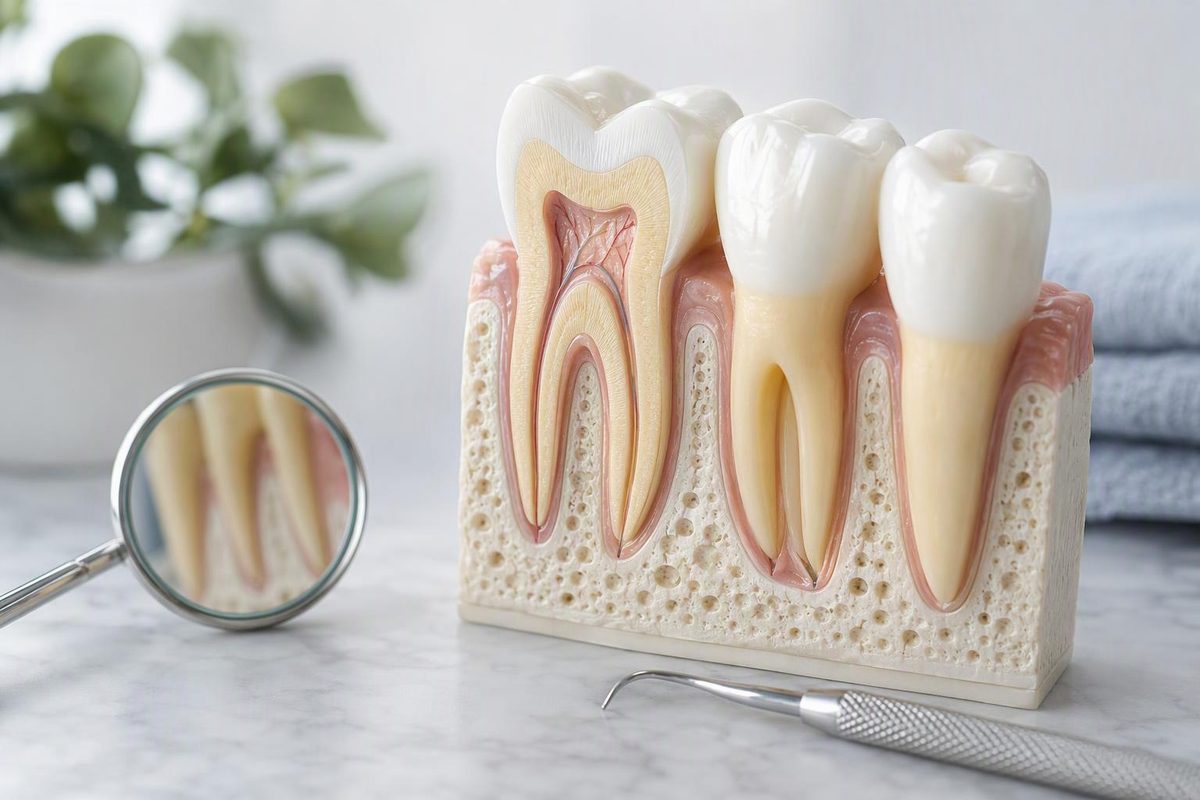
Tooth enamel can reach about 2.5 millimeters in the thickest areas of the crown, but it is much thinner near the tooth’s neck. There is no single thickness that applies to every tooth—or even to every surface of one tooth. Enamel tapers to a very thin margin where the crown meets the root. Anatomical background
Enamel is the hard outer covering of the crown, the part of the tooth above the root. Its thickness is the distance from the outer surface to the underlying dentin, not the width of the whole tooth.
How thickness varies by tooth and surface
The useful question is not just “which tooth?” but also “where on that tooth?” A measurement near a front tooth’s neck is not interchangeable with one near its biting edge or between neighboring teeth.
These examples from permanent teeth illustrate the scale of that variation:
| Tooth and measurement location | Reported enamel thickness |
|---|---|
| Upper front incisors: lip-facing surface, in the third nearest the crown’s neck | Means about 0.37–0.41 mm |
| Same incisors: middle third of the lip-facing surface | Means about 0.62–0.63 mm |
| Same incisors: lip-facing third nearest the biting edge | Means about 0.93–0.95 mm |
| Upper and lower incisors: side surfaces at contact points between teeth | Means about 0.60–0.84 mm |
| Upper and lower molars: side surfaces at contact points between teeth | Means about 1.20–1.44 mm |
The first three rows come from a small laboratory study of 20 intact, extracted upper incisors. These are measurements of their front surfaces, not the biting edges themselves. The final two rows come from a separate radiographic study of 34 people aged 13–24. All figures are study averages, not minimum and maximum limits for healthy enamel. Incisor surface study · Contact-point study, Table 1
This explains why “about 2.5 mm” and “less than 1 mm” can both be reasonable descriptions: they refer to different locations, and one is an approximate thick-area value while the other may be a surface-specific average.
Are back teeth always thicker?
Back teeth generally have thicker enamel between neighboring teeth than front teeth do. A 2021 systematic review covering 2,118 permanent teeth found greater thickness on these side surfaces in premolars and molars, and the least in lower central incisors. The side facing away from the center of the dental arch was, on average, about 0.10 mm thicker than the side facing toward it. However, the review rated the evidence as low quality, so the pattern is more useful than treating its numbers as exact individual predictions. Systematic review
Baby teeth also need separate reference values. A study of unworn lower molars from archaeological juvenile remains found thinner average enamel in baby molars than in permanent first molars, with differences across individual surfaces. Permanent-tooth measurements should not simply be applied to a child’s baby tooth. Primary and permanent molar comparison
What these numbers do—and do not—tell you
These measurements describe enamel anatomy; they do not establish how much enamel remains on a particular tooth. Studies use different locations and methods, including microscopes, radiographs and micro-CT imaging. Comparing numbers without those details can be misleading. Measurement methods in the review
Likewise, a figure such as “0.5 mm of enamel removed” during veneer preparation describes a proposed reduction, not the tooth’s natural enamel thickness. A uniform reduction would represent very different proportions of the enamel near the crown’s neck and farther up the crown. Average thickness figures are therefore reference information, not a universal allowance for removing enamel.