
A Simple Mouthguard-Care Routine That Avoids Damage
Use cool water, a soft brush, mild soap if approved, thorough rinsing and full air-drying; avoid heat and defer to your appliance’s care instructions.
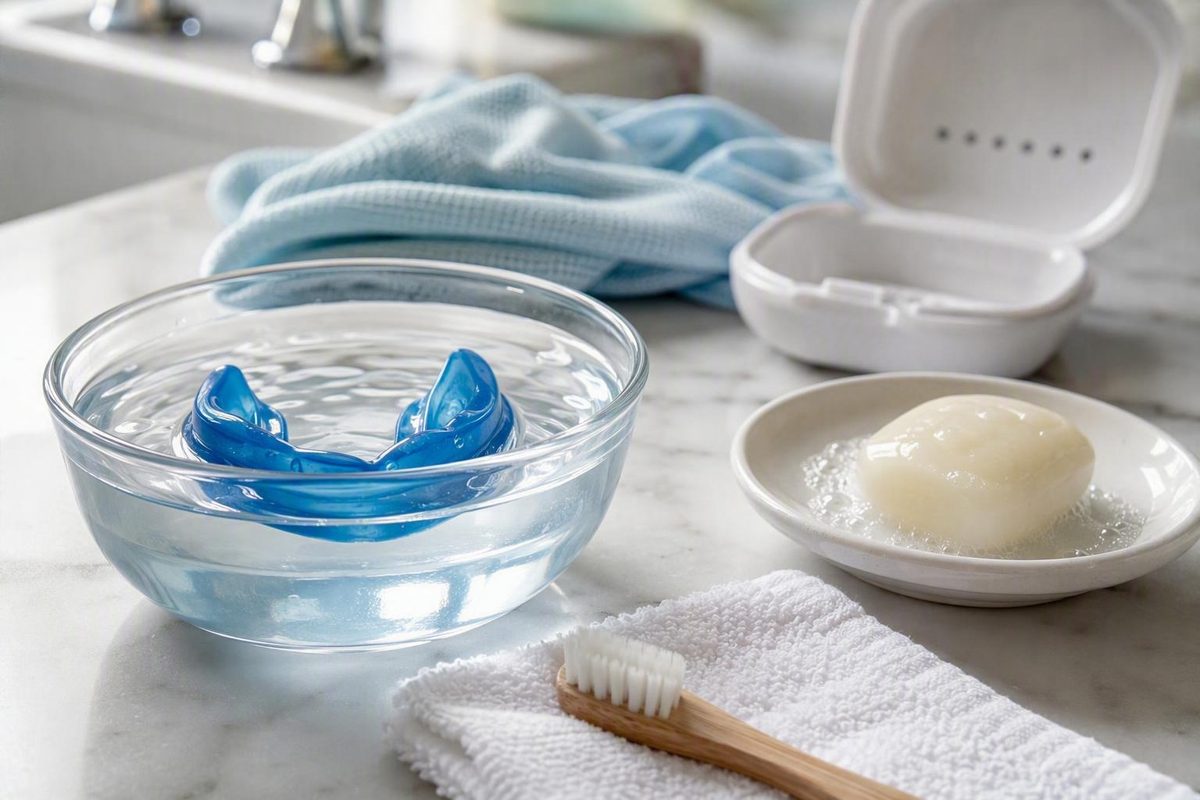
Clean your mouthguard after every use: rinse it with cool or lukewarm water, gently brush every surface with a dedicated soft toothbrush and mild fragrance-free soap or an appliance-approved cleanser, rinse thoroughly, let it air-dry completely, and store it in a clean, ventilated case. This conservative routine suits many night guards, sports guards, and orthodontic mouthguards, but the instructions supplied with your appliance take priority (Vitrin Clinic’s mouthguard-cleaning guide).
Clean your mouthguard in five steps after every use
- Rinse promptly. As soon as you remove the guard, rinse it under cool or lukewarm running water. Avoid hot water.
- Brush every surface gently. Use light pressure on the inside, outside, grooves, and tooth impressions.
- Use a mild cleanser. Apply a small amount of mild, fragrance-free liquid soap or a cleanser expressly approved for that appliance.
- Rinse thoroughly. Remove all traces of soap or cleaning product.
- Air-dry completely. Leave the guard on a clean surface with air circulating around it. Put it in its case only when dry.
Use a dedicated soft-bristled toothbrush rather than the brush you use on your teeth. Keeping the tools separate is practical and avoids transferring toothpaste residue to the appliance. You should not assume that residue is harmless: ordinary and whitening toothpastes may contain abrasives that can scratch some guard materials.
The goal is routine cleaning, not sterilization. Do not describe a home-cleaned mouthguard as sterile or germ-free. If the manufacturer, orthodontist, or prescribing dentist gives different instructions—such as requiring water only or naming a specific appliance cleanser—follow those directions instead.
Choose cleaners according to the guard—not the pantry
A cleaner being common at home does not make it compatible with every soft, hard, layered, acrylic, or thermoplastic appliance. The safest approach is to treat products other than cool water and mild soap as device-dependent.
| Cleaner | Default verdict | Main concern | Next step |
|---|---|---|---|
| Cool or lukewarm water | Use | May not remove stubborn deposits alone | Rinse after every use |
| Mild fragrance-free soap | Usually use | Residue if not rinsed away | Use a small amount and rinse thoroughly |
| Toothpaste | Usually avoid | Some formulas can scratch the surface | Use only if expressly approved |
| Tablets, vinegar, peroxide, mouthwash, baking soda, or ultrasonic cleaning | Conditional | Compatibility, concentration, and exposure limits vary | Use only when the appliance instructions approve the specific method |
Toothpaste advice genuinely conflicts. For example, one set of product-specific instructions says to avoid all toothpaste because it may scratch a custom night guard (enCore’s custom night-guard care instructions).
Other published care guidance permits a small amount of non-abrasive, non-whitening toothpaste and describes appliance tablets, diluted vinegar, diluted 3% hydrogen peroxide, brief alcohol-free mouthwash use, and ultrasonic cleaning as possible options. That same guidance emphasizes avoiding prolonged exposure and checking device compatibility (The Teeth Doctors’ mouthguard-care guide). Because the recommendations differ, cool water and mild soap are the more conservative defaults unless your appliance instructions expressly approve something else.
Treat denture or retainer tablets as product-specific rather than universally safe. Check both the mouthguard care sheet and the tablet instructions. A product intended for one kind of dental appliance may not be appropriate for another material.
Use diluted vinegar or diluted 3% hydrogen peroxide only if the guard’s manufacturer or prescribing dentist approves that method and provides workable instructions. The same rule applies to mouthwash, baking soda, and ultrasonic cleaners. For an ultrasonic machine, both the machine and any liquid placed in it must be suitable for the appliance.
When an optional method is approved:
- Use one cleaning method at a time.
- Follow the stated concentration and exposure time.
- Do not make the solution stronger or leave the guard soaking longer.
- Rinse the appliance thoroughly afterward.
- Stop if the surface, shape, comfort, or fit changes.
Do not combine cleaning chemicals or assemble a routine from unrelated online recipes. There is no universal homemade soak or chemical-cleaning schedule appropriate for every mouthguard.
Avoid heat, abrasives, and harsh cleaners
Keep the mouthguard away from:
- Hot or boiling water
- Dishwashers and microwaves
- Hair dryers and other heat-assisted drying
- Direct sunlight, radiators, and hot cars
- Bleach and harsh household cleaners
- Stiff brushes and abrasive powders
- Abrasive or whitening toothpaste
- Alcohol-based cleaners unless the manufacturer permits a specific product
Heat can soften, shrink, or deform some mouthguard materials, potentially changing the established fit. Abrasive cleaning can scratch certain surfaces, while harsh cleaners may be incompatible with the material. These effects are not identical across every appliance, which is why cool or lukewarm water and device-specific directions are safer than assumptions based on appearance alone (Nolan Freund Dental’s mouthguard-care guidance).
A boil-and-bite mouthguard may require hot water during its initial fitting. That controlled molding step does not make boiling an appropriate cleaning method. Once the guard has been fitted, reheating it may distort the established shape. Do not try to correct a poor fit by boiling or remolding the appliance unless its instructions expressly tell you to do so.
Dry the guard and clean its case
After rinsing, leave the mouthguard on a clean surface until it has air-dried completely. Do not accelerate drying with heat. Do not seal a damp guard in its case, wrap it in a tissue, or leave it loose in a gym bag where it can remain wet, collect debris, become damaged, or be discarded accidentally.
Once dry, store it in a clean, hard, ventilated case. Keep the case away from direct sunlight, hot cars, excess humidity, and pets. Ventilation does not replace drying: the guard should still be allowed to dry before storage.
Wash the empty case regularly. About once a week is a common practical schedule, but clean it sooner whenever it is dirty or damp:
- Remove the mouthguard.
- Wash the empty case with mild soap and water.
- Rinse it thoroughly.
- Leave it open until completely dry.
- Return the guard only when both items are dry.
Guidance supporting weekly case cleaning also recommends ventilated storage away from sunlight, heat, and pets. A clean guard placed in a dirty or damp case is immediately exposed to whatever residue remains there, so case care is part of the cleaning routine rather than an optional storage detail.
Know when more cleaning is not the answer
If odor or visible buildup remains after routine cleaning, check the care sheet or ask the manufacturer or dentist which method is suitable. Do not respond by increasing a cleaner’s concentration, extending its exposure time, or applying several products in sequence.
Arrange professional assessment or replacement if the guard has:
- Cracks, tears, or holes
- Warping or distortion
- Rough, sharp, jagged, or heavily chewed edges
- Persistent discomfort
- A loose, tight, or otherwise altered fit
- Odor or buildup that remains despite approved cleaning
These signs matter more than a generic replacement timetable. Useful life varies with the material, construction, fit, frequency of use, and amount of wear. Custom and orthodontic appliances may also fit differently if tooth position changes.
Persistent odor does not by itself prove that bacteria are embedded in the material. It does justify device-specific guidance, particularly if ordinary cleaning no longer resolves it.
If heat has warped the guard or its fit has changed, cleaning will not reliably restore the original shape or function. Damaged, loose, uncomfortable, or distorted mouthguards should be professionally assessed rather than repeatedly cleaned or altered at home (Greenwich Braces’ mouthguard care guidance).
Let device-specific instructions break the tie
Custom, layered, soft, hard, stock, sports, orthodontic, and boil-and-bite mouthguards can differ in construction and chemical tolerance. A cleaner accepted for one model should not automatically be transferred to another, even when the two guards look similar.
Use this decision path:
- Identify the appliance. Find its type, brand, model, and material if these are listed.
- Read its care sheet. Check approved cleansers, prohibited products, temperature limits, and soaking instructions.
- Follow device-specific directions when advice conflicts. The manufacturer or prescribing dentist is better placed to address that appliance than a general cleaning guide.
- Ask before improvising. If the instructions are missing or unclear, use the conservative daily routine and request clarification before trying a chemical soak.
- Request a professional review when function changes. This is especially important for a custom or orthodontic appliance that becomes uncomfortable, damaged, loose, or tight.
The compact default is: cool water, a soft brush, mild soap if approved, thorough rinsing, complete air-drying, and ventilated storage. Avoiding heat and following the appliance’s instructions matter more than using an elaborate soaking recipe.
Can I put my mouthguard in the dishwasher or boil it?
No, unless the manufacturer provides explicit model-specific instructions allowing it. Dishwashers and boiling water expose the appliance to heat that can deform some materials and alter the fit. The hot-water molding process for certain boil-and-bite guards is an initial fitting step, not a general cleaning method (Knox Valley Dental’s mouthguard-care guidance).
What if I accidentally stored my mouthguard while it was wet?
Remove it from the case, rinse it, and gently clean it using the normal approved routine. Let the mouthguard and case dry separately and completely. Wash the empty case with mild soap and water before using it again. If stubborn odor or buildup remains—or the guard is damaged or fits differently—ask the manufacturer or dentist what to do next.
Can I clean a mouthguard with toothpaste?
Only if the instructions for your specific mouthguard permit it. Some care guides allow a small amount of non-abrasive, non-whitening toothpaste, while others reject all toothpaste because it may scratch the appliance. When the instructions are unclear, use cool water and a dedicated soft brush, adding mild soap or an approved appliance cleanser if permitted.