
A Material-Safe Routine for Keeping Your Retainer Clean
Use compatible mild soap and a soft brush unless the retainer manufacturer or treating provider specifically approves a toothpaste for your appliance.
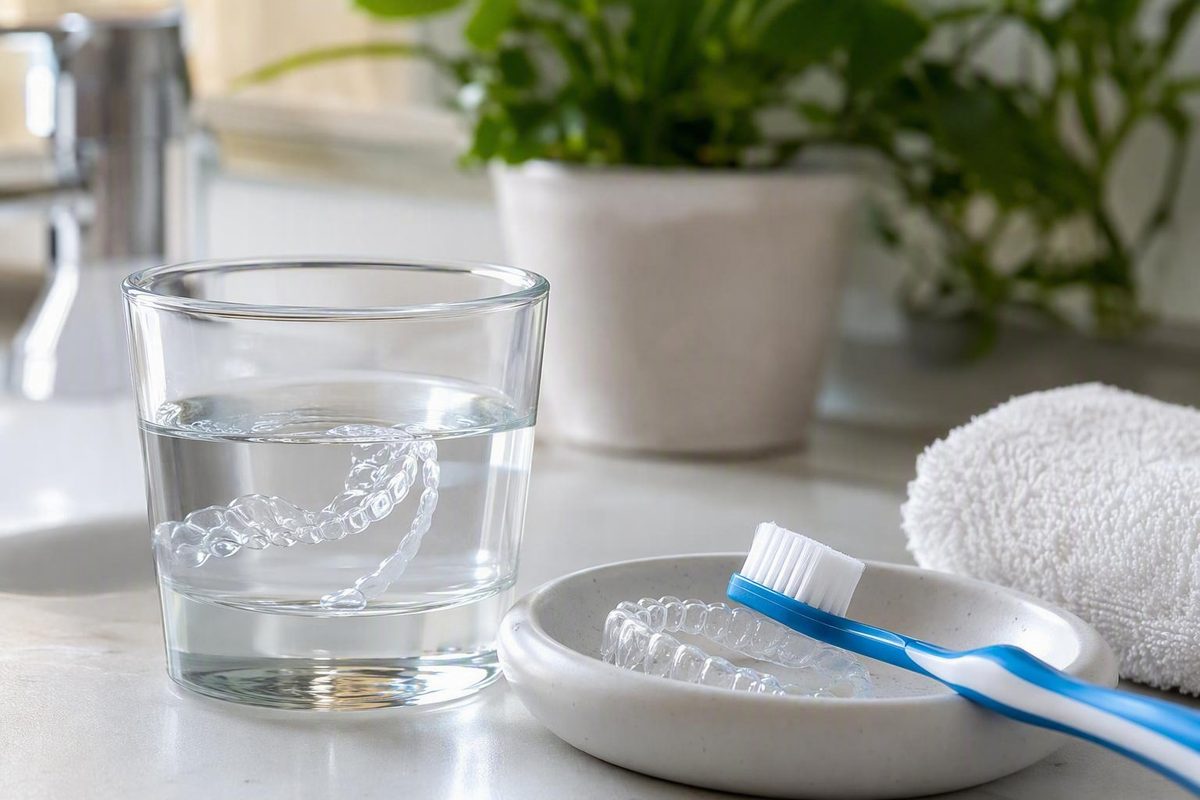
- A material-safe routine for keeping your retainer clean*
For most removable retainers, the safest routine is straightforward: rinse promptly with cool or lukewarm water, gently brush every surface with a separate soft-bristled toothbrush and a small amount of mild clear or unscented soap, rinse thoroughly, and store the appliance as directed.
The important qualification is “for most.” A clear-plastic tray, a Hawley retainer made from acrylic and metal, and a fixed wire behind the teeth do not necessarily tolerate the same products or cleaning methods.
Clean a removable retainer daily and rinse it whenever you take it out. For periodic deep cleaning, use only a product confirmed as compatible with the appliance and follow its stated soak time.
This is general reference information, not a diagnosis or an individualized care plan. Instructions from the appliance manufacturer and your treating dentist or orthodontist take priority.
The safest retainer-cleaning routine at a glance
If you have a removable retainer and its instructions permit gentle brushing:
- Rinse it promptly under cool or lukewarm water.
- Use a dedicated soft toothbrush rather than the brush used for your teeth.
- Add a small amount of mild clear or unscented liquid soap, provided it is compatible with the appliance.
- Brush gently, covering the inside, outside, grooves, edges, and deeper recesses.
- Rinse thoroughly until no soap or cleaner remains.
- Clean your teeth or at least rinse your mouth before putting the retainer back in.
- Place it in its protective case when it is not being worn, following its particular wet-or-dry storage instructions.
The American Association of Orthodontists recommends rinsing removable retainers whenever they are removed, cleaning them daily with a dedicated toothbrush and dish soap, and using a compatible retainer-cleaning tablet or solution once a week for 10–20 minutes. That weekly soak is a general baseline, not a universal schedule for every material, product, or wear pattern. See the AAO’s retainer-care guidance.
Retainer safety box
Avoid:
- Hot or boiling water
- Dishwashers
- Abrasive or whitening toothpaste
- Hard-bristled brushes and forceful scrubbing
- Bleach or bleach-containing whiteners
- Rubbing alcohol
- Harsh detergents or strong chemicals
- Alcohol-based mouthwash
- Unapproved overnight or all-day soaking
Before soaking anything, identify what you have. Is it a clear-plastic tray, an acrylic-and-metal Hawley retainer, or a wire bonded behind your teeth? A fixed retainer cannot be removed and soaked, while an acidic solution used on one plastic appliance may be inappropriate for an appliance containing metal.
Instructions supplied with the retainer and cleaner should determine product compatibility, soak duration, concentration, and storage. If a product label, an online cleaning tip, and your orthodontist’s instructions conflict, pause the disputed method and ask the treating office rather than guessing.
Identify your retainer before choosing a cleaner
Retainer care begins with the appliance, not the cleaning product. The three relevant categories are:
- Clear-plastic removable retainer: Often called an Essix-style retainer, this is a transparent molded tray that fits over the teeth.
- Hawley retainer: A removable appliance with an acrylic body and a metal wire, usually visible across the front teeth.
- Fixed or bonded retainer: A wire attached to the back of several teeth. It remains in the mouth and cannot be removed for soaking.
These designs require different precautions. Clear removable retainers are plastic trays, Hawley retainers combine acrylic and metal, and fixed retainers are bonded wires behind the teeth. Great Lakes Family Dental describes these material differences.
Clear-plastic retainers
Clear plastic is particularly vulnerable to excessive heat and abrasive cleaning. Heat can distort the tray and alter its custom fit. Abrasive toothpaste, hard bristles, forceful powders, or aggressive scouring may leave scratches, haze, or a dull appearance. Strongly colored products may stain transparent material.
A cleaner marketed for dental appliances generally is not necessarily compatible with every clear retainer. Check both the cleaner’s label and the retainer’s instructions before using it.
Hawley retainers
A Hawley retainer contains mixed materials: acrylic plus metal wire, and sometimes additional components, joins, or repaired areas. A soak that appears suitable for plastic may affect metal differently.
Vinegar deserves particular caution. Material-specific practice guidance advises against using vinegar on metal-containing retainers because the acid may react with the metal. The conservative approach is to avoid acidic soaking unless the appliance manufacturer or treating provider confirms that the complete appliance can tolerate it.
When brushing a Hawley retainer, work gently around the acrylic, wire, clasps, and junctions. Hold it securely without bending the wire or applying leverage at attachment points.
Fixed retainers
A fixed retainer remains bonded behind the teeth. It should not be pulled, detached, or treated like a removable appliance. Cleaning instead focuses on brushing along the wire and gumline and using floss or another suitable interdental tool beneath and around the bonded areas.
A quick decision tree
Can you remove the retainer yourself as instructed?
- Yes, and it is a clear molded tray: Follow the removable-retainer routine, emphasizing low heat, gentle brushing, and non-abrasive products.
- Yes, and it has acrylic plus a metal wire: Follow the removable-retainer routine, but verify that any soaking product is compatible with both acrylic and metal.
- No, it is bonded behind the teeth: Skip soaking. Follow the fixed-retainer brushing and interdental-cleaning routine.
- Not sure: Use only the routine already approved by your provider until the material and design are confirmed.
That last category also applies if the appliance has been repaired, contains decorative elements, has soldered or joined areas, or includes components you cannot identify.
How to clean a removable retainer every day
A daily routine should remove saliva, film, and loose debris without changing the appliance’s surface or shape. More pressure and stronger chemicals are not necessarily better.
Step 1: Rinse promptly
Remove the retainer as instructed and rinse it under cool or lukewarm running water. Prompt rinsing removes loose material before saliva and debris dry on the surface.
Do not substitute hot water on the assumption that hotter means cleaner. High heat can distort susceptible retainer materials and alter their fit.
Step 2: Use a separate soft-bristled toothbrush
Keep a soft toothbrush specifically for the retainer. Do not use a hard-bristled brush or scrub aggressively.
Hold the retainer securely but gently. Avoid squeezing a clear tray, bending a Hawley wire, or gripping the appliance by a delicate edge. Use light pressure across each surface.
Step 3: Apply mild soap when compatible
Place a small amount of mild clear or unscented liquid soap on the damp brush. Gently clean:
- The inside surfaces that contact the teeth
- The outside surfaces
- Grooves and ridges
- The deepest areas around the front teeth
- Edges and recesses
- Acrylic surrounding the wire of a Hawley retainer
Clear or unscented soap avoids some of the dye, fragrance, and lingering-taste concerns associated with strongly colored or scented products. Some appliance instructions specify a particular cleanser or restrict brushing, so generic soap advice must not replace those directions.
Step 4: Rinse thoroughly
Rinse every surface until no visible foam or cleaning-product residue remains.
Inspect the retainer under good light. Look for remaining soft film, cracks, distorted edges, or loose components, but do not probe suspicious areas with a sharp tool.
Step 5: Clean your teeth before reinsertion
When possible, brush and clean between your teeth before putting the retainer back in. If that is impractical, rinse your mouth thoroughly.
Cleaning both the mouth and retainer is therefore more useful than cleaning either in isolation.
Step 6: Store it correctly
When the retainer is out, put it in a clean protective case. Do not wrap it in a tissue or napkin, place it loose in a pocket, or leave it exposed on a countertop.
Storage advice is not uniform. Some appliance instructions call for dry storage, while others specify moisture or another condition. Follow the manufacturer’s or orthodontist’s directions rather than assuming every retainer should be stored the same way.
The overall daily method—lukewarm rinsing, a separate soft brush, clear unscented soap, thorough rinsing, and protection from heat and abrasion—is also reflected in orthodontic-practice guidance. Tebo Orthodontics outlines this routine.
Why toothpaste is not the default
Toothpaste is designed for teeth, not necessarily for appliance resin, acrylic, plastic, or metal. Many formulas contain polishing or whitening ingredients that may scratch, dull, or cloud a retainer.
Some dental-practice sources permit toothpaste labeled non-abrasive, while the AAO and other practices advise avoiding toothpaste. Because consumers cannot reliably judge a product’s abrasiveness from texture alone, omitting toothpaste is the more conservative baseline. Use mild compatible soap unless the retainer manufacturer or treating provider specifically approves a toothpaste for that appliance.
Gentle brushing is a mechanical cleaning step: it loosens and removes film and debris. It should not be described as sterilizing or disinfecting the appliance, and adding a household substance does not turn ordinary cleaning into validated disinfection.
Deep cleaning: what to use, how often, and what remains uncertain
For periodic deep cleaning, the preferred general option is a retainer-specific tablet or solution whose label confirms compatibility with the appliance. Follow the label’s directions for quantity, concentration, water temperature, and timing.
The AAO’s general recommendation is a compatible retainer cleaner once weekly for 10–20 minutes. Practice guidance differs, with some sources recommending more frequent cleaning and others suggesting a deeper clean every one or two weeks. Comparative evidence in the supplied guidance does not establish one optimal schedule for every appliance. The AAO provides the weekly baseline.
Use that baseline only when it agrees with all three of the following:
- The retainer’s care instructions
- The cleaner’s compatibility and timing information
- Your treating provider’s directions
Two checks before every soak
Compatibility check: Is the product approved for every material and component in the appliance?
Timing check: Does the planned soak duration match the product instructions?
These are separate questions. Even when a product is compatible with a material, using the wrong concentration or exceeding the stated soak time may be unsuitable. Do not turn a short soak into an overnight or all-day soak unless both the cleaner and appliance instructions expressly permit it.
Cleaning-method compatibility table
| Method | General status | Principal concern | Next step |
|---|---|---|---|
| Mild clear or unscented soap | Broadly supported for daily cleaning of most removable retainers | Dye, fragrance, residue, or appliance-specific restrictions | Use a small amount with a soft brush, then rinse thoroughly |
| Retainer-specific tablet or solution | Potentially appropriate | Not every product suits every material; soak times vary | Confirm material compatibility and follow the label |
| Toothpaste | Generally avoided | Abrasive and whitening formulas may scratch, dull, or cloud plastic | Use compatible mild soap unless specifically directed otherwise |
| Vinegar | Material-dependent and disputed | Acidic solutions may be unsuitable for metal, delicate plastic, repairs, or mixed materials | Use only with appliance-specific approval |
| Baking soda | Disputed | Sources recommend both soaks and pastes, but powder or forceful scrubbing may abrade clear plastic | Do not make it the default; ask before using |
| Hydrogen peroxide | Provider-dependent | Dilutions and timings vary; universal compatibility is not established | Use only when appliance-specific instructions provide a complete method |
| Denture cleaner | Conditional | Some formulas may be harsh, cause yellowing, or be incompatible with retainer materials | Prefer a retainer-specific product and verify before use |
| Mouthwash | Generally unsuitable by default | Alcohol may affect materials; dyes may stain clear plastic | Use even clear, alcohol-free rinse only when expressly approved |
| Ultrasonic cleaner | Optional | The device, solution, and appliance must all be compatible; comparative benefit is uncertain | Treat it as a convenience, not a necessity |
Vinegar
Vinegar recommendations differ substantially in dilution, water temperature, and soaking time. Some practices recommend it for deposits, while others warn about acid exposure or exclude metal-containing appliances.
Do not use undiluted or concentrated acid, and do not assume that a soak suggested for one clear tray is suitable for a Hawley retainer. Dental-clinic guidance also emphasizes dilution and acknowledges that cleaning methods may differ between clear plastic and metal-containing retainers. Review the material cautions from Complete Smiles.
When approval is uncertain, choose a retainer cleaner whose label explicitly covers the appliance instead.
Baking soda
Baking soda is similarly disputed. It appears in practice recommendations as a diluted soak, a paste, and an odor remedy. Other guidance warns that powder or forceful scrubbing may be abrasive, especially on clear plastic.
That disagreement does not mean every contact will damage every appliance. It means baking soda is not a material-neutral default. Do not apply dry powder or scrub forcefully, and use it only when appliance-specific instructions approve a particular method.
Hydrogen peroxide
Hydrogen peroxide should be treated as provider-dependent. Published practice instructions use different ratios and soak times, and the supplied guidance does not establish universal compatibility.
Do not improvise a concentration from an incomplete online recipe. If peroxide is approved for your appliance, use the exact product strength, dilution, and timing supplied by the provider or manufacturer. Do not assume that it sterilizes the appliance or will remove every stain.
Denture cleaners and mouthwash
A denture cleaner is made for a different appliance category. Some dental practices permit occasional use, while others warn about harsh ingredients, yellowing, haze, or material incompatibility. A product being suitable for dentures does not automatically make it suitable for a clear or mixed-material retainer.
Standard mouthwash is also a poor default. Alcohol may be unsuitable for appliance materials, and colored rinses may stain clear plastic. Even a clear, alcohol-free rinse should be used only when the appliance instructions or treating provider expressly approve it.
Ultrasonic cleaners
An ultrasonic cleaning pod may be convenient, but it is not essential when approved brushing and soaking work adequately. The available practice guidance presents these devices as optional and does not provide comparative clinical evidence establishing superiority over ordinary compatible cleaning. The Ivory Dental discusses cleaning pods as a convenience rather than a requirement.
If using one, confirm compatibility among the appliance, device, and cleaning solution. Follow the device instructions and continue to rinse and inspect the appliance as directed.
Cleaning a fixed or permanent retainer
A fixed retainer is attached behind the teeth. It cannot be removed for soaking and should never be pulled away from the teeth for cleaning.
Brush around the complete wire
Brush daily with gentle attention to:
- The wire itself
- Each bonded attachment point
- The backs and biting surfaces of adjacent teeth
- The gumline
- Spaces where food tends to collect
Brushing only the front surfaces of the teeth leaves the bonded area untouched.
Use a floss threader beneath the wire
A common method is:
- Feed ordinary floss through a floss threader.
- Guide the threader gently beneath the bonded wire.
- Remove the threader while leaving the floss under the wire.
- Curve the floss against the side of one tooth and move it gently toward and away from the gumline.
- Clean the neighboring tooth surface.
- Repeat in each accessible space.
Do not snap the floss into the gums or pull hard against the wire.
Superfloss, a suitably sized interdental brush, and a water flosser may be alternatives or supplements. No single device is necessarily best for every wire design or mouth. Professional guidance recommends daily cleaning around fixed wires and identifies floss threaders and other interdental tools as possible methods. Children’s Dental Associates explains the distinction between removable and fixed-retainer care.
Know what home cleaning cannot remove
Soft plaque and recently trapped food may respond to brushing and interdental cleaning. A hard, adherent deposit may be tartar rather than loose debris. Hardened material around a bonded retainer may require professional removal; trying to chip it away at home could damage the tooth, wire, or bonded attachment.
Arrange a dental or orthodontic assessment if:
- The wire feels loose or bent
- A bonded point appears detached
- Cleaning causes continuing pain or irritation
- Appropriate tools cannot reach beneath the wire
- A hard deposit remains
- The teeth appear to be moving
A dentist or orthodontist can identify the wire design, demonstrate a suitable technique, and determine whether a deposit or damaged bond needs professional care.
Methods that can scratch, stain, weaken, or warp a retainer
The clearest avoidable risks are excessive heat, abrasion, harsh chemicals, sharp tools, and soaking beyond an approved time.
Excessive heat can alter the fit
Retainers are made to a custom shape. High heat may distort susceptible materials, leaving the appliance unable to seat as intended. Avoid:
- Hot or boiling water
- Dishwashers
- Boiling or steam-based “sanitizing”
- Hot vehicles
- Radiators and direct heat sources
- Prolonged exposure to strong sunlight or excessively warm locations
There is no useful universal maximum water temperature for every retainer material. “Cool or lukewarm” is the conservative practical instruction unless the manufacturer specifies otherwise.
Abrasion can create scratches and haze
Toothpaste—especially whitening or strongly polishing formulas—hard brushes, forceful powders, and aggressive scrubbing may scratch or dull plastic. Fine scratches can appear as cloudiness and may make the surface harder to keep clean.
Abrasive damage can be mistaken for remaining film. Scrubbing harder may then worsen the haze rather than remove it.
Harsh chemicals can affect materials
Bleach, bleach-containing whiteners, rubbing alcohol, strong detergents, alcohol-based products, and other harsh chemicals are discouraged because they may discolor, weaken, or otherwise affect retainer materials. Colored rinses and strongly dyed cleaners may stain clear appliances.
“Clear” and “alcohol-free” remove two concerns but do not by themselves prove that a product is appliance-compatible. Image Orthodontics likewise advises avoiding toothpaste, hot water, bleach, harsh detergents, alcohol, and strong chemicals when caring for retainers. Review its retainer-cleaning precautions.
Sharp tools can cause damage
Do not use a knife, pin, metal pick, scouring pad, or hard scraper on white crust or stubborn deposits.
If gentle approved cleaning does not remove the deposit, seek professional assessment rather than using a sharper instrument.
Compatible products can still be misused
A cleaner may be suitable for an appliance but still have a limited permitted exposure time. Overnight, all-day, or repeatedly extended soaking should occur only when both the product and appliance instructions allow it.
Save-or-print do-not-use checklist:
- [ ] No hot or boiling water
- [ ] No dishwasher
- [ ] No abrasive or whitening toothpaste
- [ ] No hard brush or forceful scrubbing
- [ ] No bleach or bleach-containing whitener
- [ ] No rubbing alcohol
- [ ] No harsh detergent or unapproved strong chemical
- [ ] No alcohol-based or strongly colored mouthwash
- [ ] No sharp scraping tools
- [ ] No soaking beyond the approved time
These exposures do not guarantee immediate damage in every case, but each creates an avoidable risk.
Clean the case and prevent immediate recontamination
A clean retainer placed in a dirty or waterlogged case can pick up residue again. Wash the empty case regularly with mild dish soap, rinse it thoroughly, and allow it to dry without standing water inside.
Published schedules are inconsistent. Great Lakes Family Dental recommends daily case cleaning, illustrating the more frequent end of current practice guidance. See its case-care recommendation.
Other practice guidance recommends weekly washing with dish soap, showing why one universal interval is difficult to justify. Children’s Dental Center provides the weekly example. Follow any case-specific directions and clean the case often enough to prevent visible film, odor, or accumulated moisture.
A napkin makes it easy to discard accidentally, while an exposed countertop leaves it vulnerable to contamination, impact, or pets. Keep the case where it will not be crushed, lost, or mistaken for rubbish.
Protect both case and retainer from:
- Dishwashers
- Direct sunlight
- Hot vehicles
- Radiators and heating appliances
- Pets
- Heavy objects
- Open bags or loose pockets
Do not infer a universal wet-or-dry storage rule. Some sources call for a clean, dry, ventilated case; other instructions advise keeping particular appliances moist. The correct choice depends on the appliance and its supplied directions.
When it matches your provider’s instructions, remove a removable retainer before eating or drinking anything other than water. Clean your teeth afterward when possible—or at least rinse your mouth—and rinse the retainer before reinsertion. Premier Orthodontics gives these instructions for clear retainers and also warns against hot cars, dishwashers, boiling, napkin storage, and access by pets. View the clear-retainer instructional video.
A minimal travel kit needs only:
- The protective case
- A dedicated soft toothbrush
- Mild compatible soap in a leakproof container
- Provider-approved cleaning tablets, if used
There is no well-supported universal case-replacement interval. Replace a case when it is cracked, damaged, no longer closes securely, or cannot be cleaned adequately rather than relying on an arbitrary deadline.
Odor, cloudiness, white crust, damage, and poor fit
Troubleshoot according to the symptom. Do not respond to every problem by using a stronger chemical or a longer soak.
Odor, bad taste, soft film, or loose debris
Start by repeating the basic routine:
- Rinse promptly.
- Brush gently with a soft dedicated brush and compatible mild soap.
- Rinse thoroughly.
- Clean the case.
- Clean your teeth or rinse your mouth before reinsertion.
- Use a compatible retainer cleaner for its labeled time if deeper cleaning is due.
If odor or taste persists despite approved cleaning, arrange professional assessment. Do not escalate to bleach, concentrated acid, alcohol, or an indefinite soak.
White spots or crust
White deposits may be plaque, mineral buildup, tartar, or a combination. Appearance alone may not reliably distinguish soft removable film from hardened material.
Try only gentle approved cleaning. Do not diagnose the deposit by scraping it. If it is hard, firmly attached, or repeatedly returns, take the removable appliance to a dentist or orthodontist. Hardened deposits around a fixed wire may require in-office removal. Smart Dental Network recommends professional help for stubborn deposits that approved home cleaning cannot remove.
Cloudiness or haze
Have the appliance assessed if cloudiness persists, worsens, or occurs with a changed fit.
Stains or persistent odor
A compatible cleaner may remove some surface residue, but no home method can be promised to restore every discolored or odorous appliance. Persistent staining or odor may reflect embedded residue, surface damage, or another problem requiring inspection.
Seek professional advice rather than trying bleach, concentrated vinegar, undiluted peroxide, or prolonged soaking.
Damage, pain, or changed fit
Stop home-cleaning experiments and contact the treating dentist or orthodontist if you notice:
- A crack or hole
- A sharp or broken edge
- Visible warping
- A loose or bent fixed wire
- A detached bonded point
- Ongoing irritation
- Pain
- Apparent tooth movement
- A retainer that suddenly fits differently
- A retainer that will not seat normally
Do not wear a cracked or visibly warped removable retainer unless the treating orthodontist tells you to do so. Do not pull, cut, or manipulate a loose bonded wire. Contact the orthodontist promptly in either situation, and use a backup only if an appropriate one was previously supplied for that purpose. Fit changes, cracks, warping, looseness, or discomfort are all reasons for orthodontic review. Runnels Orthodontics outlines these warning signs.
Do not force a painful, tight, warped, or visibly damaged removable retainer into place.
Frequently asked questions
Can I clean my retainer with toothpaste?
The conservative answer is no. Many toothpastes contain abrasive or polishing ingredients that may scratch, dull, or cloud plastic, and whitening formulas are a particular concern.
Some practice sources permit products labeled non-abrasive, but that disagreement does not make toothpaste the best default. Use compatible mild soap and a soft brush unless the retainer manufacturer or treating provider specifically approves a toothpaste for your appliance.
Are vinegar, baking soda, or hydrogen peroxide safe for retainers?
Not universally.
- Vinegar is acidic, recipes vary, and it may be unsuitable for metal-containing or delicate appliances.
- Baking soda appears in both soak and paste recommendations, but powder or forceful scrubbing may abrade clear plastic.
- Hydrogen peroxide instructions vary in concentration and timing, and compatibility is not established for every appliance.
Do not improvise a recipe. Use these substances only when you have material-specific instructions from the appliance manufacturer or treating provider. A compatible retainer-cleaning product used according to its label is the more predictable general option.
How often should I deep-clean or soak my retainer?
Weekly is a practical baseline for many removable retainers, but it is not a universal rule. The correct schedule depends on the appliance, the cleaner’s label, wear pattern, and instructions from the treating provider.
Daily gentle cleaning remains important even when periodic soaking is used. Do not compensate for missed daily care by extending a soak beyond its approved time.
Why does my retainer smell, look cloudy, or have white crust on it?
Odor or bad taste may accompany trapped residue or film. Cloudiness may come from buildup, but it can also reflect scratches, chemical exposure, or heat damage. White material may be plaque, mineral buildup, tartar, or a mixture.
Repeat the gentle routine and clean the case. If approved cleaning does not resolve the problem, seek professional assessment. Do not scrape hard deposits or assume stronger chemicals will reverse damaged material.
Do I need an ultrasonic retainer cleaner?
Usually not. An ultrasonic cleaner is an optional convenience rather than a basic requirement. A dedicated soft toothbrush, compatible mild soap, and an approved periodic soak may be adequate.
If you choose an ultrasonic device, confirm compatibility among the appliance, machine, and cleaning solution. Follow the device instructions and do not assume that the device is clinically superior or eliminates ordinary inspection and care.
The practical rule to remember
The safest approach has three parts:
- Clean gently every day.
- Use only material-compatible products for the stated time.
- Do not try to clean away structural damage or hardened tartar.
Heat and abrasion are the clearest avoidable risks. Vinegar, baking soda, peroxide, denture cleaners, mouthwash, and ultrasonic devices require more caution than many online tips imply.
Contact a dentist or orthodontist about persistent deposits or odor, pain, irritation, cracks, loose wires, warping, tooth movement, or changed fit. Decay Guide publishes general dental reference information and does not provide diagnosis, treatment, or individualized dental advice.