
Why One Spot on Your Gum Is Swollen—and When It Cannot Wait
Possible causes include trapped food, gum disease, decay or an abscess; pus, fever, facial swelling or trouble swallowing determine how urgent care is.
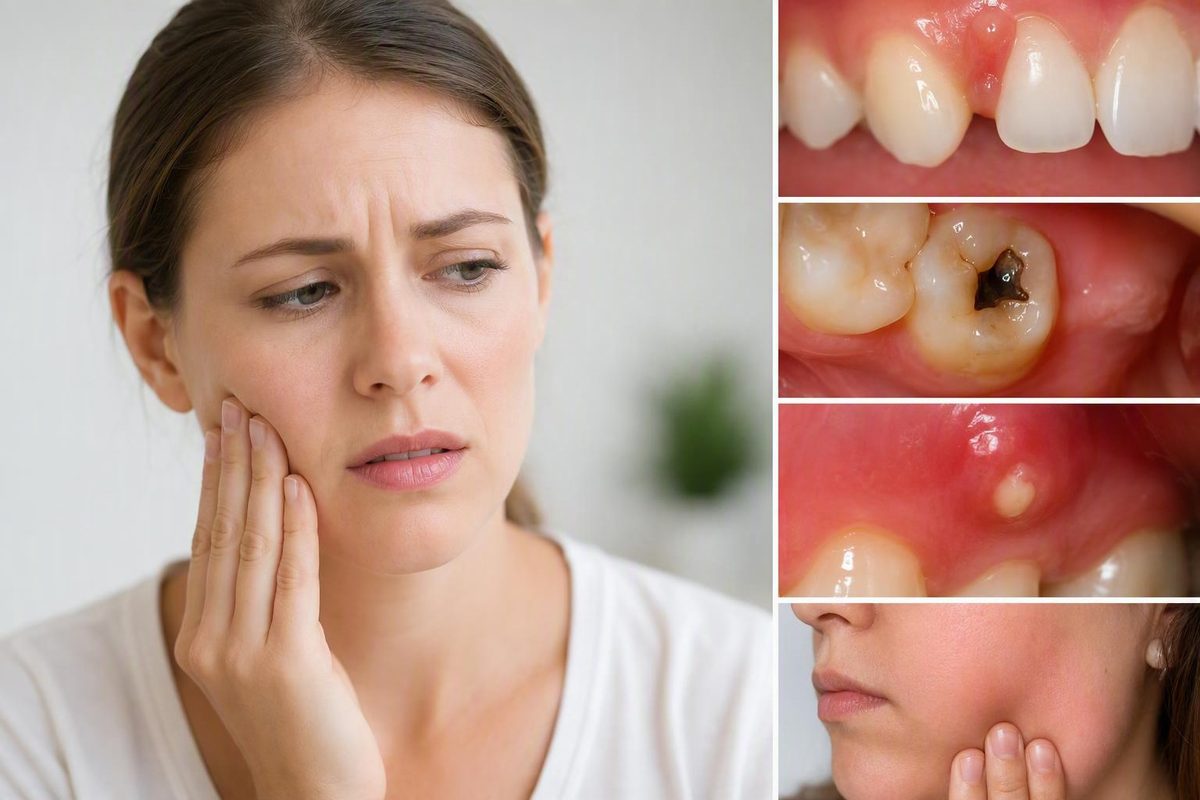
Gum swelling under one tooth can result from trapped food, plaque-related irritation, gum disease, decay, trauma, inflammation around a partly erupted wisdom tooth, or an abscess in the gum or tooth root. Its appearance and location alone cannot identify the cause. The safest next step depends mainly on whether the swelling is worsening or spreading and whether you have pus, fever, severe pain, facial swelling, or difficulty breathing or swallowing.
Decay Guide provides general educational information. It cannot diagnose an individual swelling, recommend treatment for a particular tooth, or replace an examination by a dentist.
First, decide how urgently you need care
Use this three-level guide rather than trying to diagnose the swelling yourself.
1. Get emergency help now
Contact local emergency services or go to an emergency department immediately if you have:
- Difficulty breathing, speaking, or swallowing
-
Extensive swelling inside the mouth
-
Marked difficulty opening your mouth
These signs can mean that swelling or infection is affecting areas beyond the tooth. NHS dental-abscess guidance identifies breathing, speaking, swallowing, eye, vision, extensive mouth-swelling, and mouth-opening problems as reasons for immediate emergency assessment (NHS).
2. Arrange prompt dental assessment
Contact a dentist promptly if the swelling is:
- Painful, worsening, persistent, or recurrent
- Shaped like a pimple, blister, lump, or bump
- Accompanied by pus or an unpleasant taste
- Painful when you bite or chew
- Associated with fever, swollen neck glands, or feeling unwell
- Accompanied by facial or jaw swelling
- Near a loose tooth
A bump also deserves prompt attention if it repeatedly fills, drains, or returns, even when it is not very painful.
Published waiting periods vary because they refer to different problems. Advice for mild sore or bleeding gums may allow a short period of self-care, while a suspected abscess, worsening facial swelling, fever, or swallowing or breathing difficulty calls for urgent professional help. Severity, progression, recurrence, and accompanying symptoms therefore matter more than one universal number of days (Wirral Community Health and Care NHS Foundation Trust).
3. Briefly monitor only mild irritation that is clearly improving
Short monitoring may be reasonable when all of the following apply:
- Food recently became trapped beside the tooth.
- The swelling is small and mildly tender rather than severely painful.
- There is no pus, fever, facial swelling, significant biting pain, or other warning sign.
- Gentle cleaning removes the likely irritant without causing marked pain.
- The area then clearly and steadily improves.
Arrange a dental examination if it does not improve, becomes more painful, develops a bump or drainage, or returns after initially settling.
What can cause swelling beneath one tooth?
Localized swelling usually means that something is irritating the gum or tooth in that area.
| Possible cause | Typical clues | What may be needed |
|---|---|---|
| Trapped food or localized plaque | Recent food impaction, mild redness, tenderness, or bleeding; possible improvement after gentle cleaning | Examination if it persists; removal of debris and cleaning guidance |
| Gingivitis or periodontitis | Red, tender, or bleeding gum; bad breath; deeper disease may involve recession, pockets, chewing pain, or loose teeth | Gum examination, pocket measurements, professional cleaning, and sometimes X-rays or deeper periodontal treatment |
| Tooth decay | Toothache, temperature sensitivity, discoloration, biting pain, bad taste, or no early symptoms | Examination and sometimes X-rays; treatment may include a filling, crown, root-canal treatment, or extraction |
| Periodontal abscess | Localized, often painful swelling arising in the tissues supporting the tooth; sometimes pus or a bad taste | Gum and pocket assessment, possible imaging and drainage, and treatment of the periodontal source |
| Periapical abscess | Infection that begins inside the tooth and develops around the end of its root | Tooth testing and imaging; drainage plus treatment of the infected tooth |
| Partly erupted wisdom tooth | Inflamed tissue around a back tooth, often beneath a gum flap where food collects | Examination, local cleaning, and treatment based on the tooth’s position and whether inflammation recurs |
| Dental trauma | Swelling after a blow, crack, biting injury, or other damage | Examination, tooth testing, imaging when needed, and treatment appropriate to the injury |
Food impaction, plaque, decay, periodontal abscesses, and inflammation around a partly erupted wisdom tooth are all recognized possibilities in localized swelling, but their symptoms can overlap (Franklin Dental Care). Trauma can also irritate or damage the tissues around a tooth and warrants evaluation when swelling or other symptoms follow an injury.
Plaque-related gingivitis can cause red, swollen, tender, or easily bleeding gums. If inflammation progresses into deeper supporting tissues, periodontal pockets, recession, chewing pain, loose teeth, and bone loss may occur. Plaque can also harden into tartar, which cannot be removed with an ordinary toothbrush.
Decay may initially cause no pain. As it advances, it can produce toothache, sensitivity, discoloration, a bad taste, or infection and swelling near the root. These clues remain non-diagnostic: persistent, recurrent, painful, or infection-suggestive swelling needs a dental examination to distinguish a gum problem from a problem originating inside the tooth.
Signs the swelling could involve an abscess
A dental abscess is a buildup of pus caused by infection in a tooth or gum. Not every swollen spot is an abscess, and no single symptom confirms one.
Possible clues include:
- A pimple-like bump on the gum
- Visible pus or drainage
- A salty, unpleasant, or bad taste
- Intense, persistent, or throbbing pain
- Pain when biting or chewing
- Sensitivity to hot or cold
- Fever or feeling generally unwell
- Swollen glands in the neck
- Difficulty chewing or opening the mouth
- Swelling of the face or jaw
A suspected abscess requires prompt dental treatment and generally will not resolve on its own. The same guidance notes that symptoms can include intense tooth or gum pain, temperature sensitivity, a bad taste, chewing or mouth-opening difficulty, fever, swollen neck glands, and facial or jaw swelling (NHS).
Pain is not a reliable test. A painless bump that repeatedly fills, drains, or returns should therefore not be dismissed.
If a bump bursts and the pressure or pain decreases, that does not prove that the infection has healed. Drainage may reduce the buildup of pus while the underlying decay, infected tissue, periodontal pocket, or damaged tooth remains. Lasting resolution of suspected infection requires treatment of that source.
What to do while arranging dental care
The following measures are temporary support only. They may reduce irritation or discomfort, but they cannot repair a cavity, remove established tartar, or eliminate infection inside a tooth.
Do
- Brush gently with a soft toothbrush. Keep the surrounding teeth reasonably clean without scrubbing the swollen tissue.
- Rinse with warm salt water, then spit it out. This may soothe the area and help keep its surface clean.
- Choose soft foods if chewing is uncomfortable.
- Eat on the opposite side to reduce pressure on the swollen area.
- Avoid very hot or cold foods and drinks if they trigger sensitivity.
- Apply a wrapped cold compress externally to the cheek for short periods if swelling or soreness is present.
- Clean between the teeth gently only when trapped food appears to be the problem and cleaning does not cause marked pain.
- Consider over-the-counter pain relief only as directed on the product label and only if it is suitable for you. Ask a pharmacist or clinician if you are uncertain because suitability can vary with age, pregnancy, allergies, ulcers, kidney or liver conditions, and other medicines.
Patient guidance supports soft food, a soft toothbrush, eating on the other side, avoiding temperature extremes, warm salt-water rinses, and an externally applied cold compress while dental care is being arranged. It also warns against applying heat to facial swelling (Wirral Community Health and Care NHS Foundation Trust).
Don’t
-
Do not force floss, interdental brushes, toothpicks, or other tools into a severely painful or infected-looking area.
-
Do not apply heat to facial swelling.
- Do not keep manipulating the area to see whether pus will come out.
- Do not delay professional care because rinsing, drainage, or pain medicine temporarily makes it feel better.
Mouthwash may help keep the surface clean, but it cannot remove tartar, repair decay, or reach infected tissue inside a tooth. Salt water can provide temporary comfort and surface cleansing, but it is not a treatment for a dental abscess.
If symptoms progress while you are waiting—particularly if swelling spreads, fever develops, you feel increasingly unwell, or breathing or swallowing becomes difficult—move to the more urgent level of care described above.
How a dentist finds and treats the source
A dentist will usually ask when the swelling began, whether it drains or returns, what triggers the pain, and whether you have fever, facial swelling, recent injury, recent dental treatment, or relevant health conditions.
The examination may include:
- Looking and feeling around the tooth and gum
- Checking for decay, cracks, drainage, or looseness
- Measuring periodontal pockets around the tooth
-
Checking whether biting or pressure causes pain
-
Taking X-rays when needed to look for decay, bone loss, infection near a root, or an impacted tooth
Periodontal assessment commonly involves examining the teeth and gums, reviewing medical history, measuring gum pockets, and sometimes taking X-rays to look for bone loss. Treatment can range from improved home cleaning and professional cleaning to scaling and root planing, medication, or periodontal surgery, depending on severity (National Institute of Dental and Craniofacial Research).
Treatment for localized swelling follows the identified source:
- Trapped debris or local irritation: The dentist may remove the irritant and explain how to clean the area without causing further trauma.
- Plaque, tartar, or gum disease: Professional cleaning may be enough for a limited problem. Deeper periodontal disease may require scaling and root planing or, in more advanced cases, medication or surgery.
- Established decay: Decayed tissue may be removed and the tooth restored with a filling or crown if it remains repairable.
- Periodontal abscess: Treatment may involve drainage when appropriate, cleaning the affected pocket, and managing the underlying periodontal disease.
- Infection inside the tooth: Root-canal treatment may remove infected tissue, clean and seal the canals, and allow the tooth to be restored.
- An unrestorable tooth: Extraction may be necessary when damage or infection has left the tooth unable to be predictably repaired.
- Wisdom-tooth inflammation or trauma: Treatment depends on the tooth’s position, the type of damage, symptom severity, and whether the problem recurs.
Drainage can reduce pus and pressure but may not remove the original source. After an abscess is drained, the affected tooth may still require root-canal treatment or removal to prevent further infection (York and Scarborough Teaching Hospitals NHS Foundation Trust).
Antibiotics are not a universal treatment for localized gum swelling. They do not remove infected pulp, mechanically drain trapped pus, repair decay, remove tartar, or make an unrestorable tooth repairable. Clinical prescribing guidance generally reserves antibiotics for professionally assessed situations involving systemic illness, severe or spreading infection, or a higher risk of complications. Definitive dental treatment may still be required even when an antibiotic is prescribed (Nottinghamshire Area Prescribing Committee).
Reducing the chance of another swollen area
After the current problem has been assessed and treated, these habits can reduce avoidable plaque buildup, decay, and gum irritation:
- Brush twice daily with fluoride toothpaste.
- Clean between the teeth regularly when the tissues are comfortable enough.
- Use a gentle technique around the gumline rather than force.
- Attend dental checkups at intervals recommended for you.
- Have plaque and tartar professionally managed when needed.
- Limit frequent exposure to sugary foods and drinks.
- Avoid smoking and other tobacco use.
- Seek dental care for damaged teeth or recurring food traps.
Plaque is a soft film that can be disrupted through regular home cleaning. Once it hardens into tartar, however, only professional cleaning can remove it. Twice-daily brushing with fluoride toothpaste, regular interdental cleaning, routine dental care, and avoiding tobacco are recommended preventive measures.
Prevention does not replace assessment of a swelling that is already persistent, recurrent, painful, worsening, or suggestive of infection. Use emergency services for breathing or swallowing problems, eye involvement, marked difficulty opening the mouth, or extensive or rapidly spreading swelling. Arrange prompt dental assessment for painful, worsening, recurrent, persistent, or bump-like swelling, especially with pus, fever, chewing pain, facial swelling, or a loose tooth. Gentle cleaning and comfort measures are short-term support only, and the absence of severe pain does not rule out infection.