
Choose Floss by Fit and Feel, Not by the Coating Alone
Neither coating is a universal winner. Check whether it enters, moves without force, wraps around both teeth, and lasts through the routine.
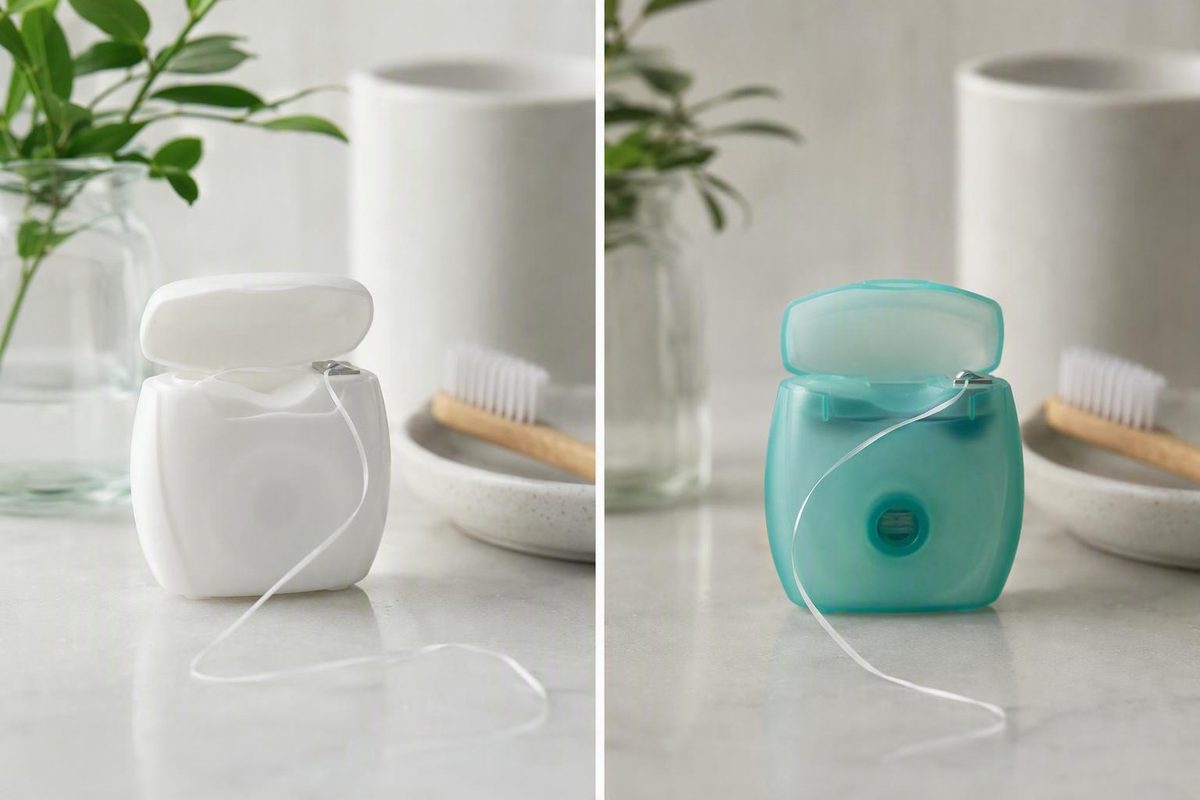
The short answer: neither type is a universal winner
The supplied evidence does not establish that waxed or unwaxed floss is universally better at removing plaque. Several secondary sources report no meaningful difference between them, but the evidence pack contains little direct comparative research and no useful effect sizes. That is not the same as proving that the two types are clinically equivalent. One dental-practice summary cites research finding no statistically significant superiority, but it does not provide enough detail here to support a precise estimate of comparative effectiveness in its waxed-versus-unwaxed discussion.
This article is therefore best read as a qualified usability guide, not as a clinical-effectiveness review. Most of the available comparisons come from oral-care companies, insurers, dental-practice blogs, and affiliate-supported educational material rather than fully described clinical trials or systematic reviews.
The most defensible distinction is between cleaning ability and usability:
- Cleaning depends on whether you can guide the floss against both teeth beside each contact.
- Usability depends on fit, glide, grip, comfort, snagging, and ease of handling.
- Wax can change how floss feels or moves without proving a superior cleaning result.
- Diameter, shape, material, and filament construction may affect performance as much as the coating.
- A product that is comfortable and controllable may be easier to use consistently.
Across the available sources, correct and regular use is emphasized more consistently than coating choice. A practical selection rule is:
- The floss should pass through the contact with gentle, controlled pressure.
- It should bend around each tooth instead of merely dropping through the gap.
- It should come back through the contact without repeatedly catching, shredding, or hurting.
- It should be manageable enough to use as part of a daily routine.
If waxed and unwaxed floss both meet those conditions, either is a reasonable choice. Preference matters because a product that feels unpleasant, slips from your fingers, or repeatedly snags is less useful in practice, regardless of what its packaging promises.
What waxed and unwaxed actually mean
The basic distinction is simple:
- Waxed floss has a surface coating.
- Unwaxed floss does not have that coating.
Waxed floss commonly feels smoother or slicker. Unwaxed floss may feel more textured and provide more tactile feedback. These are typical handling descriptions, not guarantees for every product.
The labels tell you only whether a coating is present. They do not fully describe the material, number of filaments, shape, width, diameter, or resistance to shredding.
Filament construction
Multifilament floss consists of multiple fibers bundled or twisted together. Traditional nylon floss is commonly made this way and may be sold in waxed or unwaxed versions. When its fibers catch on a tight contact or rough area, they can separate, fray, or shred.
Monofilament floss has a single-filament construction and is generally described as more resistant to shredding. It may also have a coating, so monofilament does not necessarily mean unwaxed. Delta Dental distinguishes multifilament nylon from more shred-resistant monofilament products and notes that nylon floss can be waxed or unwaxed in its guide to floss construction.
Not all nylon floss behaves alike.
Shape and diameter
Conventional string floss may be narrow and round or somewhat flattened. Dental tape is generally broader, flatter, and thicker than ordinary string floss. It can be waxed or unwaxed, demonstrating why shape and coating should be considered separately.
A broad tape may feel substantial in an open space but be difficult to pass through a narrow contact. Expandable floss is another distinct format that may feel fuller after entering an open area, although it may not suit a close contact.
Do not assume every waxed product is thicker than every unwaxed one. Wax adds a coating, but the product’s total diameter also depends on its underlying material and design.
Packaging descriptions can help, but a careful real-world comparison is often more informative than the coating label alone.
Waxed versus unwaxed: the practical tradeoffs
The table below separates the defining difference from characteristics that are merely common tendencies.
| Feature | Waxed floss | Unwaxed floss | Evidence limits |
|---|---|---|---|
| Coating | Has a surface coating | Does not have that coating | This is the defining distinction |
| Typical feel | Commonly smoother or slicker | Commonly more textured | Feel varies by material, diameter, coating, and user |
| Glide | Often reported to move through contacts more smoothly | May create more friction or tactile feedback | A thin unwaxed product may still enter more easily than a thicker waxed one |
| Perceived thickness | May feel thicker | Often described as thinner | Product-dependent; neither label gives an exact diameter |
| Grip | Can feel slippery to some users | Texture may make it easier to hold | Finger moisture, technique, and construction also matter |
| Fraying or shredding | Commonly described as less prone to fraying | Multifilament versions may fray or separate more readily | Construction may matter more than coating; neither type is guaranteed not to break |
| Flavor availability | Frequently sold in flavored versions | Often sold unflavored, although exceptions exist | Flavor and coating are separate product choices |
| Important limitations | May feel too thick, slick, or unpleasantly coated | May drag, separate, or break in a tight or rough area | Neither description applies universally |
Waxed floss is commonly selected for smooth movement. Its coating may help the fibers remain together, and some people find that it reduces snagging. Others dislike the slick texture because it is harder to grip, or they find a particular waxed product too large for close contacts.
Unwaxed floss is commonly described as thin and textured. That texture may improve grip or help a user feel where the strand is touching. An unwaxed multifilament product may, however, separate when pulled across a crowded contact or rough restoration.
Most comparison sources in the evidence pack describe waxed floss as more resistant to fraying. At least one dental-practice article reports that some users experience more shredding or breakage with waxed floss. These observations are not based on controlled product-by-product testing, so the disagreement is better treated as evidence of product and user variation than as proof that either account is universally correct. An insurer’s consumer guide likewise presents thinness, grip, glide, and durability as format-dependent tradeoffs rather than guaranteed properties in its comparison of floss types.
Claims that unwaxed floss must remove more plaque because it feels rougher are not well supported by the supplied evidence. It is also unproven that wax causes floss to slide past plaque. Texture alone does not determine whether the strand can be controlled against both tooth surfaces.
Keep flavor separate from coating as well. A floss can be waxed and unflavored, while an unwaxed product may contain other ingredients. Choose flavor according to preference and known sensitivities, not as a proxy for cleaning performance.
Tight teeth: separate fit from glide
Conflicting advice about close contacts often comes from treating two different properties as if they were the same:
- Diameter affects whether the strand is small enough to enter.
- Surface and construction affect how smoothly it moves once entry begins.
A thin unwaxed product may fit through a contact that is too narrow for a thicker alternative. A smooth waxed product may move more readily through a close contact once its diameter fits. UnitedHealthcare similarly describes waxed floss as commonly stronger but potentially difficult where teeth are very close, while unwaxed floss may be thinner but more likely to fray or break in its practical floss-selection guidance.
Neither waxed nor unwaxed tells you the product’s exact diameter. The labels also do not reveal whether it is multifilament string, monofilament floss, or broad dental tape.
Use a two-step test.
Step 1: Does it fit?
Apply gentle, controlled pressure. A small side-to-side motion may help guide the floss through the contact.
If the product will not enter without substantial force, try a thinner string. That could be unwaxed, but it could also be a thin coated or monofilament product. Focus on actual fit rather than assuming that every unwaxed strand is narrow.
Do not compensate for poor fit by forcing the floss abruptly through the contact.
Step 2: Can you move it with control?
Once the strand is through, check whether it can:
- move without severe dragging;
- curve around one tooth at a time;
- travel gently along the side of each tooth;
- come back through the contact without repeated snagging.
If a thin product fits but drags, separates, or becomes difficult to maneuver, a smoother coated or shred-resistant construction may be easier to control.
Do not snap floss through a tight contact. If gentle pressure cannot pass a suitably thin product, or the contact is painful, stop forcing the site and ask a dental professional to assess it.
Fillings, crowns, braces, bridges, implants, and retainers
Dental work changes the selection problem. Instead of asking only whether floss should be waxed or unwaxed, consider:
- Can the cleaning material reach the intended area?
- Does it repeatedly snag or separate?
- Can it pass beneath or around the appliance?
- Is conventional string floss suitable for that particular design?
The supplied recommendations for dental work are mainly practical guidance, not direct comparative evidence showing that one coating produces better clinical outcomes.
Fillings and crowns
Multifilament floss can fray when it catches on a tight contact or rough area near a restoration. If ordinary floss repeatedly separates, consider a monofilament or another product specifically described as shred-resistant.
Repeated fraying does not prove that a filling or crown is defective. Still, a strand that consistently catches at the same tooth provides useful information to report during a dental visit.
Avoid repeatedly pulling loose fibers back and forth through the site. If the contact cannot be cleaned safely or is persistently painful, professional assessment is appropriate.
Braces and fixed retainers
A fixed wire can block the usual path of string floss. Depending on the appliance, options may include:
- a floss threader;
- orthodontic floss;
- super floss with a stiffened section;
- an interdental brush where there is enough space;
- another tool recommended by the treating dental team.
A threader helps carry floss beneath a wire; it does not perform the cleaning by itself. After threading, the cleaning section must still be guided carefully against the relevant tooth surfaces.
Some practical sources favor waxed floss around braces because it may glide or fray less. That is not strong comparative clinical evidence, and access or filament construction may matter more than coating.
Bridges and implants
A bridge may require cleaning beneath its connected replacement tooth, where conventional over-the-contact flossing cannot reach. Depending on the bridge design, a threader, super floss, expandable floss, or a suitably sized interdental tool may provide access.
It would therefore be misleading to call waxed or unwaxed string floss categorically safest for every implant. Follow the treating dental team’s instructions for the specific restoration rather than assuming that all interdental tools are interchangeable.
General dental-practice guidance lists threaders, orthodontic floss, super floss, and other specialized devices as possible options around braces, bridges, and implants, while also emphasizing gentle use rather than forcing a tool into place in its flossing overview.
Seek professional assessment when floss repeatedly catches at one restoration, cannot be passed safely, or causes persistent pain. These signs identify a practical problem but do not establish its cause.
A decision guide for choosing your floss
Choose according to the problem you can observe rather than a broad marketing label.
If the floss will not fit
Prioritize a smaller diameter.
- Try a thinner string instead of forcing the current product.
- Do not assume that “unwaxed” guarantees thinness.
- Avoid broad dental tape where ordinary string already cannot enter.
- Stop if passing the strand requires abrupt force.
If the floss fits but drags
Prioritize smooth, controllable movement.
- Compare a coated product with the current strand.
- Consider a different filament construction.
- Avoid excessive finger tension that makes the strand rigid.
- Choose a product that can move while still wrapping against each tooth.
If the floss repeatedly frays or shreds
Prioritize construction and snag resistance.
- Try monofilament or another product labeled shred-resistant.
- Notice whether the problem occurs throughout the mouth or at one contact.
- If the same filling, crown, or tooth catches the strand every time, report the exact location to a dental professional.
- Do not continue sawing detached fibers through the site.
If the floss slips from your fingers
Prioritize grip and handling.
- Try a more textured strand.
- Dry your fingers before starting.
- Wind the floss around the middle fingers and control a short section with the thumbs and index fingers.
- Consider a holder or preloaded pick if loose string is impractical.
A handle may solve a gripping problem, but it does not eliminate the need to guide the cleaning section against both tooth surfaces. Dental-practice guidance identifies holders and preloaded picks as possible aids for people with limited dexterity in its technique discussion.
If your spaces are relatively wide
A broader or fuller product may feel easier to control.
- Dental tape provides a flatter, wider format.
- Expandable floss may suit some open spaces.
- An interdental brush may be practical where it enters without force.
The available evidence does not provide a universal gap measurement for switching from string floss to a particular brush size. Do not force a brush into a space or select a size based only on a broad packaging claim.
If hand control is limited
A holder or preloaded pick may reduce the finger coordination required for loose string. Some fixed appliances will still require a threader or specialized design.
Whatever format you use, check whether you can guide the cleaning section along both sides of the contact. Merely pushing a pick or holder through the gap does not necessarily provide the same controlled contact as curving string floss around each tooth.
A simple home comparison
You do not need to buy every product in the aisle. Choose one basic waxed floss and one basic unwaxed floss with reasonably similar shapes, then compare them during ordinary use.
Consider:
- entry through close contacts;
- smoothness of movement;
- grip;
- control around each tooth;
- snagging or shredding;
- comfort at the gumline;
- ease of removal;
- willingness to use the product again.
If one option performs better on most of those practical measures, it is probably the more suitable choice for your routine. Different areas of the mouth may also have different access needs—for example, a thin string for close contacts and a specialized tool beneath a fixed appliance.
The winning product is not the one with the strongest packaging claim. It is the one you can use comfortably and consistently against both sides of each contact.
Technique matters more than the label
A smooth strand used carelessly can miss tooth surfaces. A textured strand used with control may work well, and the reverse is also true.
General consumer guidance commonly recommends cleaning between the teeth once daily. It also describes flossing before or after brushing as workable when the technique is thorough and consistent. The same guidance supports using approximately 18 inches of floss, guiding it gently, forming a C-shape around each tooth, and advancing to a clean section in its flossing instructions.
A standard string-floss technique is:
- Start with approximately 18 inches of floss. Wind most of it around one middle finger and a smaller amount around the other.
- Control a short working section. Hold it between the thumbs and index fingers instead of leaving a long, loose span.
- Guide it gently through the contact. Use controlled pressure and a small side-to-side motion if needed. Do not snap it into the gum.
- Curve it around the first tooth. Form a C-shape so the strand lies against the tooth rather than stretching straight across the space.
- Clean the tooth surface. Move gently along the side of the tooth and just below the gumline without forcing the strand deeply into the tissue.
- Repeat against the neighboring tooth. Passing once through the contact does not automatically clean both surfaces.
- Remove it carefully. Guide it back through the contact instead of jerking it out.
- Advance to a clean section. Continue around the mouth using an unused part of the strand.
- Discard the used strand. Do not return it to the container or save it for later use.
For related general reading about brushing limitations and interdental cleaning, see What Daily Brushing Cannot Fix.
Decay Guide publishes general dental-health information. It is not a dental practice and does not diagnose, treat, or provide individual dental advice, as explained on its About page.
Troubleshooting discomfort, shredding, and difficult access
Use the observable problem to decide what should change.
- Floss will not enter: Try a thinner product. Do not force or snap the current strand through.
- Floss enters but drags: Compare both diameter and surface glide rather than switching only by wax label.
- Floss shreds: Try monofilament or another shred-resistant construction. Note whether the snag occurs everywhere or at one location.
- Floss breaks: Reduce abrupt force and test another construction. Breakage alone does not identify whether the cause is coating, contact shape, or technique.
- Waxed floss feels too slippery: Try a more textured strand, dry your fingers, or use a holder that improves control.
- Unwaxed floss feels harsh or catches: Try a smoother coated product or a shred-resistant monofilament with a suitable diameter.
- Floss cannot pass beneath an appliance: Consider a threader, orthodontic floss, super floss, or another device intended for that type of access.
- A wide space is awkward with string: Dental tape, expandable floss, or a correctly fitting interdental brush may be easier to manage.
- Loose string is impractical to hold: A floss holder or preloaded pick may help, although it may not provide suitable access around every appliance.
Threaders, super floss, interdental brushes, holders, and picks solve different problems. A threader changes access, a holder changes grip, and an interdental brush uses a different cleaning action. They should not be treated as automatically interchangeable.
Reactions to treated-floss materials are possible, but the supplied evidence does not establish their frequency or justify declaring any coating, flavor, or material categorically safe or dangerous. If one product appears to cause recurring irritation, stop using it and retain the packaging so its ingredients can be discussed with a qualified professional.
Seek dental advice for persistent pain, substantial or ongoing bleeding, inability to clean a site safely, or repeated catching in the same location. The available evidence does not support a universal amount or duration of bleeding that reliably separates normal from abnormal.
Common questions about floss waxed vs unwaxed
Does unwaxed floss remove more plaque than waxed floss?
That has not been established. Some secondary articles speculate that a more textured unwaxed strand may grip the tooth better, but they do not provide strong comparative evidence demonstrating superior plaque removal. Another dental-practice summary reports no statistically significant superiority for either type while emphasizing personal fit and regular use in its comparison.
The absence of demonstrated superiority does not prove perfect clinical equivalence. It means that coating alone is not a sound basis for declaring a winner. The practical question is whether the strand can be controlled against both teeth beside each contact.
Which floss is better for very tight teeth?
Choose by diameter first and glide second.
A thin unwaxed strand may enter a narrow contact more readily. A waxed strand may move more smoothly if its diameter is small enough to fit. Because neither label guarantees a particular thickness, inspect the format and test it with gentle pressure.
If the floss will not enter, try a thinner product. If it enters but drags or shreds, try a smoother or more shred-resistant construction. Dental-practice guidance likewise warns against snapping floss through contacts and emphasizes gentle movement around each tooth in its technique explanation.
Which type is less likely to shred around fillings or crowns?
Waxed floss is commonly described as less prone to fraying than unwaxed multifilament floss, but coating is not the only factor. Monofilament or specifically labeled shred-resistant floss may be a more useful selection than relying on wax status alone.
If the strand repeatedly catches beside the same filling or crown, do not assume that the restoration has failed. Try a shred-resistant construction and ask a dental professional to assess the site if catching continues, cleaning is impossible, or the area remains painful. Multifilament nylon can shred at tight contacts or rough fillings, while monofilament products are generally described as more resistant to that problem in Delta Dental’s construction guide.
Is waxed floss safe if it leaves a residue or contains flavoring?
A detectable coating, taste, or residue does not by itself show that the product is harmful, and the supplied evidence does not establish that wax residue reduces cleaning effectiveness. It would also be too broad to declare every coating, flavor, or additive safe for every person.
Coating and flavor are separate variables. Check the ingredient information if you have known sensitivities. If a product repeatedly appears to cause irritation, stop using it and discuss the reaction with a dental professional. A dental-practice article notes that flavored products can contain ingredients that some users find irritating, but it provides no frequency estimate or basis for generalizing that response to all flavored or waxed floss in its discussion of flavored floss.
What can I use if ordinary string floss does not work with braces, a bridge, or limited dexterity?
Depending on the access or handling problem, possible options include:
- a floss threader for carrying floss beneath a wire or bridge;
- orthodontic floss or super floss with a stiffened threading section;
- an interdental brush where there is sufficient space;
- expandable floss for some wider spaces or bridge areas;
- a holder or preloaded pick when loose string is difficult to control;
- another appliance-specific tool recommended by the treating dental team.
These products are not universally interchangeable. The appropriate choice depends on the appliance, available space, tissue contours, and whether the device can be used without force. General practice guidance lists threaders, orthodontic floss, and super floss among the options for braces, bridges, and implants, but individual instructions should come from the team familiar with the appliance.
The final rule is fit first. Do not choose solely from the words waxed or unwaxed. Check whether the product is thin enough to enter, smooth enough to move without force, controllable enough to wrap around both teeth, and durable enough to complete the routine. If both types work, use the one you prefer and will use consistently. If neither works—or floss repeatedly catches, hurts, or causes substantial or persistent bleeding—a qualified dental professional can assess the site and recommend an appropriate interdental tool.