
What to Know Before Changing Your Smile With Dental Bonding
Adding resin may make a mildly irregular tooth look straighter from the front, but it cannot move it, create room in a crowded arch or change how teeth meet.
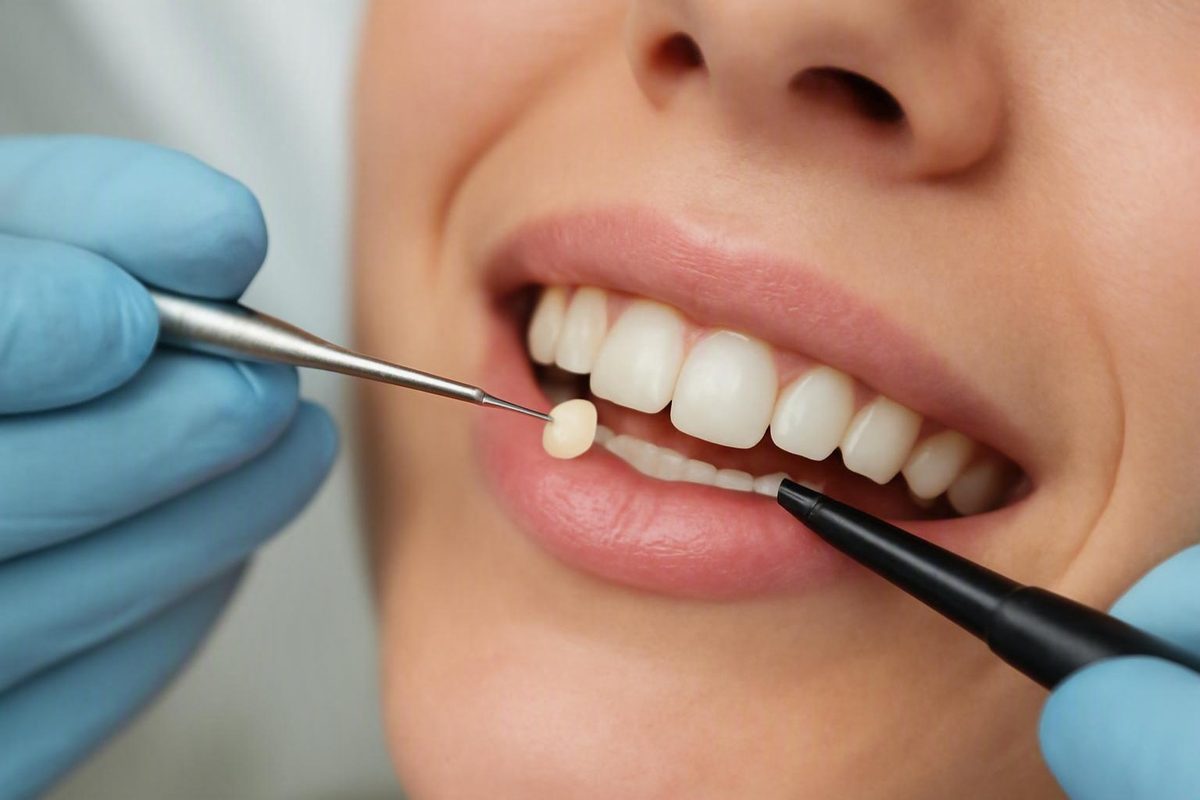
Composite bonding can make a small chip, narrow gap, worn edge, localized discoloration, or shape difference less noticeable. In many limited cases, the dentist applies and shapes the material directly during one appointment, often without the substantial tooth reduction associated with conventional porcelain restorations.
That convenience does not make the result permanent or universally predictable. Composite resin can stain, wear, chip, or need replacement. It cannot move crowded teeth, correct an underlying bite problem, or restore every badly damaged tooth.
Published costs, treatment times, and lifespan ranges are therefore useful only for orientation.
Editorial disclosure: Decay Guide is an educational publication written by a health writer, not a dentist, and its articles are not clinician-reviewed. This guide cannot determine whether bonding is suitable for you and does not replace a dental examination. Read more about how Decay Guide is written.
What composite bonding is—and what it actually changes
Composite bonding, dental bonding, and teeth bonding are overlapping names for a procedure in which a dentist applies tooth-colored composite resin directly to a tooth. The material is moldable during placement. The dentist shapes it, hardens it with a curing light, adjusts the contour, and polishes the surface.
Bonding can alter a tooth’s visible:
- Shape
- Apparent width or size
- Length
- Edge position
- Surface contour
- Color
Common limited uses include concealing a minor chip or small crack, narrowing a small space, masking some discoloration, smoothing an uneven edge, or making a short tooth appear longer. Cleveland Clinic describes bonding as a treatment that can change tooth shape, size, or color and address concerns such as minor chips and gaps, while presenting it primarily as an option for relatively small cosmetic changes (Cleveland Clinic’s medically reviewed dental bonding guide).
The key limitation is that bonding changes appearance, not tooth position. Adding resin may make a mildly irregular tooth look straighter from the front, but it does not rotate or move the tooth, create room in a crowded arch, or change how the upper and lower teeth meet. Those concerns call for an orthodontic or bite assessment rather than an assumption that resin can correct them.
Bonding should also be distinguished from a composite filling. The materials may be related, but the treatment objectives differ:
- Cosmetic bonding primarily changes visible shape, proportion, or color.
- A composite filling restores structure lost to decay or damage.
- An edge repair may have both cosmetic and restorative purposes.
- A full-surface composite veneer covers more of the visible tooth than a small localized repair and may have different maintenance demands.
These categories can overlap. A dentist may use composite to repair a damaged edge while also improving its appearance, but that does not make every composite restoration the same treatment.
Bonding is generally most appropriate when the desired change is limited and enough sound tooth structure remains to support the material. Adding a small amount of resin to a chipped edge is different from rebuilding a substantially weakened tooth or covering many visible surfaces. More extensive concerns may require broader planning, several appointments, or a different treatment.
A perfectly invisible result cannot be guaranteed. Natural teeth vary in color, translucency, texture, and reflection. A dentist may combine shades or layers to imitate those features, but the final appearance still depends on the starting tooth, the size of the defect, the resin, finishing and polishing, and the clinician’s technique.
Who may be a suitable candidate—and when bonding is not enough
A preliminary checklist for discussing composite bonding includes:
- The concern is small or localized.
- The desired result can be achieved without adding an impractical amount of material.
- The tooth and surrounding tissues are healthy enough for elective treatment.
- The proposed bonding will not be exposed to forces that make failure especially likely.
- Expectations are realistic about shade matching, maintenance, repair, and replacement.
- Habits such as grinding, nail biting, chewing pens, or crunching ice have been discussed.
Existing decay may need treatment before elective bonding. A visible surface improvement does not treat disease underneath the resin, and only a dentist can determine whether the concern is primarily cosmetic or restorative.
A concern-based framework is more useful than asking whether bonding is generally “good”:
| Concern | Could bonding be considered? | Why further assessment matters |
|---|---|---|
| Small chip on an otherwise healthy tooth | Often | The cause of the chip and the bite still matter |
| Uneven or worn edge | Possibly | Ongoing grinding or concentrated force may damage a repair |
| Narrow gap | Possibly | Added width must remain proportionate to the neighboring teeth |
| Mild localized discoloration | Possibly | Some underlying colors may be difficult to mask |
| Generalized discoloration of natural teeth | Consider whitening assessment first | Treating many teeth with resin may be more extensive than necessary |
| Crowding or rotation | Bonding may only disguise it | Orthodontics addresses tooth position rather than adding bulk |
| Extensive decay or a major crack | Not simply a cosmetic-bonding concern | Restorative assessment is needed |
| Substantial loss or weakness of tooth structure | Bonding alone may be inadequate | A crown or another restoration may be considered |
Gap closure is not automatically suitable just because resin can fill a space. Composite is added to one or both teeth beside the gap. The dentist must assess whether the proposed result is realistic rather than judging the gap in isolation.
For chipped or worn edges, the cause matters. A one-time accident presents a different situation from repeated grinding, nail biting, pen chewing, or ice chewing. Provider comparison guidance identifies bite force, grinding, nail biting, pen chewing, and the size and location of a defect as factors that may influence treatment choice and longevity (Cottage Grove Dental Care’s bonding-versus-veneers comparison).
Treatment extent also changes the decision. Repairing one small defect is not equivalent to adding composite across several teeth or covering most of their visible surfaces. General lifespan figures should not be assumed to predict all of these designs equally.
Only an examination can determine candidacy.
Cosmetic planning should also be kept separate from urgent care. A tooth with severe or sudden pain, swelling, looseness, a major break, or possible exposure of its inner tissue needs prompt clinical assessment rather than a routine cosmetic consultation. These urgent triggers are identified in a local dental-practice guide; because the supplied evidence does not include national urgent-care guidance, use them as a reason to contact a dental professional rather than as a basis for self-diagnosis (Dentist of West Covina’s urgent-symptom overview).
The composite bonding procedure, step by step
The exact appointment varies with the tooth and the treatment plan, but a typical cosmetic-bonding procedure follows these stages.
- Consultation and examination
The dentist asks what you want to change and examines the tooth, surrounding tissues, existing restorations, and bite. The aim is to distinguish a limited cosmetic imperfection from decay, fracture, wear, or a tooth-position problem. The discussion should cover alternatives, the number of teeth involved, likely preparation, maintenance, and realistic limitations.
- Planning shape and proportions
Planning may be straightforward for a small chip. Gap closure, treatment across several teeth, or a larger shape change requires closer attention to width, length, symmetry, and the amount of resin that would be added. Some practices use photographs, digital planning, or a trial mock-up, although these tools are not necessary for every case and do not replace an examination.
- Shade selection
The dentist chooses resin intended to coordinate with the surrounding tooth structure. This may involve the main tooth color as well as differences in translucency or brightness. The objective is a close match, not a guaranteed perfect match.
- Cleaning and surface preparation
The tooth is cleaned and kept suitably dry. Its surface is commonly lightly roughened or etched, and a conditioning or bonding liquid is applied to help the resin adhere. This is why minimally invasive should not be interpreted as nothing is done to the tooth surface.
- Resin placement and sculpting
The composite is applied directly to the tooth and shaped. It may be built in layers to create the intended contour, thickness, color, or edge. The amount and design depend on whether the dentist is repairing a small defect, changing length, or covering a larger visible area.
- Light curing
A curing light hardens the material. When the resin is placed in layers, individual layers may be cured during the build-up rather than only once at the end.
- Finishing and bite adjustment
The dentist trims and refines the hardened resin. Bite contacts may be checked with marking material, particularly when the bonding changes a biting edge or surface.
- Smoothing and polishing
The surface is polished to refine its texture and shine. Final appearance depends on more than shade: contour, smoothness, texture, and light reflection also affect how well the resin coordinates with the tooth.
A commonly published orientation is approximately 30 to 60 minutes per tooth, but it is not a guaranteed appointment length. Several teeth, complex layering, removal of old resin, or more extensive planning may require a longer visit or more than one appointment (Premier Dental’s procedure-time guide).
Bonding is often described as minimally invasive because substantial enamel reduction can frequently be avoided. It is not universally preparation-free.
Pain, anesthesia, recovery, and the first days afterward
Local anesthesia is often unnecessary for straightforward cosmetic bonding because major tooth reduction is usually not involved. That expectation can change when decay is being treated, a sensitive or damaged area is involved, or another procedure is performed at the same appointment.
It is more accurate to describe bonding as often comfortable than universally painless. Individual sensitivity and treatment circumstances vary. Slight, temporary sensitivity to hot or cold may occur after treatment, according to provider aftercare guidance (Envisage Dentistry’s procedure and recovery overview).
Formal downtime is generally limited for uncomplicated cosmetic bonding. The tooth may initially feel unfamiliar because the tongue can notice small contour changes. A sensation of newness is different from a bite that remains painful or clearly uneven.
Recommendations about eating and staining drinks vary among practices. Some advise temporary restrictions on coffee, tea, red wine, tobacco, hard foods, or strongly colored foods; others do not give a fixed timetable. The supplied evidence does not establish one universal restriction period for every resin, procedure, and patient. Follow the instructions from the dentist who treated you.
Before leaving, consider asking:
- When can I eat normally?
- Are there foods or drinks I should temporarily avoid in my case?
- What degree of sensitivity is expected?
- Was the repair in contact with the opposing tooth when my bite was checked?
- Who should I contact if the edge feels rough or the bite feels high?
- Is an early adjustment included in the treatment fee?
Contact the treating practice if discomfort persists, the bite feels wrong, or the resin develops a sharp or rough edge. The dentist needs to assess whether the problem involves excess material, a bite contact, a chip, or the underlying tooth.
Benefits, limitations, and what “reversible” really means
The potential advantages of composite bonding are practical:
- The material is applied directly rather than made as a separate laboratory restoration.
- Many limited cases can be completed in one visit.
- Substantial enamel reduction can often be avoided.
- Upfront cost is generally presented by provider sources as lower than porcelain cosmetic treatment.
- Resin can be shaped and polished directly on the tooth.
- A localized defect may sometimes be repaired without replacing all the material.
- Treatment can be limited to one tooth when only one tooth needs a small change.
These benefits are strongest when the problem is genuinely limited. Using a small amount of resin to restore an edge is a different commitment from covering several teeth or trying to disguise a significant position problem.
Composite also has important limitations. It can:
- Accumulate stain
- Lose surface gloss
- Become rougher with wear
- Chip or fracture
- Develop a visible color difference from the surrounding tooth
- Need polishing, repair, or replacement
- Have less predictable long-term stain resistance than porcelain
The material alone does not determine the result. The starting tooth color, defect size, amount of resin, moisture control, layering, contour, bite adjustment, finishing, and clinician’s execution all matter. Neither composite nor porcelain can be promised to look more natural in every case.
Is bonding reversible?
Bonding is often described as more reversible than porcelain veneers because it commonly avoids the substantial enamel reduction associated with many conventional veneer preparations. That comparison is useful, but the word reversible can create the wrong expectation.
The tooth surface is commonly etched or roughened. A dentist-authored discussion notes that removing old composite without taking a small amount of tooth structure can be difficult; this is professional commentary rather than an independent clinical review (Enlighten Smiles’ dentist-authored composite-versus-porcelain discussion).
Damage-free removal therefore cannot be guaranteed.
The more accurate trade-off is:
Bonding can conserve tooth structure and reduce the initial treatment commitment, but it may require more maintenance and provide less predictable long-term color stability than porcelain.
That trade-off may be appealing for a healthy tooth requiring a small change. It should still be considered over the expected life of the tooth, not only at the first appointment.
How long composite bonding lasts—and why estimates vary
A broad patient-education estimate is that composite bonding may last about three to 10 years before touch-up or replacement. Cleveland Clinic gives this range while emphasizing that longevity depends on treatment extent and oral habits; it is not a warranty or a prediction for a particular tooth (Cleveland Clinic’s bonding lifespan guidance).
Provider pages publish narrower, conflicting estimates:
- Farag Dentistry gives an estimate of three to five years before repair (Farag Dentistry’s service-life estimate).
- Envisage Dentistry gives a range of four to seven years with care and regular check-ups (Envisage Dentistry’s lifespan estimate).
- All Smiles Dental Care gives a typical estimate of five to seven years while also describing broader ranges elsewhere on its page (All Smiles Dental Care’s bonding comparison).
These figures come from patient-education or commercial provider pages rather than a uniform clinical standard. Their disagreement may reflect different treatment types, tooth locations, restoration sizes, bite forces, oral habits, materials, techniques, maintenance assumptions, and definitions of failure.
A small edge repair and a full-surface composite veneer should not automatically be expected to behave identically. Nor does “survival” necessarily mean “looks unchanged.” Resin may remain attached while developing:
- Staining
- Reduced gloss
- Surface wear
- Roughness
- A small chip
- A visible color difference
One patient may accept polishing or a small repair, while another may regard a subtle cosmetic change as a reason for replacement.
A localized defect does not always require complete replacement. Depending on the condition of the material and tooth, a dentist may prepare the affected area, add composite, refine the contour, and polish it. More extensive fracture, discoloration, or repeated failure may make replacement more practical.
When a dentist provides a lifespan estimate, ask what it means:
- Remaining attached?
- Remaining free from any chip?
- Remaining cosmetically acceptable?
- Avoiding all polishing or adjustment?
- Avoiding complete replacement?
- Assuming grinding or object-biting is controlled?
- Assuming a recommended protective appliance is used?
No general range can predict how often one patient will need polishing, repairs, or replacement over the next several years. The most useful estimate is one tied to the specific tooth, restoration design, bite, and habits.
Cost, insurance, and the price beyond the first appointment
Composite bonding is commonly priced per tooth, although a quote may also reflect overall complexity and treatment scope. Cost can vary with:
- Number of teeth
- Size and location of each addition
- Whether old composite must be removed
- Complexity of shade matching or layering
- Bite adjustment
- Practice and geographic location
- Whether the procedure is cosmetic, restorative, or both
- Follow-up, repair, and replacement policies
Published provider prices vary substantially. Aspen Dental lists $119 to $343 per tooth, depending on factors including tooth count and treatment complexity (Aspen Dental’s published bonding cost guide).
A California dental-practice article quotes $300 to $800 per tooth for its market (Dentist of West Covina’s California cost example).
Together, these examples span approximately $119 to $800 per tooth, but they are not a national market range, a guaranteed quote, or a reliable basis for calculating an individual bill. They come from particular commercial providers or regions and may not include equivalent services.
A written quote should identify:
- Which teeth are included
- Whether the fee is per tooth or for the whole case
- Whether consultation and diagnostic work are separate
- Whether removal of old resin is included
- Whether initial bite adjustments are included
- Whether polishing or minor repairs carry another fee
- Whether there is a short-term adjustment or repair policy
- What complete replacement would cost
- Whether a protective appliance is recommended and separately priced
- Any financing interest, charges, or payment conditions
The lowest initial quote is not automatically the lowest long-term cost. Composite may have a lower upfront fee than porcelain, but it may also need maintenance or replacement sooner. That does not prove porcelain will cost less over time: porcelain requires a greater initial financial and treatment commitment and may itself eventually need repair or replacement.
Insurance is case-specific. Purely cosmetic bonding may be excluded, while treatment connected with decay, injury, or function may sometimes receive benefits depending on the plan, indication, coding, deductibles, exclusions, and annual limits. A provider article describes that distinction but does not establish a right to coverage or a promise of payment (SA Family Dentist’s cost and insurance overview).
Before treatment, request the proposed procedure codes and written treatment plan, then ask the insurer:
- Is this code covered for this clinical indication?
- Is preauthorization required?
- Does the plan distinguish cosmetic and restorative bonding?
- What deductible or annual limit applies?
- Is the dentist in network?
- Would a future repair be treated differently from initial placement?
- What balance would I owe if the insurer pays less than estimated?
Clarify both the provider’s charges and the insurer’s conditions before proceeding.
Bonding versus veneers, crowns, whitening, and orthodontics
The best comparison begins with the problem being treated. These options do different jobs even though each can affect how a smile looks.
Bonding versus porcelain veneers
Bonding is generally the more conservative and quicker option for a small chip, narrow gap, or localized shape change. The dentist places the material directly, and substantial enamel reduction can often be avoided.
Porcelain veneers are custom-made shells placed over the fronts of teeth. Provider comparisons generally present them as more stain-resistant and longer-lasting than composite, but also more expensive and more likely to involve enamel alteration and multiple treatment stages. The exact preparation varies, so veneer treatment should not be treated as one uniform procedure (Cottage Grove Dental Care’s veneers-versus-bonding comparison).
The choice is not simply “temporary versus permanent.” Both treatments may eventually need maintenance or replacement. More useful questions are:
- How much healthy tooth structure would be altered?
- How extensive is the desired change?
- How important is stain resistance?
- How much maintenance is acceptable?
- Is the proposed treatment limited to one tooth or several?
- What happens if the appearance needs to be changed later?
Bonding versus crowns
A crown covers substantially more of a tooth than localized cosmetic bonding. Bonding may be considered for a minor visible defect on an otherwise sound tooth. A heavily decayed, deeply cracked, or substantially weakened tooth needs restorative assessment because appearance is not the only concern.
A crown is not automatically necessary for every damaged tooth, and bonding is not automatically sufficient. The appropriate treatment depends on the remaining tooth structure, type of damage, previous restorations, bite, and examination findings.
Bonding versus orthodontics
Bonding adds material; orthodontics moves teeth. Composite may disguise a small visual irregularity, but it does not correct:
- Crowding
- Tooth rotation
- Root position
- Lack of space
- An underlying bite problem
Bonding versus whitening
Whitening changes the color of natural tooth structure. It does not repair a chip, close a space, or alter tooth shape. Bonding can change shape and cover selected areas, but existing composite does not lighten with conventional tooth-whitening treatment.
If whitening and bonding are both planned, discuss the order before the resin shade is selected. Provider guidance recommends whitening first so the final composite can be coordinated with the resulting natural-tooth shade (All Smiles Dental Care’s whitening and bonding guidance).
A compact decision guide
| Main concern | Assessment to consider first |
|---|---|
| Small chip or localized edge defect | Composite bonding may be suitable |
| Modest shape or length difference | Bonding may be suitable if the amount of material is practical |
| Narrow gap | Bonding may work if the resulting tooth widths remain proportionate |
| Generalized natural-tooth discoloration | Whitening assessment |
| Crowding, rotation, or bite problem | Orthodontic assessment |
| Major crack, extensive decay, or substantial weakness | Restorative evaluation |
| Broad changes across several visible tooth surfaces | Compare bonding with veneers and other options |
The decision depends on oral health, defect size, remaining tooth structure, bite, budget, aesthetic priorities, tolerance for maintenance, and willingness to accept irreversible tooth alteration.
How to protect bonded teeth and recognize a problem
Bonded teeth generally need consistent oral care rather than a special hygiene system. Brush regularly, clean between the teeth, and attend dental examinations and cleanings on a schedule appropriate to your oral health.
Avoid using bonded teeth as tools. Concentrated force can damage an edge, so provider aftercare guidance advises against habits such as:
- Biting fingernails
- Chewing pens or pencils
- Crunching ice
- Opening packages
- Holding or tearing hard objects with the teeth
Coffee, tea, red wine, tobacco, dark sauces, and other strongly colored exposures may contribute to composite discoloration over time. This does not establish that one fixed abstinence period will prevent staining.
If you grind or clench, tell the dentist before treatment. Grinding and bite force are among the factors provider sources associate with bonding wear or damage. A protective appliance may be appropriate for some people, but the need for one should be assessed individually rather than assumed for every patient.
Future shade changes also need planning. Existing composite does not lighten with conventional whitening, so whitening the surrounding natural teeth can make previously matched bonding look darker by comparison. Depending on the condition of the material, a dentist may discuss polishing, modification, repair, or replacement.
Arrange a nonurgent review if you notice:
- A sharp or rough edge
- A visible chip
- Increasing discoloration
- Persistent sensitivity
- Gum irritation around the bonded area
- A bite that feels different
- Repeated food trapping around the restoration
Cleveland Clinic specifically advises contacting a dentist when bonding develops a sharp edge or feels abnormal during biting. Do not file or reshape the material yourself.
Seek prompt clinical assessment for severe pain, swelling, tooth looseness, a major fracture, or suspected exposure of the tooth’s inner tissue. These findings should not be treated as routine cosmetic maintenance.
Take this checklist to a consultation:
- What did the examination find about the tooth and bite?
- Is the concern cosmetic, restorative, orthodontic, or a combination?
- What alternatives address the underlying problem?
- How much surface preparation or enamel alteration is expected?
- Can the proposed gap closure or reshaping preserve reasonable proportions?
- Should whitening occur before shade selection?
- What appearance limitations should I expect?
- What lifespan is realistic for this tooth and repair design?
- Does that estimate refer to attachment, appearance, or freedom from maintenance?
- Could a small future chip be repaired?
- What would repair or replacement cost?
- What is included in the written quote?
- Which follow-up adjustments are included?
- How could grinding, clenching, or other habits affect the result?
- What ongoing maintenance is likely?
Composite bonding is best understood as a conservative option for selected, limited changes—not a universal substitute for orthodontic or restorative care. Its principal attraction is the possibility of improving appearance while preserving more natural tooth structure. The corresponding trade-off is accepting possible staining, chipping, polishing, repair, and eventual replacement.
An individualized examination and written quote are more useful than before-and-after photographs or broad online ranges. Use the consultation checklist to compare options and make sure the proposed treatment addresses the condition of the tooth, not only its appearance.
Can composite bonding fix crooked teeth?
Composite bonding can sometimes disguise a small visual irregularity by changing the visible contour. It does not move the tooth, correct root position, create space, or treat an underlying bite problem.
For genuine crowding or rotation, an orthodontic assessment addresses the tooth’s position rather than masking it with added material.
Can composite bonding be whitened after treatment?
No. Conventional tooth whitening changes natural tooth structure but does not lighten existing composite resin. If the surrounding teeth are whitened later, the bonding may become darker by comparison.
If you want both treatments, discuss whitening before final shade selection. Bonding that no longer matches may need professional polishing, modification, or replacement rather than whitening.
Can chipped or stained bonding be repaired instead of replaced?
Sometimes. A localized chip may be treated by preparing the affected surface, adding resin, refining the contour, and polishing it. Stained composite may sometimes be professionally polished, although replacement may be necessary in other cases.
A dentist-authored comparison confirms that chipped composite can sometimes be repaired and stained material polished, while noting that replacement may still be needed depending on its condition (Enlighten Smiles’ composite repair discussion).
Is composite bonding completely reversible?
Not necessarily. It is often described as more reversible than porcelain veneers because major enamel reduction can frequently be avoided. However, the surface is commonly etched or roughened, and separating tooth-colored resin from the underlying enamel can be difficult.
Damage-free removal cannot be guaranteed. Previous preparation, the amount of material, removal technique, and repeated repair or replacement all affect whether the tooth remains entirely unchanged.
When should a bonded tooth be checked by a dentist?
Request a review if the bonding feels sharp or rough, develops a visible chip, becomes increasingly discolored, remains sensitive, irritates the surrounding gum, traps food repeatedly, or makes the bite feel abnormal. Do not attempt to file or reshape it yourself.
For severe symptoms or a major break, follow the prompt-care guidance above rather than treating the problem as cosmetic maintenance.