
What Bleeding During Flossing Can—and Cannot—Tell You
Inflammation and technique injury can overlap: inflamed tissue is easier to injure, and a forceful slip can make an irritated site bleed more.
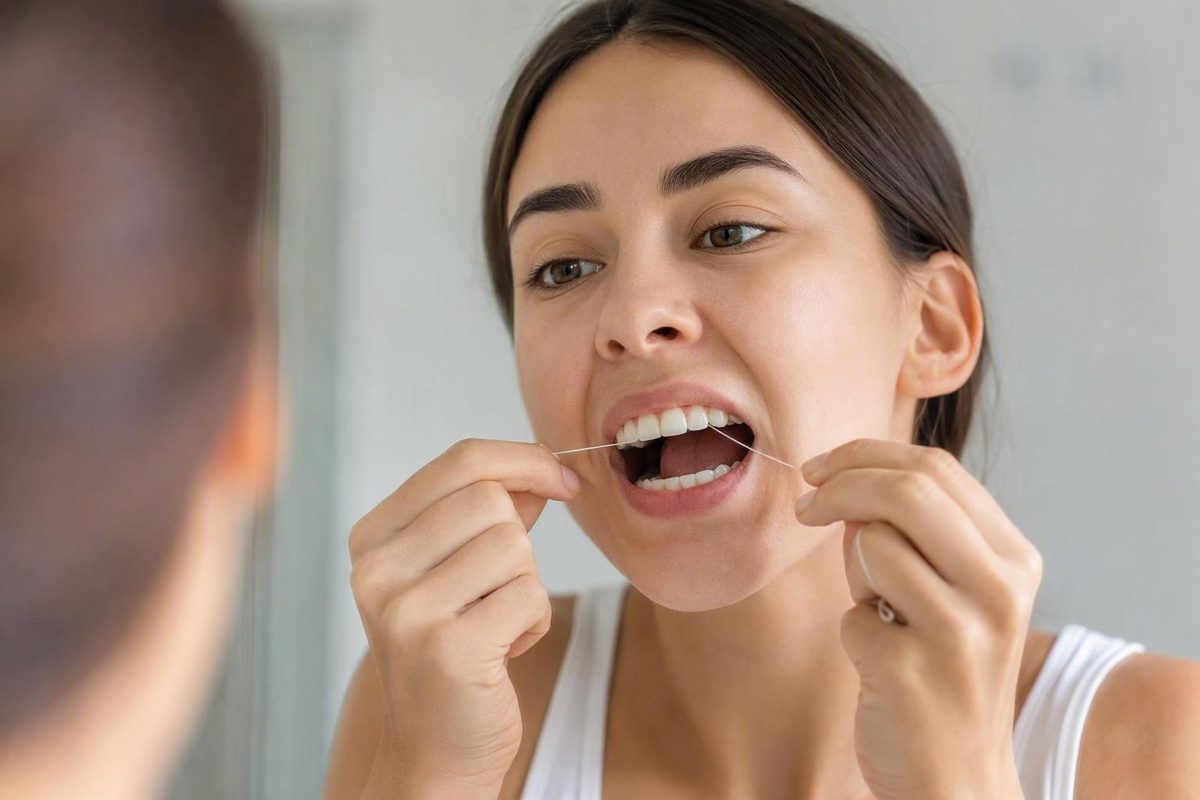
The short answer: inflammation is more likely than floss itself
If you are wondering, “Why do my gums bleed when I floss?”, a likely explanation is plaque-related inflammation near and between the teeth, often called gingivitis in its early form. This is especially plausible if you have not been cleaning between your teeth consistently. The floss may be touching tissue that is already irritated and prone to bleeding rather than creating the underlying problem. Cleveland Clinic identifies plaque, tartar, and bacterial buildup as leading explanations and notes that healthy gums should not bleed routinely.
That does not mean every trace of blood proves that you have gum disease. Mild bleeding can appear temporarily when you begin flossing or return to it after a long break. Floss can also cut or irritate one spot if it suddenly snaps through a tight contact and strikes the gum.
The useful question is therefore not only whether blood appears. Consider where it happens, what immediately preceded it, whether it is improving, and what other symptoms are present.
Four broad patterns can help organize what you are seeing:
- Bleeding after a flossing gap: Several areas bleed after you resume cleaning between your teeth. This is compatible with more widespread plaque-related inflammation.
- One spot after a forceful slip: A particular point bleeds immediately after the floss snaps downward, perhaps with a sharp or sore sensation. Localized irritation is more plausible.
- Bleeding around multiple inflamed areas: Several spaces bleed repeatedly, and the gums also appear red, puffy, or tender. Gingivitis or another periodontal problem becomes more concerning.
- Persistent or unexplained bleeding: The bleeding does not improve with gentle, consistent care, becomes worse, starts without brushing or flossing, or occurs with recession, pain, persistent bad breath, pus, loose teeth, or a change in the bite. This pattern warrants a dental assessment.
These patterns are clues, not diagnoses. Inflammation and technique injury can occur together: inflamed tissue is easier to injure, while a forceful slip can make an already irritated site bleed more. Tartar, medicines, hormonal changes, and certain health conditions may also affect how readily the gums bleed.
The balanced response is neither panic nor dismissal. Brief, mild bleeding after restarting flossing is not automatically an emergency. But recurrent bleeding should not simply be accepted as normal, particularly when it is not improving or is accompanied by other symptoms.
How plaque makes gums bleed
Plaque is a film containing bacteria that adheres to tooth surfaces. It collects on visible surfaces, along the gumline, and between teeth—areas where a toothbrush may not clean effectively.
When plaque remains close to the gums, it can irritate the surrounding tissue. The inflammatory response may make the gums red, swollen, tender, and more likely to bleed when touched by a toothbrush or floss. Flossing can therefore reveal inflammation that was already present.
This explains an apparently contradictory experience: someone skips flossing for a while and sees no blood, then resumes and suddenly notices bleeding. The absence of bleeding while the tissue was not being touched did not establish that the gums were healthy. Cleaning brought the inflamed area into contact with the floss.
Gingivitis is the early, generally reversible form of gum disease. It affects the gums but does not, by definition, mean that the deeper tissues and bone supporting the teeth have already been destroyed. Better plaque control and appropriate professional care can allow this inflammation to settle. Bleeding alone cannot confirm gingivitis, however, because technique injuries and other contributors can produce a similar visible result.
In some people, inflammation that persists can progress to periodontitis. Periodontitis affects the tissues and bone supporting the teeth and may eventually contribute to tooth mobility or tooth loss. Unlike gingivitis, established supporting-tissue or bone damage is not simply restored through more careful home flossing. Colgate’s overview distinguishes reversible gingivitis from periodontitis involving loss of tooth-supporting bone.
Another important distinction is the difference between plaque and tartar:
- Plaque is a soft bacterial film that regular mechanical cleaning can disrupt.
- Tartar, also called calculus, is hardened or mineralized plaque that ordinary brushing and flossing generally cannot remove reliably.
Tartar provides a rough surface around which additional plaque may accumulate. When deposits sit near or below the gumline, applying more pressure with a toothbrush or floss will not reliably remove them and may cause avoidable injury. Professional instruments are normally required to remove hardened deposits. American Dental Group’s explanation of plaque and calculus notes that routine home cleaning generally cannot remove hardened tartar.
Persistent bleeding is therefore not necessarily evidence that you are failing to try hard enough. Technique may be ineffective, but tartar or deeper inflammation may also be present. If periodontitis has developed, the problem extends beyond removing soft plaque from accessible tooth surfaces.
For a broader discussion of these mechanical limits, see what daily brushing cannot fix.
New flossing, an inflamed gumline, or a small technique injury?
The pattern of bleeding can make one explanation more plausible than another, although it cannot establish the cause.
Suppose you have not flossed for months. When you restart, several spaces bleed mildly and the gums feel tender. That pattern is compatible with plaque-related inflammation being exposed by cleaning. If the amount of blood, number of affected spaces, and tenderness gradually decline, the trend is reassuring.
Now consider a different sequence: floss catches between two teeth, suddenly releases, and strikes the triangular gum tissue between them. You feel an immediate sting and see blood from that one site. A localized cut or irritation is more compatible with that history.
Useful contrasts include:
| Pattern | More compatible with |
|---|---|
| One spot bleeds immediately after a painful slip | Localized flossing trauma |
| Several areas bleed after a long break from flossing | Plaque-related inflammation |
| Multiple areas bleed with red, puffy, or tender gums | More generalized gum inflammation |
| Bleeding continues without improvement despite gentle care | Tartar, persistent inflammation, periodontitis, or another contributor requiring assessment |
| Bleeding begins without brushing or flossing | A cause that technique alone does not adequately explain |
These categories can overlap. An inflamed gumline is more vulnerable to a technique injury, and one forceful incident can aggravate an already sore site.
Common technique mistakes include:
- Snapping the floss through the contact between two teeth
- Pushing it straight down into the gum
- Using excessive pressure in the belief that harder cleaning is better
- Sawing forcefully against soft tissue instead of cleaning the tooth surface
- Repeatedly working an injured spot to see whether it still bleeds
Brushing may complicate the picture as well. Excessive pressure and hard or worn bristles can irritate the gumline, making it harder to determine whether flossing is the only trigger.
There is no precise, evidence-based day on which mild bleeding must stop. Published guidance varies: one dental source describes improvement after several days, while another gives a general range of 7–14 days after consistent, gentle cleaning begins. Neither timeframe is a diagnostic guarantee. The 7–14-day estimate is presented as a general expectation rather than a fixed cutoff.
The direction of change is more useful than treating a particular date as a test. Less blood, fewer affected spaces, and declining tenderness suggest improvement. Bleeding that remains unchanged, becomes heavier, occurs frequently, or repeatedly returns calls for professional assessment rather than increasingly forceful experiments at home.
How to keep cleaning without injuring the gums
Mild bleeding by itself is generally not a reason to abandon cleaning between your teeth. If plaque-related inflammation is contributing, stopping may leave the irritant in place and allow inflammation to continue.
But “keep cleaning” does not mean forcing floss into painful tissue, repeatedly reopening a cut, or ignoring bleeding that is substantial, worsening, or persistent. The goal is controlled contact with the tooth surface—not pressure directed into the gum.
A gentle string-floss technique looks like this:
- Guide the floss slowly through the contact. Use a controlled back-and-forth movement if needed to pass a tight point, but do not let the strand snap downward when it clears the contact.
- Curve the floss around one tooth. Form a C shape so that the strand hugs the side of the tooth.
- Hold it against the tooth surface. This directs the cleaning action toward the tooth rather than into the gum tissue.
- Move it gently along the tooth. Slide the floss up and down and slightly beneath the gum edge without forcing it deeply into the tissue.
- Clean the neighboring tooth. Reposition the strand into a C shape around the other tooth in the same space and repeat.
- Move to the next space. Use a clean section of floss where practical and work systematically rather than repeatedly scrubbing one area.
Avoid snapping the strand downward or sawing forcefully across the gum. Gentle movement may be necessary to pass a tight contact, but once the floss is between the teeth, it should hug and clean each tooth separately.
Support interdental cleaning with gentle brushing twice daily using a soft-bristled toothbrush. Brushing cleans the outer, inner, and chewing surfaces but does not eliminate the need to clean between teeth. Brookwood Dentistry’s guidance recommends twice-daily soft-bristled brushing and a gentle, C-shaped flossing motion.
Mouthwash, if used, is not a substitute for physically disrupting plaque with a brush and an appropriate interdental tool. The supplied evidence does not support recommending a particular rinse or product for bleeding gums. A rinse may form part of an individualized dental plan, but it should not be used to postpone assessment of continuing symptoms.
String floss is not the only practical option. Depending on anatomy, dental work, and hand dexterity, alternatives may include:
- Floss threaders for braces, bridges, or other dental work
- Pre-threaded flossers when loose floss is difficult to handle
- Interdental brushes for spaces that can comfortably accommodate them
- Water flossers for some people with appliances, restorations, or limited dexterity
Tight contacts, larger spaces, implants, bridges, orthodontic appliances, sensitivity, and dexterity can all affect what works safely and effectively. Dentzz Dental lists threaders, interdental brushes, and water flossers as possible options for people with braces or dental work.
If ordinary floss is painful or difficult to maneuver, ask a dentist or hygienist to demonstrate a method suited to your mouth. That is more useful than repeatedly forcing a tool into a space where it does not fit comfortably.
What home care can improve—and what it cannot remove
Better plaque control can allow plaque-related gingivitis to settle. This is why consistency matters: the purpose is to disrupt bacterial film while minimizing injury, not to “scrub away” bleeding through force.
Signs of an improving trend may include:
- Less blood on the floss
- Fewer spaces that bleed
- Less redness or puffiness
- Reduced tenderness during brushing or flossing
- Less sensitivity near the gumline
Improvement does not prove what caused the original bleeding, but it supports continuing the gentle routine. A lack of improvement suggests that home care may not be addressing the entire problem.
Professional cleaning has two relevant roles. It can remove deposits that brushing and flossing cannot reliably remove, and it creates an opportunity for a clinician to assess whether the gums show localized trauma, gingivitis, deeper periodontal involvement, or another concern.
Hardened tartar is the clearest limit of ordinary home care. Brushing or flossing harder will not reliably detach it. Mouthwash, dietary changes, and supplements are not substitutes for professional tartar removal. Extra pressure may injure the gums while leaving the deposit in place.
Home care also has limits once periodontitis is present. Gingivitis can generally resolve when plaque is controlled and professional care is provided as needed. Periodontitis may involve lasting damage to supporting tissue and bone. Daily cleaning remains important for controlling plaque, but it should not be described as rebuilding tissue that has already been lost.
Professional management depends on the diagnosis. Gingivitis may improve with professional cleaning and better daily plaque control. Periodontitis may require periodontal treatment such as scaling and root planing, which removes deposits from tooth and root surfaces; more involved disease may require additional periodontal care. Bleeding alone cannot determine which treatment, if any, is appropriate. Ivy Dental Specialty describes periodontitis as affecting tooth-supporting tissues and notes that scaling and root planing or other periodontal procedures may be required.
There is no universal professional-cleaning interval appropriate for every reader. Follow-up may vary with gum health, tartar accumulation, previous periodontal disease, dental work, health factors, and examination findings.
Use the trend as a practical home observation. Declining bleeding and tenderness are reassuring. No improvement, increasing bleeding, or new symptoms support booking an examination.
Other contributors: medicines, hormones, and health conditions
Plaque-related inflammation and technique are usually more useful starting points than a frightening list of uncommon diseases. Nevertheless, other factors can affect how readily gums bleed or how strongly they respond to plaque.
Blood-thinning medicines
Anticoagulants and other medicines that affect clotting can make bleeding easier to trigger or more noticeable. That does not prove that the medicine is the sole cause. Plaque-related inflammation, tartar, or trauma may still explain why bleeding starts at a particular gum site.
Do not stop, skip, or change a prescribed blood thinner—or any other prescribed medicine—because of gum bleeding without guidance from the clinician who prescribed it. If bleeding began after a medication change, tell your dentist and prescribing clinician. Delta Dental of Washington discusses blood thinners as a possible contributor and recommends telling the dentist about new medicines when gum bleeding occurs regularly.
Hormonal changes
Hormonal changes associated with puberty, menstrual cycles, pregnancy, hormonal birth control, and menopause may increase gum sensitivity or alter the tissue’s response to plaque. Hormones may modify susceptibility; they do not make plaque control irrelevant or establish the cause of an individual bleeding episode. Cleveland Clinic lists these hormonal stages among possible contributors to gum sensitivity and bleeding.
Someone who develops bleeding during pregnancy, for example, may still have plaque-related inflammation requiring dental attention. The hormonal context may help explain susceptibility, but it does not replace an oral examination.
Health conditions and nutritional deficiencies
Diabetes, immune or clotting disorders, and deficiencies of vitamins C or K are possible contributors in the appropriate clinical context. Bleeding during flossing cannot diagnose any of these conditions, and a small amount of blood on floss should not be treated as proof of a systemic illness. Brookwood Dentistry identifies diabetes, immune disorders, blood-thinning medicines, pregnancy, and vitamin C or K deficiencies as possible contributors while recommending professional assessment for persistent bleeding.
A medication or broader health review becomes more relevant when bleeding is new or unexplained, occurs without flossing, begins after a medicine change, or continues despite correct and consistent plaque control. A dentist can assess likely oral causes and determine whether the history suggests that medical input is also needed.
Smoking adds a different nuance. It may suppress visible gum bleeding even when periodontal disease is present, so little or no blood does not by itself prove that the gums are healthy. Colgate’s guidance notes that smoking can reduce visible bleeding despite significant periodontal disease.
When bleeding gums deserve a dental examination
Arrange a dental assessment when bleeding is frequent, persistent, worsening, unexplained, spontaneous, or still present despite consistent, gentle cleaning. You do not need to wait for every warning sign to appear.
There is no reliable universal deadline after which bleeding automatically changes from harmless to serious. Use the direction of change instead:
- Improving: Less blood, fewer affected spaces, and declining tenderness
- Not improving: The same areas continue to bleed to the same degree
- Worsening: More sites bleed, bleeding is easier to trigger, or new symptoms appear
- Recurrent: Bleeding settles but repeatedly returns despite consistent care
- Spontaneous: Blood appears without brushing, flossing, or another obvious contact
Symptoms that increase concern include:
- Red, swollen, or tender gums
- Persistent bad breath
- Gum recession or teeth that appear longer
- Pain while chewing
- Continuing sensitivity near the gumline
- Pus, a sore, or another sign of infection
- Teeth that feel loose
- A change in how the teeth meet when you bite
A small bleeding point immediately after a painful flossing slip is different from recession, loose teeth, or a changing bite. Those latter findings raise greater concern about the tissues and bone supporting the teeth. McCarl Dental Group lists recession, infection, loose teeth, bite changes, and persistent bad breath among warning signs that warrant periodontal evaluation.
Bleeding that appears even when you are not brushing or flossing also deserves assessment because technique alone does not adequately explain that pattern. Incidental contact may sometimes disturb an irritated area, but spontaneous or unexplained bleeding should not be repeatedly tested at home.
A professional evaluation can help to:
- Assess whether the pattern is more consistent with localized injury or broader inflammation
- Look for plaque and hardened tartar
- Evaluate whether findings suggest gingivitis or periodontitis
- Check recession, tenderness, tooth mobility, and related symptoms
- Review medicines, pregnancy, and relevant health history
- Determine whether professional cleaning or further care may be appropriate
The exact assessment and treatment depend on the findings. Symptoms can guide how promptly you seek care, but they cannot establish the cause at home.
Bleeding that is substantial, spontaneous, or difficult to stop merits prompt clinical advice rather than prolonged home experimentation. Severity, accompanying symptoms, and medical context all affect urgency.
Frequently asked questions
Should I stop flossing if my gums bleed?
Usually not solely because of mild bleeding. If plaque-related inflammation is contributing, stopping interdental cleaning may leave plaque in place. Continue with a gentle, tooth-hugging technique and look for a downward trend.
Do not keep forcing floss through a painful or injured site. Avoid snapping the strand, reduce pressure, and arrange an assessment if bleeding is frequent, worsening, spontaneous, substantial, or persistent.
How long can gums bleed after I start flossing again?
There is no guaranteed diagnostic deadline. Sources give varying general expectations, from several days to roughly two weeks, so the direction of change is more useful than a particular date.
Mild bleeding should become less frequent and less noticeable rather than remain unchanged. If it worsens or occurs with swelling, persistent bad breath, recession, pain, pus, loose teeth, or bite changes, arrange an examination.
Why do my gums still bleed even though I floss every day?
Daily flossing does not guarantee that plaque is being removed effectively. The floss may pass straight through each space without wrapping around both teeth, or it may injure the gums because it is being snapped downward.
Persistent bleeding can also reflect tartar that floss cannot remove, continuing gingivitis, periodontitis, aggressive brushing, medication effects, hormonal changes, or another contributor. A dentist or hygienist can review your technique, remove hardened deposits where needed, and assess whether a deeper problem is present.
Can tartar be removed by brushing or flossing harder?
No. Tartar is hardened plaque and generally requires professional removal. Greater pressure with floss or a toothbrush may irritate the gums without detaching the deposit.
Home care remains valuable because it disrupts soft plaque and helps limit further accumulation. Its limitation is mechanical: ordinary bristles and floss are not reliable tartar-removal instruments.
Can blood thinners or pregnancy contribute to bleeding gums?
Yes. Blood-thinning medicines can increase susceptibility to bleeding, while hormonal changes during pregnancy may make the gums more sensitive or alter their response to plaque. Neither factor proves the sole cause, and local inflammation may still require attention.
Do not stop or alter prescribed medicine without consulting the prescribing clinician. If bleeding is new, persistent, spontaneous, or began after a medication change, tell your dentist and the relevant medical clinician.
The practical takeaway
A little blood after restarting flossing may decline as inflamed gums receive consistent, gentle cleaning. A single bleeding point immediately after the floss snaps downward may instead reflect a small technique injury.
Guide floss slowly through each contact, curve it around each tooth in a C shape, and clean the tooth surface without forcing the strand into the gum. Watch for steady improvement rather than relying on an exact deadline.
If bleeding remains frequent, worsens, occurs spontaneously, or appears with swelling, persistent bad breath, recession, pain, pus, loose teeth, or bite changes, arrange a dental assessment. Home care can disrupt soft plaque, but it cannot reliably remove tartar, diagnose periodontitis, or determine whether a medicine or health condition is contributing.