
When an Adult Tooth Appears Behind a Baby Tooth
A loose baby tooth may be gently wiggled and monitored; don’t force a firm tooth. Worsening position, pain, swelling or cleaning trouble needs dental advice.
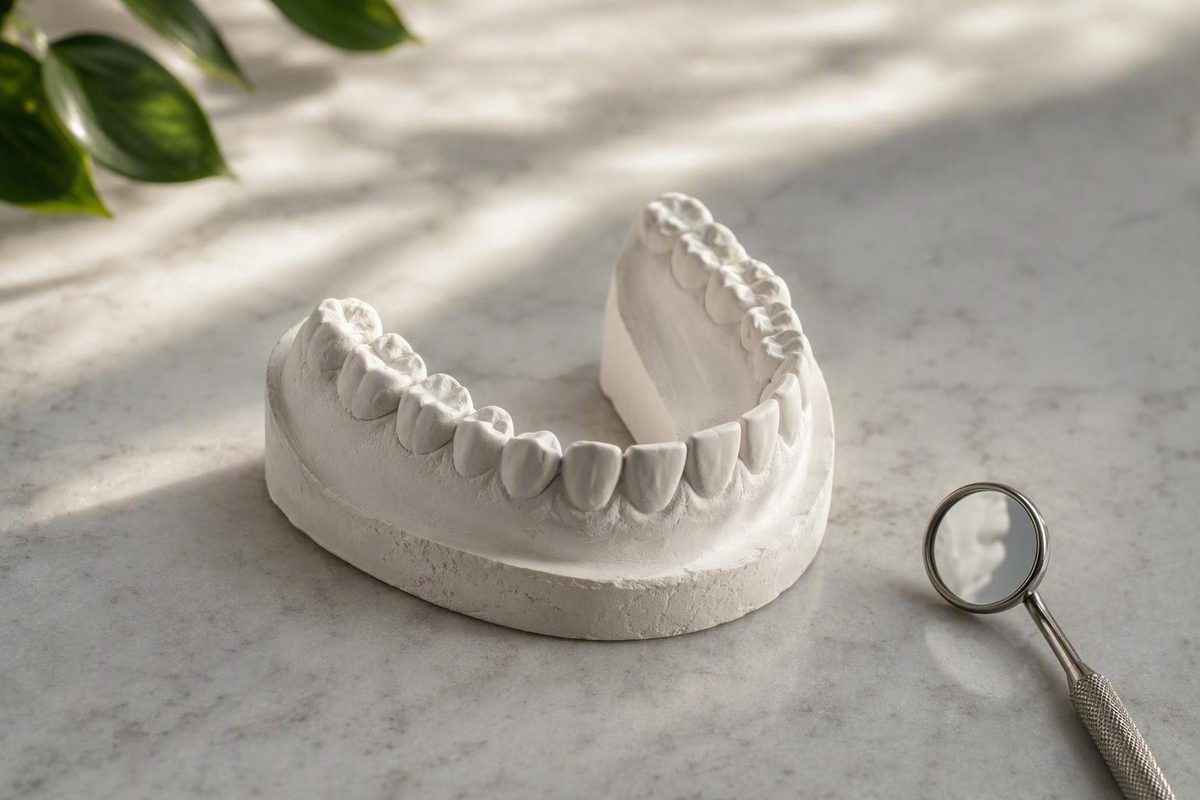
What parents mean by “shark teeth”
“Shark teeth” is an informal name for a permanent tooth erupting behind or beside a baby tooth that has not yet fallen out. For a time, both teeth are visible, creating a double row.
This does not mean that a child is developing extra sets of teeth like a shark. It usually reflects an overlap in the transition from primary teeth to permanent teeth. The typical presentation is a permanent tooth visible on the tongue side of a retained lower front baby tooth, as described by Woodside Pediatric Dentistry.
The appearance can be dramatic, but it does not by itself show whether treatment is needed. If the baby tooth is already loose, it may fall out and create room for the permanent tooth to move forward. If it remains firm, several teeth are involved, or the area is difficult to clean, a dental examination can clarify what is happening.
The most useful first questions are:
- Is the baby tooth loose or completely firm?
- Is the child comfortable?
- Can both visible teeth and the space between them be cleaned?
- Is the permanent tooth becoming more displaced?
- Is one tooth involved, or are there several?
- Is this happening at the lower front of the mouth or somewhere less typical?
This article provides general reference information, not a diagnosis or treatment plan for an individual child. Decay Guide is an independent information publisher, not a dental practice. A dentist who examines the child can identify the teeth and assess their eruption, spacing, and health.
The available evidence for this topic consists mainly of educational articles from pediatric dental practices, together with a hospital educational video. These sources broadly agree on the usual lower-front presentation and on avoiding forceful removal of a firm tooth, but they do not establish a universal waiting period or treatment rule.
Why an adult tooth can erupt before the baby tooth falls out
In the usual replacement sequence, a permanent tooth develops beneath its baby predecessor. As the permanent tooth advances, the baby tooth’s root is gradually resorbed—meaning the body removes the root structure. With less root holding it in place, the baby tooth becomes loose and eventually falls out.
With shark teeth in kids, the permanent tooth may follow an off-center path, often toward the tongue. Because it is not directly beneath the baby tooth, it may not act on the baby-tooth root in the usual way. Part of that root can remain and continue to hold the baby tooth while the permanent tooth becomes visible. Pediatric dentist Dr. Emily Hahn describes this tongue-side position and possible retained root in a St. Louis Children’s Hospital educational video.
Possible contributors include:
- Delayed or incomplete root resorption: More of the baby-tooth root remains than expected.
- Eruption angle: The permanent tooth approaches from behind rather than directly below.
- Available space: Limited room may influence where the new tooth appears.
- Timing: The permanent tooth may become visible before the baby tooth has completed its loosening process.
These are possible mechanisms, not diagnoses that parents can confirm at home. A firm baby tooth does not prove that its entire root remains, and a permanent tooth appearing behind it does not necessarily mean that the adult tooth erupted “too early.” Position and timing may both contribute.
How the two eruption paths differ
USUAL REPLACEMENT                       OFF-CENTER ERUPTION
(cross-section)                         (cross-section)

Lip side       Tongue side              Lip side       Tongue side
   ←               →                       ←               →

        Baby crown                            Baby crown
            │                                      │
        Baby root                              Baby root
            ↑                                      │
   Expected eruption path                         ↗
            │                             Permanent tooth rises
     Permanent tooth                      on the tongue side and
   rises beneath the root                 may miss part of the root
In the usual path, the permanent tooth rises toward the baby-tooth root and promotes resorption. In the off-center path, it emerges toward the tongue side, so more root may remain and the baby tooth may stay firm.
Where and when the double row usually appears
The best-supported presentation in the available sources is a permanent lower front incisor emerging behind a retained baby incisor during early mixed dentition, commonly around ages five to seven. Shiny Smiles Pediatric Dentistry describes the lower-front region and ages five to seven as the typical pattern.
Upper-front cases are also reported. Descriptions of later or more posterior presentations are less consistent, so the familiar lower-incisor explanation should not automatically be applied to every new tooth near the back of the mouth.
Basic tooth terminology helps:
-
Incisors are the front teeth.
-
Premolars are permanent teeth that replace baby molars.
That final distinction is important. An unusual posterior eruption could also involve a premolar replacing a baby molar or another eruption pattern that cannot be identified reliably from the nickname “shark teeth.”
Arrange professional identification when:
- You cannot tell which tooth is erupting.
- The double row is outside the lower-front region.
- Several teeth are affected.
- A posterior tooth appears displaced, blocked, or uncomfortable.
- The pattern seems unusual for the child’s stage of dental development.
The supplied evidence does not support a reliable prevalence percentage or the claim that most children experience shark teeth. The practical point is simply that pediatric dental practices recognize the pattern, especially around the lower incisors, while each child’s spacing and eruption path remain individual.
The practical decision guide: monitor, book, or call promptly
There is no single deadline that applies to every double row. Looseness, symptoms, cleanability, location, and visible progression are more useful than counting days alone.
The following tiers are a practical synthesis of the supplied educational sources, not a formal pediatric-dentistry guideline.
Monitor at home
Short-term observation may be reasonable when all of the following apply:
- The baby tooth is already loose.
- The child is comfortable.
- There is no significant swelling or marked gum irritation.
- The child can bite and eat normally.
- Both visible rows can be cleaned.
- The permanent tooth does not appear to be moving progressively farther out of line.
Let the child gently wiggle an already-mobile tooth, keep the area clean, and watch for change. A dated photograph taken from a similar angle can be an optional way to document whether the baby tooth is tilting, more of the permanent tooth is appearing, or the spacing is changing. This is an organizational aid, not a substitute for an examination.
Book a dental examination
Arrange a routine dental examination rather than continuing indefinite observation when:
- The baby tooth is completely firm.
- The permanent tooth continues to emerge farther behind it.
- The adult tooth appears substantially displaced.
- Several teeth are involved.
- Crowding or overlap appears to be increasing.
- Food repeatedly becomes trapped.
- The area cannot be cleaned adequately.
- The baby tooth remains while much more of the permanent tooth becomes visible.
- The location or tooth type is unclear.
A firm baby tooth is a useful reason to book because retained root structure is one possible explanation. An examination—and sometimes an X-ray—may be needed to clarify root status and tooth position.
Practice-based recommendations do not agree on a standard waiting period. Some suggest review after several weeks when a baby tooth remains firm; others use longer periods. One Chestnut Dental article gives two to three months, but that is practice advice rather than a universal clinical cutoff. A firm tooth, increasing displacement, poor cleanability, or uncertainty can justify booking sooner.
Worsening position without significant symptoms generally belongs in this routine-assessment tier rather than being treated automatically as an emergency.
Contact a dental professional promptly
Contact the child’s dental office promptly for advice if the child develops:
- Significant or increasing pain
- Swelling
- Marked gum irritation
- Difficulty biting or chewing
- Difficulty eating
These findings do not identify the cause, and the supplied sources do not establish a formal emergency threshold. They do, however, make simple watchful waiting less appropriate. Tell the office what you see, when it began, whether it is worsening, and whether eating is affected so staff can advise how quickly the child should be assessed. Pain, swelling, and chewing difficulty are among the reasons for evaluation listed in practice guidance from Shiny Smiles Pediatric Dentistry.
A comfortable lower-front double row is generally described in the available practice sources as non-emergency. That reassurance is conditional: significant symptoms warrant prompt professional advice, while worsening displacement without those symptoms usually calls for a routine appointment.
Safe home care while the baby tooth is loose
The central safety distinction is straightforward: a baby tooth that is already loose may be gently wiggled; a firm retained tooth should not be forced out.
If the tooth is clearly mobile and the child is comfortable, let the child move it gently with their tongue or clean hands. Pediatric dental guidance consistently limits wiggling to teeth that are already loose and advises against forcing a tooth that does not move; Dentistry for Children & Adolescents states that distinction explicitly.
Do not yank, twist, tie string around, or repeatedly pull a firm tooth. Its root status and relationship to the permanent tooth are unknown. If it is not mobile, arrange an examination instead of trying to make it mobile.
How to clean a double row
Closely spaced rows create extra surfaces and a narrow channel where food can become trapped. Practice sources therefore emphasize careful brushing and flossing around the overlap.
Use this practical sequence:
- Brush the outward-facing surfaces. Clean the front of the baby tooth and every visible permanent-tooth surface the brush can reach.
- Brush behind both rows. Place the brush on the tongue side and use small, gentle movements.
- Angle gently toward each gumline. Clean where each visible tooth meets the gum rather than brushing only the biting edge.
- Clean the overlap carefully. Adjust the brush angle to reach the channel between the rows.
- Floss only where it passes comfortably. Do not force floss through a painful or inaccessible space.
- Check after meals if food trapping is noticeable. Remove visible debris with ordinary gentle brushing rather than using sharp objects.
Two visible rows can trap food and make cleaning more difficult, according to Kids Dental Space’s pediatric dental overview. If the overlap cannot be cleaned despite careful effort, ask a dentist or hygienist to demonstrate an appropriate technique and assess the area.
Do
- Let the child gently wiggle a baby tooth that is already loose.
- Brush the front and back of both visible rows.
- Watch for pain, swelling, irritation, eating difficulty, or worsening position.
- Keep routine dental visits and mention the eruption change.
Don’t
- Yank, twist, tie, or force out a firm tooth.
- Force floss through a painful overlap.
- Use sharp objects to remove trapped food.
- Ignore increasing symptoms or an area that cannot be cleaned.
This article does not recommend child-specific medication or dosing. Questions about pain relief should be directed to an appropriate healthcare professional who knows the child’s age, health history, allergies, and other medicines.
What may happen after the baby tooth falls out
Once the baby tooth is lost, more space becomes available. The tongue and other normal oral forces may help a permanent tooth that erupted behind the row move forward. This is a possible outcome, not a guarantee. New England Kids Pediatric Dentistry similarly describes forward movement after space opens while qualifying it as an expected rather than certain result in its overview of double rows in children.
The result can depend on several interacting factors:
- How much space is available in the dental arch
- The permanent tooth’s eruption angle
- How far behind the expected row it sits
- The positions of neighboring teeth
- The developing bite
- Whether other permanent teeth are erupting nearby
Temporary crookedness during eruption therefore cannot reliably predict final alignment. One tooth may look markedly out of line while emerging and improve after the baby tooth is lost. Another may remain behind because space is limited or its eruption path is less favorable.
There is no evidence-supported correction deadline. Instead, watch the direction of change: is the tooth gradually moving toward the expected row, remaining unchanged, or becoming more displaced?
If the permanent tooth remains behind after the baby tooth is gone, have its position followed during routine dental care. Book sooner if the overlap worsens, biting becomes difficult, the area remains hard to clean, or symptoms develop.
What a dentist may examine and when extraction enters the discussion
A dental visit does not automatically lead to an X-ray or extraction. The first step is to identify the teeth and assess how eruption is progressing.
The dentist may examine:
- How loose or firm the baby tooth is
- How much of the permanent tooth has erupted
- The permanent tooth’s angle and position
- The space between neighboring teeth
- Whether one or several teeth are affected
- The child’s bite
- The gums around both teeth
- Food trapping and cleanability
- Broader crowding or eruption concerns
An X-ray may be considered when it would help show how much baby-tooth root remains or clarify the permanent tooth’s position and development. The double-row appearance alone does not establish that every child needs imaging. Practice guidance from Leap Kids Dental describes examination, bite and space assessment, monitoring, and possible X-ray use as case-dependent options rather than automatic steps in every shark-teeth evaluation.
Observation may remain appropriate if the baby tooth is loosening, the child is comfortable, hygiene is manageable, and the permanent tooth’s path appears favorable.
Extraction may enter the discussion when a retained baby tooth remains firm or appears to obstruct the permanent tooth’s eruption. Symptoms, position, crowding, and difficulty maintaining the area may also affect the overall decision, but no single feature described here proves that extraction is required.
When extraction is recommended, the retained baby tooth may be removed using local anesthesia. The Center for Pediatric Dentistry lists local anesthetic as one possible part of treatment in its parent guide to shark teeth.
Removing a primary tooth earlier than appropriate can also be a concern, so the decision should be based on examination rather than appearance alone. A Kids Smiles Pediatric Dentistry article notes that primary teeth have a space-related role and that removing them too soon can create separate concerns in its discussion of retained baby teeth. That is a general consideration, not proof that a particular retained incisor should stay in place.
The relevant question is not simply, “Are there two rows?” It is: “Is this baby tooth loosening normally, likely to fall out soon, or interfering with eruption?”
An orthodontic assessment may be considered when the dentist sees a broader issue involving space, several displaced teeth, persistent crowding, or the developing bite. A referral means those factors deserve closer assessment; it does not mean braces are inevitable.
What shark teeth do—and do not—say about future braces
A double row by itself does not establish that a child will need braces.
Future orthodontic decisions depend on the developing dentition as a whole, including:
- Total available space
- Tooth size and position
- The number of affected teeth
- Whether crowding persists
- Upper- and lower-jaw relationships
- How the bite develops
- Whether permanent teeth can erupt into usable positions
Shark teeth can be part of a temporary transition that improves after the baby tooth falls out. In another child, the double row may be one visible feature within a broader crowding pattern. One episode cannot reliably distinguish between those possibilities.
Likewise, extracting a retained baby tooth should not be presented as a way to guarantee straight permanent teeth or prevent braces. Extraction can remove an obstruction, but it cannot create unlimited arch space or control every aspect of bite development. Woodside Pediatric Dentistry also notes that spacing, the number of affected teeth, and bite development matter when considering whether a child may eventually need orthodontic care in its parent guidance on shark teeth.
The sensible approach is to monitor eruption and bite development through regular dental care rather than predicting a long-term orthodontic outcome from one photograph.
| Often compatible with a temporary eruption stage | Findings that justify dental assessment |
|---|---|
| One lower-front permanent tooth appearing behind a baby tooth | A baby tooth that remains completely firm |
| Baby tooth already loose | Permanent tooth becoming progressively more displaced |
| Child comfortable and eating normally | Significant or increasing pain |
| Area can be brushed from both sides | Swelling or marked irritation |
| No obvious worsening over time | Difficulty biting, chewing, or eating |
| Position begins improving after the baby tooth is lost | Several teeth affected |
| Temporary crooked appearance during eruption | Increasing crowding or an overlap that cannot be cleaned |
| No broader bite concern identified at routine visits | Unclear posterior eruption or concern about the developing bite |
Frequently asked questions
How long should I wait for a loose baby tooth to fall out?
There is no evidence-supported waiting period that applies to every child. The supplied practice articles offer inconsistent timelines, ranging from several weeks to a few months, so those figures should not be treated as a universal deadline.
If the tooth is clearly loose, the child is comfortable, the area can be cleaned, and the position is not worsening, short-term monitoring may be reasonable. Watch for continued loosening rather than forcing the process.
Book an examination if progress appears to stop, the permanent tooth moves farther behind the baby tooth, cleaning becomes difficult, or symptoms develop. You can also mention the double row at an already scheduled routine visit rather than waiting for an arbitrary cutoff.
What should I do if the baby tooth is not loose at all?
Arrange a dental examination. A completely firm baby tooth may still have substantial root support, particularly when the permanent tooth is emerging toward the tongue rather than directly beneath it. The St. Louis Children’s Hospital educational video advises dental assessment when a new tooth appears while the baby tooth remains firm.
Do not try to loosen the tooth by force. If the child is comfortable and eating normally, this generally calls for a routine appointment rather than an assumption that emergency treatment is necessary. Contact the dental office more promptly if significant pain, swelling, marked irritation, or eating difficulty develops.
Can I pull out my child’s shark tooth at home?
Do not force out a firm retained baby tooth. Avoid yanking, twisting, tying it to an object, or pulling through resistance.
If the baby tooth is already very loose, gentle child-led wiggling with the tongue or clean hands may help it progress naturally. Stop if it hurts or the child becomes distressed. If you are unsure whether the tooth is ready, let a dentist assess it.
Also remember that the “shark tooth” visible behind the baby tooth is usually the permanent tooth. That is not the tooth a parent should attempt to remove.
Does every child with shark teeth need an X-ray or extraction?
No. A dentist may recommend observation when the baby tooth is loosening and the eruption pattern appears favorable.
An X-ray may be considered if the dentist needs more information about the baby-tooth root or the position and development of the permanent tooth. The visible double row alone does not prove that imaging is necessary.
Extraction is also case-dependent. It may be discussed when a firm retained baby tooth appears to obstruct eruption or when the overall combination of position, symptoms, crowding, and hygiene makes continued observation less suitable. It is not required for every child with shark teeth.
Will the permanent tooth straighten after the baby tooth falls out?
It may move forward once space becomes available, helped by the tongue and other oral forces. However, natural correction is not guaranteed.
Available space, eruption angle, neighboring teeth, and bite development all affect the result. Do not assume that temporary crookedness will be permanent, but do not rely on a guaranteed correction deadline either.
Keep watching the direction of movement and have the tooth followed during regular dental visits. Arrange an earlier assessment if it remains substantially behind, becomes more displaced, is difficult to clean, or affects biting.
The practical takeaway: If the baby tooth is loose, the child is comfortable, and the area can be cleaned, gentle child-led wiggling and monitoring may be reasonable. If the tooth is firm, the permanent tooth is becoming more displaced, several teeth are involved, or cleaning is difficult, arrange a dental examination. Contact a dental professional promptly for significant pain, swelling, or difficulty eating. Extraction and braces are possibilities in selected cases, not automatic consequences of seeing a second row.