
What to Do When Whitening Leaves Your Teeth Hurting
Brief twinges across several teeth that steadily improve are more reassuring. One-tooth, heat-triggered or lingering pain needs prompt assessment.
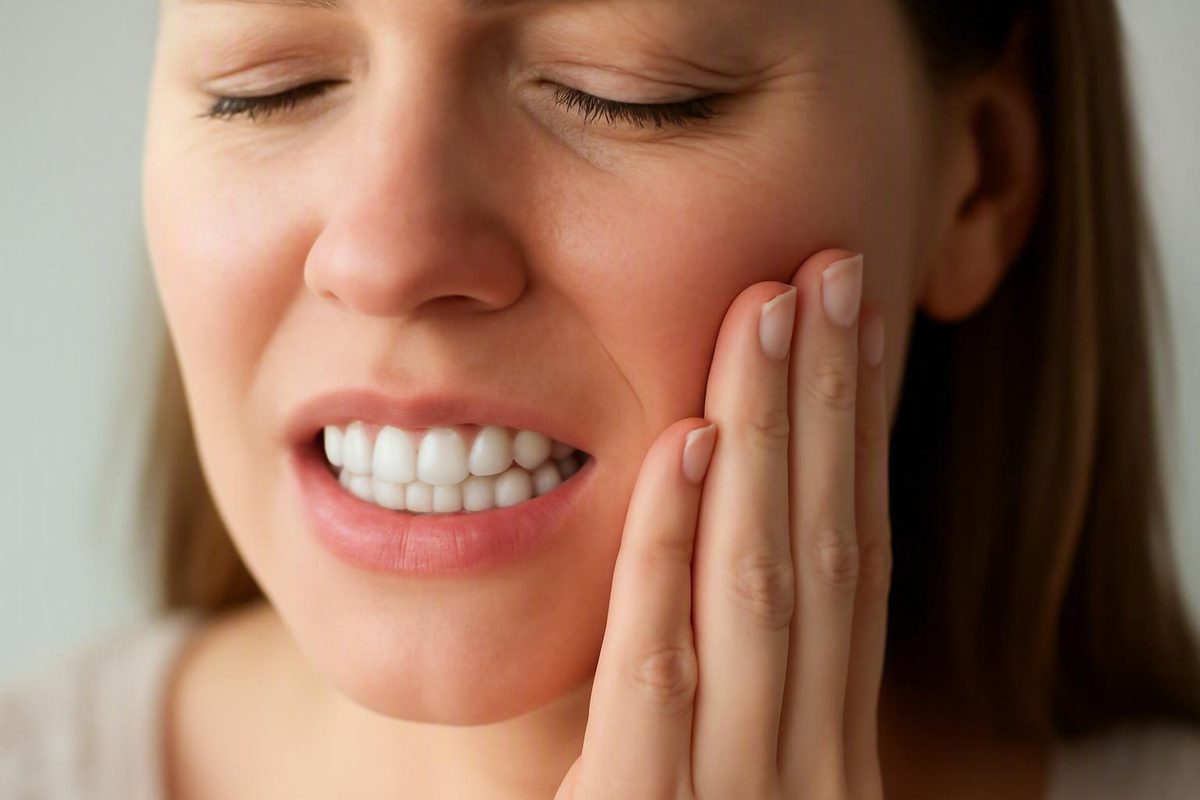
The short answer: what to do when teeth become sensitive after whitening
Mild sensitivity across several whitened teeth is commonly reported after peroxide-based whitening and is often temporary. It may feel like a brief, sharp twinge triggered by cold air, hot or cold food and drink, sweets, acidic items, or brushing. However, pain that starts after whitening is not automatically harmless: cavities, cracks, exposed roots, gum disease, worn enamel, and damaged fillings can cause similar symptoms (GoodRx guidance on sensitivity after whitening).
If your teeth hurt during or after whitening:
- Pause further whitening. Do not push through meaningful pain.
- Remove the strip, tray, or other product if it is still in place.
- Follow the product’s directions for removal, rinsing, and adverse effects. Do not extend the wear time or add another application.
- Choose lukewarm or room-temperature food and drinks.
- Temporarily avoid very hot, cold, sweet, or acidic items if they trigger discomfort.
- Brush gently with a soft-bristled toothbrush and fluoride toothpaste.
- Check the pattern. Is the discomfort spread across several treated teeth and steadily improving, or is one tooth much more painful?
- Look at your gums for burning, redness, swelling, or white patches where whitening gel may have touched them.
Do not restart merely because a fixed number of hours or days has passed. No universal restart schedule can account for the product, exposure, severity of the reaction, or condition of the teeth. Wait until symptoms have resolved, and seek dental advice before whitening again if the episode was severe, prolonged, recurrent, or concentrated in one tooth.
Arrange prompt dental assessment if the pain is severe or worsening, occurs without a trigger, is focused in one tooth, lingers after heat or cold, interrupts sleep or eating, or occurs with swelling, fever, discharge, bleeding, discoloration, or visible tooth or restoration damage. These features are less consistent with straightforward temporary sensitivity; dental-practice guidance also identifies severe or worsening pain, swelling, fever, discoloration, and impaired sleep or eating as reasons to seek evaluation (guidance on the course and warning signs of post-whitening sensitivity).
Decay Guide publishes general dental-health information. It is not a dental practice and cannot diagnose the cause of an individual’s pain or recommend a personalized treatment plan, as explained in its description of Decay Guide’s scope.
What whitening-related sensitivity feels like—and what may be something else
Timing is useful context, but it does not establish the cause. The comparison below provides triage clues, not a diagnosis.
| Symptom pattern | What it may feel or look like | What to do |
|---|---|---|
| Generalized tooth sensitivity | Brief, sharp twinges across several treated teeth, especially with cold air, hot or cold drinks, sweets, acids, or brushing. Discomfort stops shortly after the trigger is removed and trends toward improvement. | Pause whitening, avoid triggers temporarily, use gentle oral care, and watch the trend. Seek assessment if symptoms become severe, localized, spontaneous, or prolonged. |
| Gel-related gum irritation | Burning, soreness, redness, swelling, or white or blanched areas where gel, a strip, or tray overflow touched the gumline. | Remove the product, follow its instructions, clear away residual material as directed, and do not reapply while the tissue is irritated. Seek care for severe, spreading, or persistent injury or difficulty eating. |
| Possible localized dental pain | Pain mainly in one tooth; pain without an obvious trigger; discomfort that lingers; strong heat sensitivity; pain when biting; or visible damage to a tooth, filling, crown, or other restoration. | Arrange a dental examination rather than assuming this is an ordinary whitening reaction. Seek prompt help when pain is severe or occurs with swelling, fever, or discharge. |
Whitening gel on the gums can cause burning, redness, swelling, or discomfort. Poorly fitting strips or trays may also allow whitening material to reach soft tissue or collect in particular areas (dental-practice overview of tooth pain and gum irritation).
A painful single tooth deserves particular attention. Pain when biting, spontaneous aching, visible damage, or discomfort that lingers after a trigger strengthens the case for examination.
Heat sensitivity also warrants caution. Temporary whitening sensitivity is commonly described in relation to cold, air, brushing, and acidic or sweet foods. A tooth that reacts strongly to warmth—particularly if the pain continues after the heat is removed—should not be treated as equivalent to a few fleeting cold twinges.
Whitening may aggravate a previously quiet sensitive area or make an existing problem easier to notice. That does not mean whitening created every problem that became painful afterward. Mayo Clinic lists whiteners as one possible cause of sensitivity while also identifying worn enamel, exposed roots, cavities, cracked or chipped teeth, worn fillings, and gum disease; it recommends dental evaluation to identify or rule out the cause (Mayo Clinic guidance on sensitive teeth).
Relief from a desensitizing toothpaste does not prove that a tooth is healthy. Consider the location, severity, triggers, duration, and direction of change together.
Why teeth can hurt after whitening
Many whitening systems use hydrogen peroxide or carbamide peroxide in strips, gels, trays, or professionally administered treatments. Both home and in-office whitening can cause sensitivity; professional treatment should not be assumed to be universally free of it.
The biological explanation is less settled than simplified product descriptions sometimes suggest. A cautious interpretation is that peroxide exposure can temporarily irritate the tooth’s internal pulp or nerve and affect sensation through pathways in the dentin beneath the enamel. Dentin contains microscopic channels associated with the tooth’s sensory response, helping explain why temperature, air, sweets, acids, or brushing may provoke short, sharp discomfort after whitening (GoodRx discussion of peroxide exposure and pulp irritation).
Some consumer pages attribute the reaction to dehydration, mineral loss, increased enamel permeability, or “opened pores.” The supplied sources do not present these explanations consistently or establish that permanent porosity or necessary mineral damage explains every case. It is more accurate to say that peroxide exposure can temporarily increase sensitivity in some people, while the exact biological contribution may vary.
The intensity of the response may be affected by:
- Whitening-agent concentration: More concentrated exposure may increase sensitivity, although concentration is not the only variable.
- Exposure time: Leaving a product on longer than directed increases contact.
- Treatment frequency: Closely repeated applications may not allow an earlier reaction to settle.
- Gel quantity: Excess gel may increase exposure and overflow onto the gums.
- Product fit: A poorly fitting tray or strip may distribute gel unevenly or irritate soft tissue.
- Existing dental condition: Previous sensitivity, exposed roots, gum recession, worn or eroded enamel, cracks, decay, and restoration problems may change how the teeth respond.
- Individual response: People using similar products may experience different levels and durations of discomfort.
Commercial oral-care guidance similarly states that sensitivity can vary with the product, formulation, dose, concentration, and individual dental history, and that both home and in-office whitening may cause symptoms (Colgate overview of whitening sensitivity).
Stronger or faster whitening is therefore not automatically better. The practical goal is not to tolerate the greatest possible exposure; it is to use an appropriate method without ignoring adverse symptoms.
Evidence quality also matters. Much readily accessible whitening-specific guidance comes from dental practices, manufacturers, and oral-care brands. These sources broadly agree that sensitivity is recognized and often temporary, but their proposed mechanisms, duration estimates, and preferred products differ. Repeated advice across commercial pages may reflect common practice without proving that a particular mechanism, ingredient, or protocol is superior.
How long sensitivity may last: a cautious recovery timeline
Consumer guidance commonly places the most noticeable sensitivity in the first 24 to 48 hours, with improvement over the following several days. Some dental-practice guidance extends the possible course to one or two weeks, particularly when symptoms were present before whitening or another dental problem is involved. These ranges are cautious reference points, not validated deadlines or guarantees (dental-practice guidance on duration and recovery).
Manufacturer estimates should be interpreted narrowly. Philips, for example, says sensitivity associated with the specific Sonicare products covered by its support page usually subsides within one to three days. That estimate does not establish a universal recovery time for unrelated strips, gels, trays, or office treatments (Philips Sonicare product-support guidance).
| Time since whitening | A more reassuring pattern | A less reassuring pattern | Reasonable next step |
|---|---|---|---|
| First 24 hours | Mild, brief twinges across several treated teeth, mainly with cold, air, sweets, acids, or brushing | Severe pain, pain in one tooth, spontaneous aching, strong heat sensitivity, swelling, discharge, visible damage, or inability to eat normally | Pause whitening. Avoid triggers and inspect the gums. Seek prompt assessment for warning signs. |
| 48–72 hours | Sensitivity is becoming less frequent or less intense | Pain is worsening, lingering, occurring without a trigger, or becoming concentrated in one tooth | Continue gentle care only if symptoms are clearly improving. Arrange assessment for worsening, localized, or spontaneous pain. |
| First week | A clear improving trend, even if occasional mild twinges remain | Severe symptoms continue, improvement stalls, or pain repeatedly returns without progress | Do not resume whitening. Contact a dentist if symptoms are not clearly settling. |
| Roughly one to two weeks | Symptoms have resolved or are close to resolution | Sensitivity persists, repeatedly recurs, or still interferes with eating or brushing | Obtain a dental assessment. This is a cautious triage range, not a cutoff proving earlier symptoms are harmless. |
Duration may vary with previous sensitivity, worn or eroded enamel, exposed roots, gum recession, decay, cracks, restoration problems, stronger or repeated exposure, and individual dental history. Recurrent pain after every session may indicate that the whitening approach needs modification or that a dental problem should be addressed first.
Rather than asking only how many days have passed, consider:
- Is the pain less intense than yesterday?
- Are episodes becoming less frequent?
- Is the discomfort spread across several teeth or isolated to one?
- Does it stop quickly when the trigger is removed?
- Has heat become a trigger?
- Is there swelling, discharge, bleeding, discoloration, or visible damage?
- Can you eat, drink, brush, and sleep normally?
A short duration does not make severe one-tooth pain routine. Conversely, mild generalized sensitivity that is steadily improving may remain compatible with a temporary reaction. Trend and warning signs are more useful than the calendar alone.
A practical care plan for the first few days
Start by stopping the source of exposure. Do not try to mask significant discomfort while continuing the same whitening schedule. Remove the product, pause further sessions, and follow its directions. If a dentist supplied the system, tell the practice about the reaction before changing a prescribed schedule or concentration.
For the next few days:
- Drink room-temperature or lukewarm water.
- Choose foods that are not extremely hot or cold.
- Limit citrus, soda, wine, and other acidic items when they provoke symptoms.
- Avoid repeatedly testing a painful tooth with ice water, hot drinks, or sweets.
- If an acidic item causes discomfort, rinse with water.
- Continue oral hygiene using light pressure.
Use a soft-bristled toothbrush, gentle strokes, and fluoride toothpaste. Vigorous scrubbing is not a treatment for sensitivity and can be uncomfortable around exposed roots or irritated gums. Avoid strongly abrasive toothpaste while symptoms are active. Mayo Clinic likewise advises gentle brushing, fluoride toothpaste, and avoiding abrasive toothpaste for sensitive teeth (Mayo Clinic self-care recommendations).
A toothpaste formulated for sensitive teeth may help, but it should not be expected to provide guaranteed immediate relief. Such products generally depend on regular use. Two commonly described ingredient approaches are:
- Potassium nitrate, used in sensitivity toothpaste to reduce the nerve response associated with discomfort.
- Stannous fluoride or other fluoride products, used to protect sensitive surfaces or block pathways associated with sensitivity.
The supplied evidence does not establish either approach as universally superior. One dental-practice overview describes potassium nitrate as affecting nerve signaling and stannous fluoride as blocking exposed dentin pathways, while also noting that sensitivity toothpaste may require consistent use rather than working immediately (overview of sensitivity-toothpaste ingredients).
Use toothpaste according to its directions rather than applying excessive amounts or increasing frequency in the hope of faster relief. If ordinary measures are insufficient, a dentist may apply or recommend a professional fluoride product or another desensitizing treatment after assessing the cause. Such treatments do not replace diagnosis: temporary generalized sensitivity, exposed roots, decay, cracks, gum disease, and restoration failure require different management.
Pain medicine may reduce discomfort but does not address the cause. It may also be unsuitable because of allergies, pregnancy, age, medical conditions, or interactions with other medicines. This article does not provide dosing or recommend taking medicine preventively around whitening. Follow the label and ask a pharmacist, dentist, or other clinician about individual suitability.
Keep secondary tips in perspective. A straw may alter where a drink contacts the teeth but does not treat sensitivity. A saltwater rinse may feel soothing to irritated soft tissue, but it is not a primary treatment for pain arising inside a tooth. Neither measure should delay assessment of severe, localized, worsening, or persistent symptoms.
A simple daily check may help:
- Morning: Is brushing more or less painful than yesterday?
- During meals: Are fewer foods triggering discomfort?
- Evening: Is the pain still brief and trigger-dependent, or does it appear by itself?
- Before bed: Can you sleep normally, and is one tooth becoming more prominent?
Judge improvement from the overall pattern, not one comfortable hour followed by worsening pain.
When sensitivity needs a dentist rather than more home care
Arrange prompt dental assessment for:
- Severe or escalating pain
- Pain that begins spontaneously
- Pain focused in one tooth
- Strong heat-triggered pain
- Pain that lingers after hot, cold, sweet, or acidic exposure
- Pain when biting or chewing
- Swelling of the gum, face, or jaw
- Fever or feeling systemically unwell
- Discharge, pus, or an unpleasant taste associated with the painful area
- Unexplained bleeding
- Tooth or gum discoloration
- A visible crack, chip, loose restoration, or other damage
- Pain that interrupts sleep
- Difficulty eating, drinking, or brushing normally
Dental-practice guidance identifies sudden or severe sensitivity, heat sensitivity, swelling, discharge, visible damage, and symptoms that do not improve as reasons for dental evaluation. It also lists fractures, decay, infection, failed restorations, gum disease, and substantial enamel erosion as possible underlying causes (overview of warning signs for tooth sensitivity).
Even without a prominent warning sign, contact a dentist if symptoms do not clearly improve over several days, persist for roughly one to two weeks, or return after every whitening session. These are cautious triage ranges rather than hard boundaries. Severe symptoms should be assessed promptly rather than monitored until an arbitrary deadline.
An examination can identify or rule out:
- Decay
- A cracked or chipped tooth
- An exposed root
- Gum recession or gum disease
- Worn or eroded enamel
- A worn, loose, or defective filling
- A damaged crown or other restoration
- Another localized source of pain
Treatment depends on what the examination finds. Fluoride or another desensitizing approach may be appropriate for some sensitive surfaces. Bonding, sealants, gum procedures, crowns, or root-canal treatment are not routine remedies for ordinary post-whitening sensitivity. They are considered only when an examination identifies an underlying structural, gum, restoration, or pulp problem for which that treatment is appropriate.
Do not use improvement with toothpaste as a diagnostic test. Reduced pain is welcome, but it does not rule out decay, a crack, infection, gum disease, an exposed root, or a defective restoration.
Before whitening again: reduce controllable sources of irritation
The available evidence does not establish a universal number of symptom-free hours or days before whitening can safely restart. Withhold further whitening until symptoms have resolved. If the reaction was severe, prolonged, localized, or recurrent, seek dental advice before another session.
Before using a product again, review the factors you can control:
- Exposure time: Stay within the stated application or wear time.
- Frequency: Do not add sessions or whiten more often than directed.
- Gel quantity: Do not assume that extra gel will improve the result.
- Gum contact: Remove overflow as directed and stop if the gums burn or blanch.
- Tray fit: Do not continue with a tray that fits poorly, presses in one area, or repeatedly allows gel onto the gums.
- Product directions: Follow the applicable instructions rather than improvising a more intensive regimen.
- Symptom response: Stop again if meaningful pain returns.
After assessment, possible modifications may include less gel, a lower peroxide concentration, shorter exposure, or wider intervals. Changes should remain within the product instructions and any guidance from the dentist supervising treatment. Commercial guidance recognizes these as possible ways to reduce exposure, but suitability depends on the particular product and the condition of the teeth (Sensodyne overview of sensitivity after whitening).
Desensitizing toothpaste is sometimes started before whitening. The supplied sources disagree on the ideal lead-in period, with suggestions ranging from about one week to two or four weeks. That disagreement does not justify a precise universal protocol. Regular advance use may be reasonable general preparation for someone prone to sensitivity, but product directions and dental advice should determine the details. One dental-practice article, for example, recommends beginning a potassium-nitrate or stannous-fluoride toothpaste at least a week in advance while also emphasizing breaks and adherence to whitening instructions (Derry Family Dentistry’s prevention overview).
Consider a dental examination before whitening if you have:
- Existing tooth sensitivity
- Gum recession or exposed roots
- Worn or eroded enamel
- Suspected decay or a cracked tooth
- A history of severe whitening reactions
- Pain in one tooth before treatment
- Symptoms of gum disease
- Numerous fillings, crowns, veneers, bridges, or other restorations
Screening can identify vulnerable areas before cosmetic treatment and clarify whether active dental disease should be addressed first. It can also help set realistic expectations where restorations or the source of discoloration may affect the result.
Both home and professional whitening can cause sensitivity. Professional involvement may help with examination, product selection, tray fit, concentration, exposure, and management of complications, but it does not guarantee a sensitivity-free experience.
What the evidence can—and cannot—tell you
The available sources broadly agree on several practical points:
- Sensitivity is a recognized effect of whitening.
- Mild cases are often temporary.
- Pausing treatment is more prudent than continuing through pain.
- Gentle oral care and temporary avoidance of temperature and acid triggers may improve comfort.
- Severe, unusual, localized, or persistent symptoms need assessment.
There is less certainty about exact duration. Estimates range from one or two days to two weeks or longer. Differences in products, treatment schedules, baseline dental health, individual response, and definitions of sensitivity make a universal recovery promise inappropriate. “Usually temporary” does not mean “guaranteed to resolve by a particular day.”
The whitening-specific evidence supplied here is also commercially weighted. Many accessible pages are published by dental practices, product manufacturers, or oral-care brands. They may provide clinically plausible explanations and practical guidance, but often include limited primary research and may promote products or services. Repetition across such pages reflects common consumer guidance; it does not establish comparative effectiveness.
Important questions remain unresolved or insufficiently answered by this evidence set:
- Which desensitizing ingredient works best specifically for post-whitening sensitivity?
- How long should desensitizing toothpaste be used before treatment?
- Is there a safe universal restart interval?
- How do strips, trays, pens, whitening toothpastes, and in-office systems compare in independent trials?
- Which combinations of concentration, exposure time, and frequency create meaningful lasting risk?
- How should whitening be modified for people with recession, erosion, restorations, cracks, or previous severe reactions?
Claims of permanent sensitivity also require care. Symptoms can persist, and whitening may aggravate an existing dental condition, particularly when products are misused or vulnerable teeth are treated. But the supplied evidence does not establish an exposure threshold at which permanent sensitivity becomes likely or allow an individual outcome to be predicted.
The most defensible standard is practical rather than brand-based: watch the symptom pattern and its direction of change. Brief, generalized discomfort that steadily improves is more reassuring. Severe, worsening, spontaneous, localized, heat-triggered, lingering, or prolonged pain is less reassuring and should not be dismissed because a product page gives a typical recovery time.
Frequently asked questions
How long do sensitive teeth after whitening usually last?
Symptoms are often described as most noticeable during the first 24 to 48 hours and may improve within several days. Some cases last a week or longer, and consumer guidance includes estimates extending to approximately two weeks. These are patterns, not guarantees.
Monitor whether sensitivity is becoming less intense and less frequent. Seek assessment sooner for severe, worsening, spontaneous, heat-triggered, or one-tooth pain. If symptoms do not clearly improve over several days or persist for roughly one to two weeks, arrange an examination rather than relying on the calendar alone (guidance on typical duration and concerning persistence).
Should I stop whitening if my teeth become sensitive?
Yes. Pause whitening if it causes meaningful sensitivity or pain. Remove the product, follow its directions, reduce temperature and acid triggers, and avoid restarting on a fixed timetable.
Wait until symptoms have resolved. Obtain dental advice before restarting if the reaction was severe, prolonged, localized, or repeated after multiple sessions. Any later adjustment—such as less gel, shorter exposure, wider intervals, or lower strength—should stay within the product instructions and professional guidance.
Why does only one tooth hurt after whitening?
Pain isolated to one tooth is less typical of generalized whitening sensitivity. It may indicate that the tooth was already vulnerable because of decay, a crack, an exposed root, worn enamel, or a damaged restoration. Whitening may aggravate or reveal the problem without necessarily creating it.
Arrange an examination if one tooth is distinctly more painful, particularly when the pain occurs spontaneously, lingers after a trigger, responds strongly to heat, hurts during biting, or occurs with discoloration or visible damage. Tooth whiteners can cause sensitivity, but cavities, cracked or chipped teeth, worn fillings, exposed roots, and gum disease are also recognized causes.
How can I tell tooth sensitivity from whitening-gel irritation on my gums?
Tooth sensitivity usually feels like a sharp twinge arising inside one or more teeth, often after cold, air, sweets, acids, heat, or brushing. Gel irritation is felt in the soft tissue and may cause burning, redness, tenderness, swelling, or white or blanched patches near the edge of a strip or tray.
Remove the whitening product and clear away overflow according to its instructions. Do not reapply while the tissue remains irritated. Seek dental care if the affected area is severe, worsening, persistent, or interferes with eating. The two problems can also occur together.
Can teeth whitening cause permanent sensitivity?
Whitening is a recognized cause of sensitivity, but mild generalized cases are commonly temporary. The supplied evidence does not support predicting a permanent outcome from a particular product category, symptom, or number of days.
Persistent pain may reflect repeated exposure, misuse, substantial irritation, or an underlying problem such as decay, a crack, an exposed root, gum disease, worn enamel, or a defective restoration. Stop whitening and arrange assessment if symptoms are severe, worsening, localized, heat-triggered, lingering, recurrent, or prolonged.
A simple decision framework
Pause whitening, remove the product, reduce temperature and acid triggers, brush gently, and track whether discomfort is generalized and steadily improving. Do not use an exact deadline—or temporary relief from toothpaste—as proof that everything is normal.
Pain that is severe, worsening, focused in one tooth, triggered by heat, lingering, or accompanied by swelling, fever, discharge, discoloration, visible damage, or impaired sleep or eating should be assessed promptly. Decay Guide provides general dental-health information and cannot diagnose the cause of an individual’s pain.