
What the Omega-3 and Aspirin Gum Trial Really Shows
A 109-person trial found omega-3 plus aspirin nearly matched antibiotics after deep cleaning. See the doses, outcomes, limits, and safety questions.
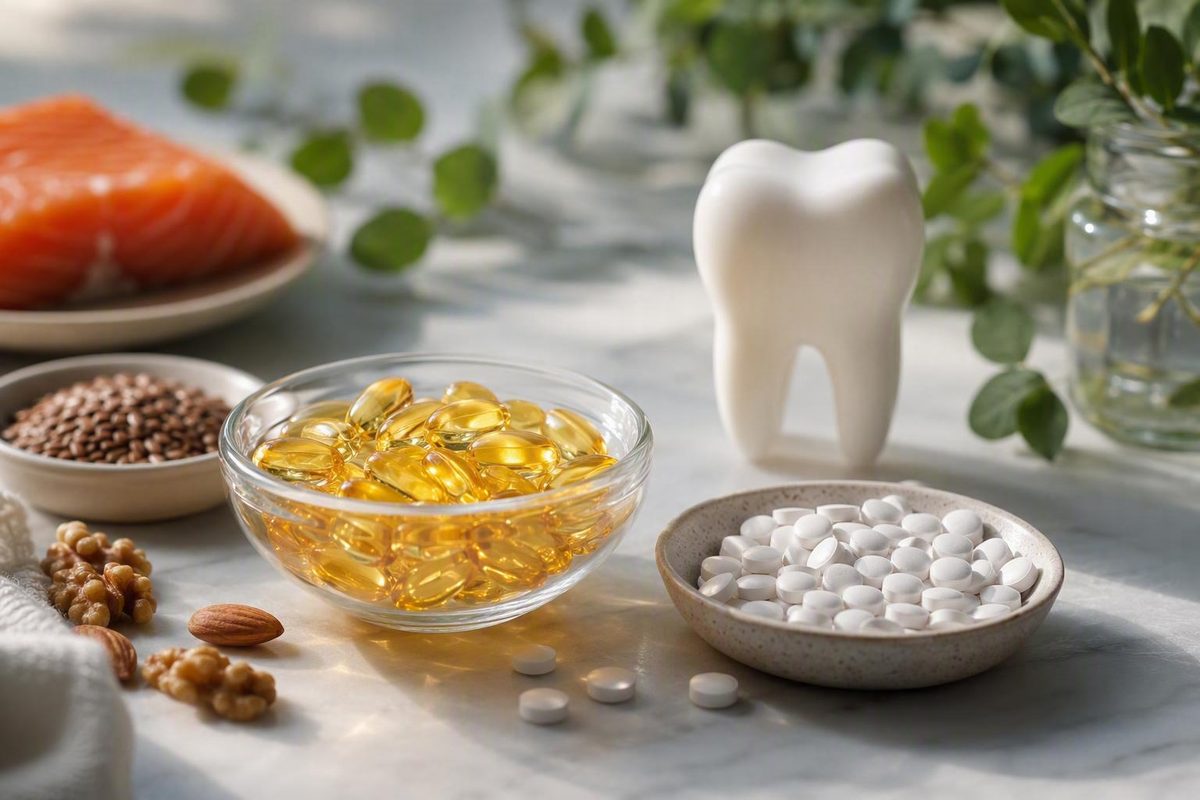
Omega-3 plus low-dose aspirin may become an antibiotic-sparing option for selected adults with advanced periodontitis, but it is not an established do-it-yourself replacement for antibiotics. In one 109-person randomized trial, it produced a similar one-year pocket-depth result after professional treatment below the gumline. Every participant received that treatment; the capsules did not replace it.
The direct comparison involved adults with stage III or IV periodontitis. It does not apply automatically to gingivitis, mild periodontitis, an abscess, unexplained bleeding gums, or an acute dental infection. Do not start aspirin or high-dose omega-3, or stop a prescribed antibiotic, based on this trial alone.
Set an illustrative cohort size, then sort or select an arm to compare treatment burden and the one-year endpoint.
All groups received professional subgingival instrumentation. Change the cohort to translate the reported percentages into illustrative counts; select an arm for a direct comparison.
| Study Arm | Regimen Added to Instrumentation | Duration | Active Pills/Day | One-Year Endpoint | At 100 | Safety/Exposure Class |
|---|---|---|---|---|---|---|
| Cleaning + placebo | Matching placebos | — | 0 active; placebo count — | 23.1% | 23.1 of 100 | Placebo exposure; event rate — |
| Antibiotics | Metronidazole 400 mg + amoxicillin 500 mg, each 3× daily | 14 days | ~6 antibiotic tablets* | 58.6% | 58.6 of 100 | Systemic antibiotic exposure; event rate — |
| Omega-3 + aspirin | Omega-3 3 g + aspirin 100 mg daily | 6 months | — | 57.7% | 57.7 of 100 | Aspirin/omega-3 exposure; event rate — |
| Both active regimens | Both regimens above | 14 days + 6 months | ~6 antibiotics + omega/aspirin count —* | 57.1% | 57.1 of 100 | Both exposure classes; event rate — |
*The ~6 figure is calculated from two named antibiotics taken three times daily, assuming one tablet supplies each listed strength. The exact dosage forms and omega-3 capsule count were not supplied. “—” means not reported. No comparative adverse-event rate was supplied.
Endpoint definition: no more than four periodontal sites with probing depth ≥5 mm at one year. Similar percentages do not by themselves prove formal equivalence or noninferiority.
Source: 109-person randomized trial, PubMed PMID 42124342. Rates and regimens are reported trial details; differences and illustrative cohort counts are calculated from those rates.
The Trial Compared Add-Ons to Deep Cleaning
The multicenter, double-blind, randomized, placebo-controlled trial enrolled 109 adults with stage III or IV periodontitis and followed them for one year. All four groups received subgingival instrumentation, according to the trial abstract.
Subgingival instrumentation is professional mechanical treatment used to remove or disrupt deposits and biofilm beneath the gums. Patients may hear it described as deep cleaning, scaling, root planing, periodontal debridement, or subgingival scaling. Those terms are not always perfectly interchangeable, but they refer to the professional foundation that every trial participant received.
A swallowed capsule cannot perform that mechanical work. This was also true of the antibiotics: they were tested as an adjunct, not as a substitute for instrumentation.
Participants were assigned to one of four arms:
- instrumentation plus matching placebos;
- instrumentation plus metronidazole and amoxicillin;
- instrumentation plus omega-3 and low-dose aspirin; or
- instrumentation plus both active regimens.
The antibiotic protocol was metronidazole 400 mg plus amoxicillin 500 mg, each taken three times daily for 14 days. The other protocol was omega-3 3 g plus aspirin 100 mg daily for six months. These are research-protocol details, not personal dosing instructions.
The regimens also imposed different treatment burdens. The antibiotic course lasted two weeks, while omega-3 plus aspirin continued daily for six months. The available evidence does not establish which regimen patients found easier, safer, or more acceptable. The exact omega-3 capsule count was not reported in the supplied evidence and can vary with formulation.
The One-Year Rates Were Similar, Not Proven Equivalent
The trial’s specified endpoint was having no more than four periodontal sites with a probing depth of at least 5 mm after one year. A periodontal probe measures the space between a tooth and the surrounding gum.
The endpoint was reached by 58.6% of the antibiotic group, 57.7% of the omega-3-plus-aspirin group, 57.1% of the combined-treatment group, and 23.1% of the instrumentation-plus-placebo group.
That supports a narrow statement: the two individual active regimens had very similar reported rates on this endpoint. It does not prove that omega-3 plus aspirin and antibiotics are universally interchangeable.
Formal equivalence or noninferiority requires an appropriate statistical design, a prespecified margin, confidence intervals, and an analysis showing that the margin was met. Similar percentages alone do not establish that conclusion.
Success also did not mean that every periodontal pocket disappeared or that each participant returned to ideal periodontal health. It meant that no more than four measured sites remained at or above the 5 mm threshold.
The result does not by itself show equal effects on tooth loss, need for surgery, quality of life, every clinical-attachment measure, bleeding at every site, microbiological outcomes, adverse events, recurrence, or treatment discontinuation. Follow-up ended at one year, so durability beyond that point is unknown.
The supplement regimen had ended six months before the final assessment. Its response was still evident at one year, which supports additional research into durability but does not establish a permanent effect.
Combining Both Regimens Added No Endpoint Benefit
The group receiving antibiotics together with omega-3 and aspirin reached the endpoint at a rate of 57.1%. That was not higher than the 58.6% antibiotic rate or the 57.7% omega-3-plus-aspirin rate.
The trial therefore provides no evidence that combining both strategies improved this particular target. It does not prove that the combined treatment could never differ on a secondary measure, but it gives no basis for assuming that more systemic treatment was better.
The comparison with instrumentation alone is also important. Its endpoint rate was 23.1%, while each active adjunct group was around 57% to 59%. That difference is why the result is scientifically interesting. It does not turn the adjunct into a stand-alone treatment because instrumentation was common to every arm.
Multiple news reports about these percentages still represent one trial, not independent replication. Randomization, blinding, and placebo controls strengthen the study, but 109 participants remain a modest sample for changing routine care across diverse populations.
The Finding Applies to Advanced Periodontitis
“Gum disease” can mean gingivitis, mild periodontitis, advanced periodontitis, an abscess, or symptoms that have not been diagnosed. The antibiotic comparison directly addressed selected adults with stage III or IV periodontitis who received professional subgingival instrumentation.
It did not establish benefit for gingivitis, mild periodontitis, periodontal abscesses, acute dental infections, unexplained bleeding gums, or supplement-only treatment. A clinical examination and periodontal measurements are needed to determine whether a person has the disease category that was studied.
An antibiotic-sparing adjunct could eventually be useful for some people who cannot tolerate particular antibiotics. That possibility warrants research, but an antibiotic allergy does not automatically make aspirin and omega-3 suitable. Clinicians must first decide whether any systemic adjunct is needed and then assess the alternatives.
A separate randomized trial enrolled 75 people with type 2 diabetes and moderate-to-severe generalized periodontitis. All received periodontal debridement. The tested regimen was 3 g of fish oil containing 900 mg of omega-3 polyunsaturated fatty acids plus 100 mg aspirin daily for two months. Investigators reported adjunctive clinical and immunological benefits, but antibiotics were not the comparator in that diabetes-specific trial.
That study cannot independently confirm replacement of metronidazole plus amoxicillin. It also illustrates why “3 g of fish oil” and “3 g of omega-3” are not necessarily the same formulation. Omega-3 content and treatment duration differed between the studies.
The principal trial is not enough to extrapolate confidently to smokers, pregnant or breastfeeding patients, people with substantial systemic illness, those with a bleeding or ulcer history, or people taking potentially interacting medicines.
Aspirin and High-Dose Omega-3 Require Medical Review
The trial’s six-month regimen is not a consumer self-care recipe. The supplied evidence does not include a comprehensive interaction guide or complete enough adverse-event data to establish that omega-3 plus aspirin is safer than antibiotics.
Aspirin can be clinically unsuitable for some people, and a reason to avoid antibiotics does not remove aspirin-related concerns. A dentist or periodontist needs an accurate list of prescription medicines, nonprescription drugs, and supplements. Medical review is particularly relevant when bleeding history, gastrointestinal ulcers, aspirin hypersensitivity, anticoagulant or antiplatelet treatment, pregnancy, breastfeeding, or fish and seafood allergy may affect the decision.
Trial exclusions identify gaps in the evidence rather than universal prescribing rules. For example, the diabetes trial excluded smokers, pregnant or lactating patients, people with aspirin or fish or seafood allergy, and those requiring prophylactic antimicrobial coverage.
The main antibiotic comparison also did not test this regimen as treatment for an acute abscess or spreading dental infection. A person prescribed an antibiotic for an acute problem should not stop, shorten, or replace it without speaking to the treating clinician.
Wider Omega-3 Evidence Remains Mixed
The direct antibiotic comparison rests chiefly on one modest-sized randomized trial. The broader omega-3 literature concerns adjunctive use with professional periodontal treatment and does not independently establish antibiotic replacement.
A 2023 systematic review and meta-analysis included seven randomized trials and favored omega-3 added to scaling and root planing for pocket-depth and clinical-attachment outcomes. Studies that administered antibiotics with omega-3 were excluded, so the review cannot show that omega-3 replaces antibiotics in periodontal care.
A 2022 systematic review included eight trials but could not reach a satisfactory conclusion because protocols were heterogeneous, some findings were questionable, risk of bias was high, and the overall evidence was judged moderate in quality. Two six-month studies appeared promising, but the authors treated that as a reason for more rigorous research rather than a settled recommendation in their review.
Those findings are not necessarily contradictory. A pooled analysis can show an average improvement while small samples, varying doses, inconsistent formulations, and risk of bias still limit confidence. Evidence about omega-3 alone also cannot automatically establish the effectiveness or safety of omega-3 combined with aspirin.
The European Federation of Periodontology’s 2020 framework describes periodontal treatment as a stepwise process involving behavior and risk-factor control, biofilm management, supra- and subgingival instrumentation, selected adjuncts, possible surgery, and supportive periodontal care. It does not address or endorse omega-3 plus aspirin as an antibiotic replacement in periodontal treatment.
Before routine practice changes, larger independent trials need to report formal noninferiority analyses, confidence intervals, complete adverse-event and bleeding data, adherence, treatment discontinuation, precise EPA and DHA formulations, and results in broader populations. Outcomes such as tooth retention, need for surgery, attachment gain, quality of life, and durability beyond one year also remain important.
Your Next Appointment Should Start With the Diagnosis
If avoiding antibiotics matters to you, ask whether you have gingivitis, chronic advanced periodontitis, an abscess, or another condition. If the diagnosis is periodontitis, ask for its stage, extent, pocket measurements, and whether the relevant sites have received adequate subgingival instrumentation.
The next issue is whether any systemic adjunct is necessary. Antibiotics are not automatically required for every person with periodontitis, and the trial does not make omega-3 plus aspirin automatically appropriate whenever antibiotics are being considered.
Ask how closely your situation resembles the adults in the 109-person trial, why an adjunct is being proposed, and how success will be measured. The study relied on repeat periodontal probing, not just whether bleeding or discomfort felt better.
A clinician considering the research would also need to review allergies, previous antibiotic intolerance, bleeding and ulcer history, current medicines and supplements, pregnancy or breastfeeding, diabetes, smoking, and other factors affecting treatment or healing. The six-month duration and the exact omega-3 formulation would need clarification because the supplied evidence does not establish that every product labeled “fish oil” supplies the studied amount.
Whatever adjunct is chosen, the treatment foundation remains professional instrumentation, daily plaque control, management of relevant risk factors, reassessment, and supportive periodontal maintenance. The trial supports further investigation and a clinician-led discussion for selected adults; it does not support replacing professional care or prescribed medication on your own.