
What Is Actually Inside a Tooth—and Why It Can Hurt
Nerve fibers sit in soft pulp beneath enamel and dentin. Cold, sweets, pressure, decay or a crack may cause pain without exposing a nerve.
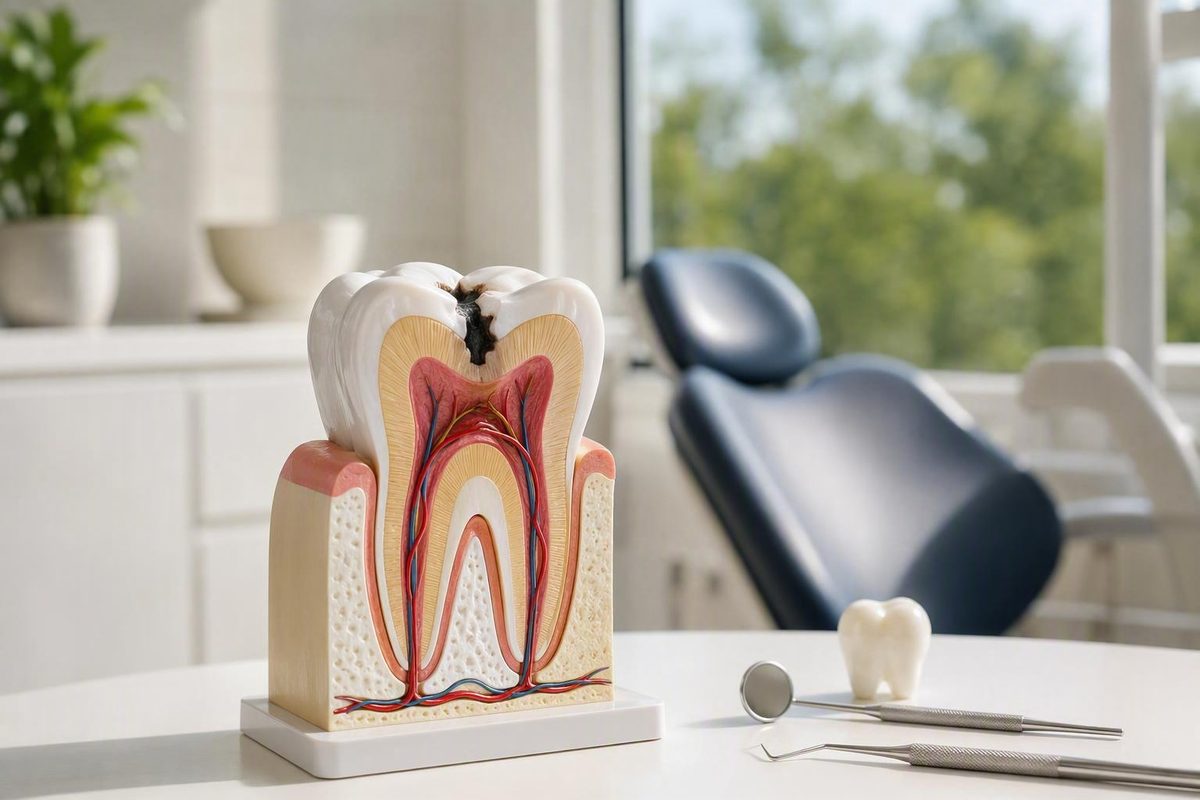
Yes, teeth have nerves. The nerve fibers sit inside the soft dental pulp at the center of the tooth, not in the enamel. Cold, sweets, pressure, decay, or a crack may affect exposed dentin or irritate the pulp without literally exposing a nerve. Sensitivity alone therefore cannot show whether the pulp is infected or whether root canal treatment is needed.
Yes—teeth have nerves inside the pulp
The dental pulp is the living tissue at the center of a tooth. In the visible crown, it occupies a space called the pulp chamber. From there, the pulp continues through narrow root canals toward small openings at the root tips.
Pulp contains more than nerve fibers. It also includes blood vessels, connective tissue, and specialized cells. The nerves detect sensations such as changes in temperature and pressure, while the blood vessels provide circulation to the living tissue. Enamel and dentin form protective layers around this inner pulp, as explained in the Cleveland Clinic overview of tooth pulp.
A simplified cross-section looks like this:
                    TOOTH CROWN
                 __________________
/ \
/ ENAMEL ← hard outer covering
/----------------------\
/ DENTIN ← layer surrounding the pulp
            |        __________        |
            |       |          |       |
            |       |  PULP    |       | ← nerves, blood vessels,
            |       | CHAMBER  |       |   cells and connective tissue
|__________| /
│ /
│ /
ROOT CANALS / ← pulp continues through roots
│ /
│ /
│ /
│ /
▼ /
                      ROOT TIPS       ← openings for vessels
                                         and nerve fibers
The important distinction is between the hard protective tissues on the outside and the living, nerve-containing tissue inside.
Enamel is the outer covering of the crown. Beneath it is dentin, which surrounds the pulp. In a healthy tooth, these layers separate the pulp from conditions in the mouth. Pain or sensitivity can develop when decay, wear, a crack, grinding, or an injury compromises that protection.
Why enamel damage may be painless—but deeper problems can hurt
Enamel does not contain living cells or nerve fibers. Damage limited to enamel may therefore produce no pain, particularly early in the decay process. A painless area is not necessarily harmless; it may simply not yet involve tissue capable of generating a pain signal.
Dentin lies between the enamel and pulp. It contains microscopic tubules. A pediatric dental-practice explanation describes how, when dentin is exposed, these tubules can convey the effects of heat, cold, acidity, or sweetness toward the nerve-containing pulp. This can create sensitivity even while the pulp remains physically covered (Bitesize Pediatric Dentistry).
That difference helps explain why a tooth may become sensitive before its pulp is directly exposed. It also explains why “exposed nerve” is often an imprecise description: the stimulus may be acting through exposed dentin rather than making direct contact with a nerve fiber.
A simplified inward progression of decay is:
- Enamel is affected first. There may be no symptoms because enamel has no nerve fibers.
- Decay extends into dentin. The tooth may become sensitive to cold, heat, or sweet foods and drinks.
- The pulp becomes irritated or exposed. Pain may become more noticeable or persistent, although symptoms vary.
- The pulp may become infected or lose vitality. Professional assessment is needed to determine what has happened.
This is a possible sequence, not an inevitable timetable. The presence, absence, or intensity of pain does not establish how far decay has progressed. It also does not distinguish decay from other possible causes of sensitivity, such as wear, a crack, grinding, or trauma.
Pulp nerves contribute to the perception of temperature, pressure, and pain. Those sensations can act as warnings that something has affected the tooth, but they do not provide a precise diagnosis. A short response to cold and a persistent toothache may feel different, yet neither symptom alone reveals the exact condition of the pulp.
Sensitivity does not always mean an “exposed nerve”
No. A sensitive tooth does not necessarily have a nerve directly exposed to the mouth. “Exposed nerve” is an informal phrase that often combines several different situations:
- Exposed dentin: Enamel has worn away, decay has opened the dentin, or part of a root surface is uncovered. External stimuli can affect the pulp through the dentin even though the pulp itself remains enclosed.
- Irritated or inflamed pulp: Decay, grinding, repeated pressure, trauma, or another source of irritation has affected the inner tissue, but there may be no direct opening into the pulp chamber.
- Direct pulp exposure: Deep decay or a crack has created a route into the pulp. This can allow contamination and may lead to infection.
Different problems can also affect the tooth in different ways. Decay may gradually remove protective tissue. Grinding can repeatedly stress teeth and contribute to wear.
Infection is another possibility when bacteria gain access to vulnerable inner tissue, but sensitivity does not prove that infection is present. The same general symptoms can accompany exposed dentin, pulp irritation, a crack, or other dental problems.
For that reason, “exposed nerve” should not be treated as a home diagnosis. Sensation alone cannot reliably show whether the pulp is mildly irritated, infected, directly exposed, or no longer vital. It also cannot determine whether the tissue can recover or whether a particular procedure is required.
What tooth symptoms can—and cannot—tell you
Possible signs of dentin or pulp involvement include a sharp twinge, throbbing toothache, sensitivity to hot, cold, or sweet items, tenderness, pain while chewing, swelling, or tooth discoloration. These signs identify a reason to pay attention, but none confirms a particular pulp condition by itself.
| Symptom | What it may indicate | Reasonable next step |
|---|---|---|
| Brief sensitivity to cold or sweets | Exposed dentin, wear, decay, or another irritant | Arrange an assessment if it persists or worsens |
| Sharp pain while eating or drinking | Sensitivity, decay, a crack, or pulp irritation | Book a dental assessment |
| Pain when biting or chewing | A crack, decay, inflammation, or another problem around the tooth | Have the tooth examined rather than assuming the cause |
| Persistent or throbbing toothache | Continuing irritation or deeper involvement | Seek prompt dental assessment |
| Tenderness, swelling, or discoloration | Possible damage or infection, among other causes | Arrange dental care rather than waiting for a home diagnosis |
Early tooth decay may cause no symptoms. As it worsens, it can cause toothache or sharp sensitivity to hot, cold, or sweet foods and drinks. The NHS guidance on tooth decay advises seeing a dentist for problems such as toothache or sharp pain while eating or drinking; painful or swollen gums also warrant assessment.
Symptoms should be interpreted as clues, not verdicts. Sensitivity can have several causes, and a particular pain pattern cannot confirm that the pulp is infected or determine whether root canal treatment is necessary. Persistent pain, pain while chewing, swelling, tenderness, or discoloration should be professionally assessed because the underlying conditions can overlap.
Pain disappearing does not necessarily mean that the tooth has healed. If the pulp dies, its nerve fibers may stop producing pain even though infection remains or spreads. Conversely, continuing pain does not by itself establish that the pulp must be removed. The Cleveland Clinic’s pulp guidance specifically notes that loss of pain after pulp death does not prove that the underlying problem has resolved.
A painful tooth does not automatically need a root canal
Treatment depends on the cause, the depth of any damage, and what a dental examination finds. Sensitivity alone does not establish that the pulp needs to be removed. A dentist may instead find exposed dentin, limited decay, wear, a crack, or another source of irritation.
For tooth decay, the possible treatment generally changes with severity. Early decay may be managed with professional fluoride treatment. A formed cavity may require a filling. If decay reaches the pulp, root canal treatment may be necessary, while extraction is used in some cases. These are general possibilities rather than recommendations for a particular tooth, as set out in the NHS treatment overview.
During root canal treatment, damaged or infected pulp is removed from the pulp chamber and root canals. The internal spaces are then cleaned, filled, and sealed. Although the treated tooth no longer contains living pulp, it can remain anchored in the jaw and continue functioning.
That does not mean every deep cavity or painful tooth has the same outcome. Symptoms cannot establish the condition of the pulp on their own, and an article cannot determine which treatment—if any—is appropriate for an individual tooth.
Decay Guide provides general dental information. It is not a dental practice and does not diagnose or treat individual readers.
Frequently asked questions
Do baby teeth have nerves too?
Yes. Baby teeth contain pulp with nerves, blood vessels, and connective tissue, just as permanent teeth do, although their anatomy is not identical in every respect. A deep cavity or injury can therefore irritate the pulp and cause a baby tooth to hurt. The pediatric dental-practice source cited above also explains that a shed baby tooth may look hollow after its roots and inner contents have been gradually resorbed as the permanent tooth prepares to erupt.