
What Is a Cavity? Tooth Decay, Holes and Early Mineral Loss
A dental cavity is a hole caused by tooth decay. Learn how cavities differ from early mineral loss, what can reverse, and why pain is not required.
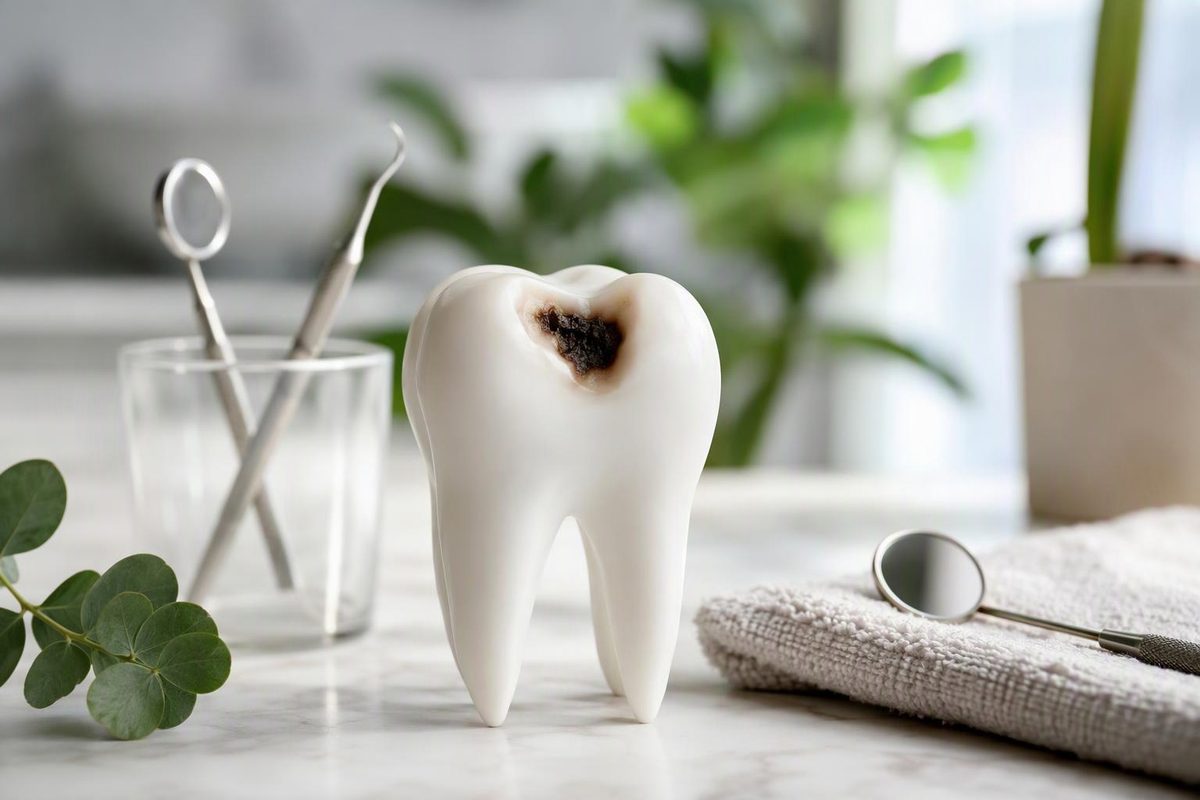
A dental cavity is a hole in a tooth caused by tooth decay. It forms when decay weakens and breaks down the tooth’s hard tissue. Unlike early mineral loss, the missing tooth structure is permanent damage: it cannot grow back through brushing or toothpaste. The National Institute of Dental and Craniofacial Research (NIDCR) makes this distinction between reversible early decay and a cavity.
Cavity, tooth decay and dental caries: what is the difference?
These terms overlap, but they describe different aspects of the problem:
- Tooth decay is the process of tooth damage caused by acids made by oral bacteria. It can begin before a hole exists.
- A cavity is the physical opening or hole that can result from that process.
- Dental caries is the clinical term used for the disease and its affected areas, including lesions with or without a hole. A lesion means an area of damaged tissue.
The American Dental Association’s classification includes both noncavitated lesions, where the surface remains intact, and cavitated lesions, where it has broken down. That is why a diagnosis of caries does not automatically mean a visible hole or the same treatment for every tooth. ADA caries classification and management
How does decay become a cavity?
Dental plaque is a sticky film of bacteria on teeth. Some of those bacteria use sugars and starches from food and drink to produce acids. The acids remove minerals from enamel, the tooth’s hard outer covering.
Saliva supplies minerals that help repair enamel, and fluoride supports this repair. But when mineral loss repeatedly exceeds mineral replacement, enamel weakens and can eventually collapse into a hole. Frequent sugar exposure can tip that balance toward decay. NIDCR’s explanation of the decay process
Cavities can occur in chewing-surface grooves, on smooth tooth surfaces or on exposed roots. They are not limited to back teeth, adults or teeth that hurt. Mayo Clinic’s overview of cavity types
Can a cavity reverse?
Early decay may reverse; an established hole cannot regrow. Before the surface breaks down, lost minerals may be replaced through remineralization. Fluoride and changes that reduce acid exposure can help stop or reverse this early damage.
Once a cavity exists, a dentist commonly restores the tooth with a filling. Brushing remains important for preventing further decay, but it does not replace missing tissue. Whether an affected area needs a filling or another approach depends on its clinical assessment—not simply its color. NIDCR’s treatment guidance
Does a cavity have to hurt or look dark?
No. Early decay often has no symptoms, and a developing cavity may be painless. Possible findings include white, brown or black changes, a visible pit or hole, or sensitivity to sweet, hot or cold foods. Mayo Clinic’s symptoms guidance
Dentists assess teeth directly and may use X-rays to find decay that is not obvious on examination. NIDCR’s diagnosis guidance
Neither a dark mark nor sensitivity alone confirms a cavity. Our guides to stain versus cavity and checking for a possible cavity explain those limits. A suspected hole warrants dental assessment rather than waiting for pain. For toothache or mouth pain, Mayo Clinic recommends seeing a dentist as soon as possible.
Is enamel erosion the same thing?
No. Decay involves acids produced by bacteria. Dental erosion is tooth-tissue loss caused by acids not produced by oral bacteria, such as acids from drinks or stomach reflux. Both can damage teeth, but they are different processes. ADA guidance on dental erosion
Decay Guide is an independent information publisher, not a dental practice. This article provides general information, not an individual diagnosis or treatment plan.