
The Right Crown Depends on the Tooth, the Bite, and the Exact Ceramic
Both are ceramics, but construction changes the trade-off: layered zirconia's surface porcelain may chip while the framework remains intact.
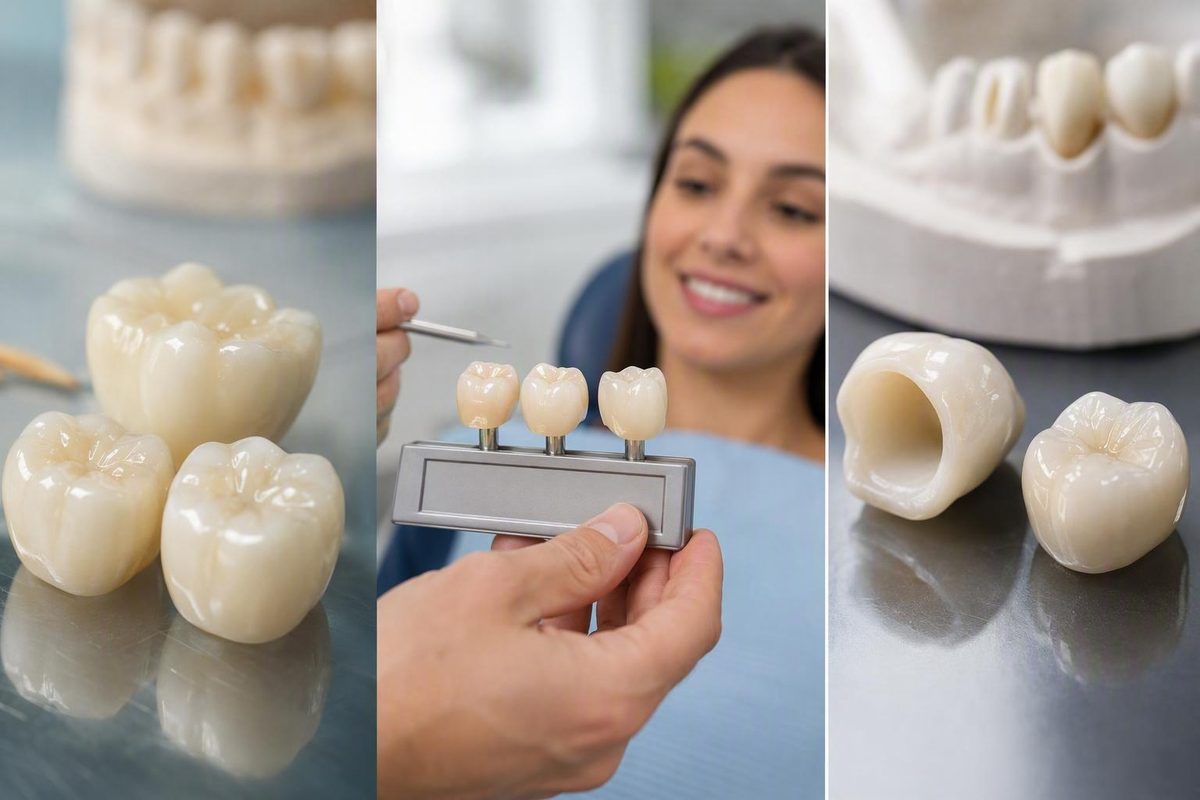
The short answer: which crown is commonly considered in each situation?
There is no universally best dental crown. The useful question is not simply “porcelain, ceramic, or zirconia?” but “Which exact material and construction best fit this tooth?”
The choice can depend on:
- Whether the crown is on a front tooth, premolar, or molar
- How visible the tooth is when you speak or smile
- The chewing forces it must withstand
- Whether you clench or grind your teeth
- Whether previous crowns have chipped or fractured
- How much healthy tooth structure remains
- The color beneath the proposed crown
- The available restorative space
- Your expectations for translucency and shade matching
- How the crown will be designed, made, fitted, and retained
The supplied dental-practice articles repeatedly describe the following as common selection patterns, although they are commercial practice materials rather than independent clinical guidelines. They generally favor glass ceramics or feldspathic porcelain when front-tooth appearance is the priority and zirconia when posterior load or grinding receives greater weight. They also emphasize individualized evaluation of the tooth and bite. One dentist-authored crown comparison, for example, bases selection on tooth location, visibility, grinding, and bite force.
| Situation | Material commonly considered | Why | Important qualification |
|---|---|---|---|
| Highly visible front tooth | Feldspathic porcelain or lithium disilicate | Emphasis on enamel-like translucency and detailed shade matching | The bite, underlying color, available space, and remaining tooth structure still matter |
| Front tooth requiring a different balance of appearance and fracture resistance | Translucent zirconia | May provide a middle ground between visibility and load tolerance | Zirconia formulations differ, and the optical result varies by case |
| Visible premolar under moderate load | Lithium disilicate or translucent zirconia | Both appearance and chewing load matter | The balance depends on the bite, available space, and grinding history |
| Heavily loaded molar | Monolithic zirconia | Fracture resistance often receives greater priority | This is a common pattern, not a rule that every molar requires zirconia |
| Tooth exposed to grinding or previous crown fracture | Monolithic zirconia is often considered | The restoration must tolerate repeated loading | Material selection does not manage the grinding habit itself |
| Case requiring a zirconia framework and a characterized surface | Layered zirconia | Combines a zirconia base with aesthetic veneering porcelain | The added porcelain creates a potential chipping mode absent from a fully monolithic crown |
| Implant crown or root-canal-treated tooth | Individually selected construction | Support, position, space, bite, and visibility influence the choice | Neither label automatically makes zirconia or glass ceramic the winner |
Layered zirconia deserves particular attention because it can sound like an uncomplicated “best of both worlds” option. Its zirconia framework provides support, while the surface porcelain allows more detailed color and translucency. However, the veneer can chip even if the zirconia beneath it remains intact. Monolithic zirconia eliminates that particular layered interface, but it may present a different aesthetic balance.
Implant crowns and crowns on root-canal-treated teeth also resist simple rules. The fact that a crown is supported by an implant, or that a tooth has received root canal treatment, does not by itself identify the best ceramic. The dentist still has to evaluate the crown’s position, available space, expected load, visibility, and available support.
These are general selection patterns, not recommendations for an individual reader. A dentist must examine the tooth, surrounding tissues, bite, restorative space, and existing damage before recommending a material.
First fix the terminology: zirconia and porcelain are both ceramics
“Best crown porcelain vs ceramic vs zirconia” sounds as though it compares three separate materials. It does not.
Ceramic is the broad category. Zirconia is a ceramic, as are the dental porcelains and glass ceramics discussed in crown comparisons. The meaningful comparison is among specific ceramic materials and crown constructions.
Zirconia is zirconium dioxide used to make dental restorations. Different formulations can prioritize translucency and mechanical performance differently, so “zirconia” is not a complete technical description.
Porcelain is even less precise in everyday dental language. Depending on the dentist, laboratory, quote, or article, a “porcelain crown” may mean:
- Feldspathic porcelain
- A glass ceramic such as lithium disilicate
- Porcelain layered over zirconia
- Porcelain fused to a metal substructure
- A general, nontechnical label for a tooth-colored ceramic crown
This inconsistency can make two apparent porcelain-versus-zirconia comparisons non-equivalent. The Essentials Dental terminology guide, for example, identifies zirconia as zirconium dioxide but uses “porcelain” mainly for the glass-ceramic category, often lithium disilicate.
An all-ceramic crown has a ceramic structure rather than a metal framework. The term may include zirconia, lithium disilicate, feldspathic porcelain, and other ceramic systems. It still does not identify the exact restoration.
A porcelain-fused-to-metal crown, usually abbreviated PFM, is different. It has a metal substructure covered with tooth-colored porcelain. Evidence about PFM crowns should not automatically be applied to all-ceramic lithium-disilicate, feldspathic, or zirconia crowns.
For example, a visible metal-associated line at a PFM margin is not a general feature of every restoration called porcelain. Similarly, a comparison between zirconia and PFM does not directly establish how zirconia compares with every glass ceramic.
The essential follow-up question is:
What exact material and construction are you proposing?
Ask whether the crown is monolithic zirconia, translucent or multilayer zirconia, porcelain-layered zirconia, lithium disilicate, feldspathic porcelain, or porcelain fused to metal. Without that detail, a broad label can hide differences relevant to appearance, chipping risk, preparation, and price.
The crown types hidden behind the broad labels
A crown is not defined only by its main ingredient. Construction matters as well. Two crowns described as zirconia may differ because one is a single zirconia structure while the other has a separate porcelain surface. Two crowns called porcelain may be made from entirely different systems.
| Crown category | Typical aesthetic emphasis | Typical load emphasis | Construction | Principal qualification |
|---|---|---|---|---|
| Monolithic zirconia | Tooth-colored result, with appearance varying by formulation | Commonly considered when fracture resistance is a leading concern | Primarily one zirconia structure | “Monolithic” does not identify the exact formulation or translucency |
| Translucent or multilayer zirconia | Greater emphasis on integration in visible areas | Intended to balance appearance and load resistance | Often monolithic, with color or translucency variation | Optical and mechanical characteristics vary among products |
| Layered zirconia | Detailed surface color, form, and translucency | Zirconia framework provides support | Zirconia base plus veneering porcelain | The surface porcelain may chip while the framework remains intact |
| Lithium disilicate | Enamel-like translucency and shade integration | Commonly considered for front teeth and selected visible premolars | Glass-ceramic restoration | Suitability remains dependent on the tooth, space, and bite |
| Feldspathic porcelain | Nuanced translucency and characterization | Generally selected with aesthetics at the forefront | Commonly built or layered for optical control | Heavy loading or limited space may change the choice |
| Porcelain fused to metal | Tooth-colored surface over a supportive framework | Historically used in front and back regions | Porcelain layered over metal | It is not an all-ceramic crown |
Monolithic zirconia means that the crown’s structural body is made primarily as one zirconia restoration rather than as a zirconia framework with a separate aesthetic porcelain veneer. It is commonly considered for molars, heavy bites, grinding, and previous crown fractures because it avoids veneer chipping as a distinct failure pathway. It can still experience other problems, including fracture, loss of retention, or decay affecting the underlying tooth.
Translucent or multilayer zirconia reflects efforts to improve zirconia’s appearance. The category still includes products with different balances of appearance and load resistance; “modern zirconia” is not one standardized material.
Layered zirconia has a zirconia core or framework covered in visible areas by aesthetic porcelain.
Lithium disilicate is a glass ceramic often associated with the e.max name in dental discussions. The supplied practice pages commonly value it for front-tooth appearance and also describe it as an option in some visible premolar cases. Its suitability cannot be determined from appearance alone.
Feldspathic porcelain is associated with refined translucency and shade characterization, especially when restoring a highly visible tooth beside natural enamel.
Porcelain fused to metal should be evaluated as its own construction. A dentist-authored explanation of PFM crowns defines them as a metal substructure covered with tooth-colored porcelain and distinguishes them from other ceramic options. Findings about metal-supported porcelain should not be treated as findings about every “porcelain crown.”
The practical lesson is that a proposal for a “ceramic crown” is incomplete. Even “zirconia crown” leaves important questions unanswered. The exact formulation and whether the crown is monolithic or layered are part of the restoration—not minor details.
Appearance versus fracture resistance is a trade-off, not a quality ranking
Crown discussions are often reduced to “porcelain is attractive but fragile” and “zirconia is strong but unattractive.” That is too crude to guide an actual decision.
Feldspathic porcelain and glass ceramics are commonly favored when the primary objective is to reproduce natural enamel’s interaction with light. A single front crown must blend not only in basic color but also in brightness, translucency, surface texture, and shade variation. A material with strong optical potential gives the dentist and laboratory more options, but it does not guarantee an invisible restoration.
Zirconia is commonly favored when repeated loading is the dominant concern. That often includes molars, heavy bites, clenching or grinding, and a history of fractured restorations. A dentist-reviewed dental-practice comparison similarly emphasizes all-porcelain crowns for visible teeth and zirconia for higher-load situations, while stating that the choice depends on the individual tooth and bite.
Modern translucent zirconia may narrow the historical appearance gap, but the result can still vary with:
- The exact zirconia formulation
- Crown thickness
- The shade beneath the crown
- Neighboring natural teeth and restorations
- Surface texture and characterization
- Laboratory execution
- Lighting and viewing angle
Neither “porcelain always looks better” nor “zirconia is indistinguishable from natural enamel” is a reliable rule.
Strength requires equally careful interpretation. Laboratory material strength is not the same as clinical crown survival. A crown functions as part of a system that includes the supporting tooth or implant, crown design, fit, retention, bite, hygiene, and maintenance. A high-strength ceramic can still require replacement because the crown loosens, decay develops at the margin, or loading is unfavorable. A suitable glass-ceramic crown may perform well in a carefully selected case even though zirconia is generally given greater priority where fracture resistance is the main concern.
There is also more than one type of fracture.
The useful comparison therefore asks two separate questions:
- What optical result does this tooth require?
- What mechanical risks must this restoration tolerate?
Material selection balances those needs. It is not a ranking in which one ceramic is inherently premium and another is inferior.
Choosing by tooth location, bite, and cosmetic priority
Tooth position is a useful starting point, but it is not enough by itself. Two molars may face different loads, and two front teeth may present very different cosmetic challenges.
Highly visible front tooth
For a central or lateral incisor with demanding cosmetic requirements, feldspathic porcelain or lithium disilicate is commonly considered. These ceramics permit close attention to translucency, brightness, shade variation, and integration with neighboring enamel.
The dentist must still consider the bite, the space available for the crown, and the color beneath it. Choosing translucency without considering a dark tooth or core may work against the intended result.
Front tooth needing a different strength–appearance balance
Translucent zirconia may be considered when the dentist wants a different balance of appearance and fracture resistance. It is an option, not an automatic replacement for glass ceramic. The formulation and crown construction remain important.
Layered zirconia is another possibility when a zirconia framework is desired but the visible surface requires additional characterization. Its porcelain veneer introduces a separate potential chipping mode.
Visible premolar
A premolar occupies a middle ground: it may show prominently in a smile while also carrying meaningful chewing load. Lithium disilicate may suit some cases because of its optical qualities, while translucent zirconia may receive greater consideration when loading or grinding risk carries more weight.
Heavily loaded molar
Monolithic zirconia is commonly considered for a molar exposed to substantial chewing force, particularly when the patient has broken a previous crown. Avoiding a separate porcelain veneer removes veneer chipping as one possible complication. This is a selection pattern, not a universal mandate for every molar.
Clenching, grinding, or previous fractures
A history of grinding or repeated crown fracture changes the weighting of the decision because fracture resistance becomes more important. The material does not remove the underlying load, however. Ask whether monitoring, bite management, or a night guard is appropriate. That decision must also be individualized.
Implant crown
An implant does not automatically require a zirconia crown. Position, available restorative space, visibility, and expected load still require evaluation.
Root-canal-treated tooth
Root canal treatment likewise does not dictate one ceramic. The amount of remaining tooth structure, existing damage, available space, bite, and overall restorative design remain relevant. A dental-practice overview of crown selection and placement identifies tooth position, grinding or clenching, visibility, cosmetic goals, and dental history as factors in choosing between porcelain and zirconia.
Before comparing materials, consider:
- Visibility: Does the tooth show at rest, during speech, or in a full smile?
- Chewing load: Is it a front tooth, premolar, or heavily loaded molar?
- Grinding history: Do you clench, grind, or show substantial tooth wear?
- Previous fractures: Has this tooth or an earlier crown chipped or broken?
- Available space: Is there enough room for the proposed restoration?
- Remaining structure: How much sound tooth remains?
- Underlying color: Does the tooth or buildup require masking?
- Neighboring restorations: Must the crown match natural enamel, veneers, or other crowns?
- Cosmetic tolerance: Is an exceptionally close match essential, or is a natural tooth-colored result sufficient?
- Construction: Is the proposed crown monolithic or layered?
This is more useful than asking which broad material is “best.” It turns an abstract ranking into a case-specific discussion.
How crowns fail—and why material is only part of longevity
The supplied dental-practice pages publish broad and inconsistent lifespan estimates. Some describe porcelain crowns as lasting around a decade or longer and zirconia crowns as lasting longer, but the ranges overlap and the pages do not provide enough independently appraised evidence to establish universal head-to-head benchmarks. These figures should not be treated as promises for an individual crown.
The more useful approach is to understand how a restoration can fail.
Bulk fracture
A crack can pass through the crown’s main structure. Greater fracture resistance addresses one part of the risk but cannot prevent every failure.
Veneer chipping
A layered crown can lose part of its surface porcelain while the underlying framework remains intact. This can occur with porcelain layered over zirconia and is also relevant to metal-supported porcelain. The consequence depends on the chip’s location and extent.
Loss of retention
A crown can come loose without the ceramic breaking. If that happens, the reason should be evaluated rather than assuming that the crown merely needs to be placed back.
Decay at the margin
A crown covers a tooth; it does not make the underlying tooth immune to decay. The junction between the crown and tooth therefore remains important, as do cleaning and continued dental care.
Fit or margin problems
A strong material cannot compensate for an unsuitable fit or contour. The restoration still has to fit the prepared tooth and function with the surrounding tissues and neighboring teeth.
Bite-related damage
Grinding, clenching, or unfavorable bite contacts can repeatedly load the crown and supporting structure. These forces may contribute to chipping, fracture, or loosening.
The supplied practice articles commonly identify cementation, decay at the crown margin, grinding, and chipping or fracture as longevity factors. The Willow Family Dentistry comparison specifically lists poor cementation, margin decay, and untreated grinding as reasons a crown may have a shorter service life.
Factors that may matter alongside the material name include:
- The condition of the tooth before treatment
- Crown design and available space
- Accuracy of the scan or impression
- Laboratory fabrication
- Fit at the crown margin
- Placement and retention
- Bite adjustment
- Oral hygiene and cleaning between teeth
- Management of clenching or grinding
- Follow-up examinations
Longevity is therefore a property of the whole restoration, not merely the ceramic. When comparing options, ask which failure mode concerns the dentist most: fracture, veneer chipping, loss of retention, decay, or an aesthetic mismatch. The answer may explain the proposed construction more clearly than a generic lifespan estimate.
Tooth preparation, placement, and care after the crown
The dentist reshapes the tooth to create space and the geometry needed for the proposed crown.
It is sometimes claimed that zirconia always requires less tooth removal. The supplied evidence does not support that as a universal rule. Preparation depends on the exact material and construction, the available space, the tooth’s condition, and the restorative plan. Minimal reduction is not automatically beneficial if it leaves inadequate room for an appropriately designed crown.
A conventional workflow generally includes:
- Assessment and planning. The dentist evaluates the tooth, surrounding tissues, bite, space, and treatment objective.
- Tooth preparation. The tooth is shaped for the selected restoration.
- Digital scan or impression. The prepared tooth, neighboring teeth, and bite are recorded.
- Temporary protection when needed. A temporary crown may protect the tooth while the final restoration is made.
- Fabrication. The crown is produced in the selected material and construction.
- Final checks. The dentist evaluates fit, contacts, bite, shape, and color.
- Placement. The crown is retained using an approach selected for the restoration and case.
A dental-practice description of crown placement outlines tooth preparation, a scan or impression, temporary protection when needed, and final checks of fit, bite, and shade.
Same-day fabrication may be available in some offices, depending on the equipment, material, workflow, and suitability of the case.
General maintenance measures include:
- Brush the crown and surrounding teeth consistently
- Clean between teeth around the crown
- Attend dental examinations at the intervals recommended for you
- Avoid using crowned or natural teeth to open packages or hold objects
- Use caution with ice and other very hard items
- Report looseness, pain, swelling, a changed bite, or a chipped surface
- Ask whether a night guard is appropriate if you grind or clench
Care cannot guarantee indefinite survival, but it can address preventable risks affecting both the crown and the tooth beneath it.
If wear against the opposing tooth concerns you, ask how the crown’s surface and bite will be checked after placement. The issue should be discussed in relation to the specific restoration and finished surface rather than reduced to a claim that one broad material is inherently harmless.
Cost, quotes, and the questions to ask before choosing
There is no dependable rule that zirconia always costs more than porcelain or that porcelain is always less expensive.
The supplied practice pages disagree. Some describe zirconia as more expensive, while others publish overlapping or similar local prices. These are office-specific figures, not national benchmarks. One New York dental-practice comparison, for example, lists approximately the same local price range for its zirconia and porcelain options, illustrating why a universal ranking is unreliable.
Price may vary with:
- Geographic location
- Exact ceramic and crown construction
- Laboratory and ceramist
- Complexity of shade matching
- Treatment complexity
- Need for a buildup, post, or other associated procedure
- Temporary restoration
- Office-based versus outside-laboratory workflow
- Follow-up services
- Insurance benefits
- Warranty or remake terms
Compare total treatment quotes rather than isolated crown fees. Ask whether the stated fee includes:
- Examination and necessary imaging
- Removal of an existing crown
- Decay removal
- Buildup or post, if needed
- Temporary crown
- Laboratory fee
- Custom shade services
- Final placement and adjustments
- Follow-up visits
- A night guard, if proposed
- Repair, remake, or warranty provisions
A focused list of questions is usually more useful than a specialist-level technical checklist:
- What is the exact ceramic and product name?
- Is the crown monolithic, multilayer, porcelain-layered, or porcelain fused to metal?
- What does “porcelain” mean in this quote?
- Why does this construction suit this tooth and my bite?
- What alternative would you consider, and what trade-off would it introduce?
- How much tooth preparation is expected, and is there enough space?
- Does the underlying tooth color need to be masked?
- How will the crown be retained, and why is that approach appropriate?
- Will an outside laboratory make it, or is same-day fabrication proposed?
- Does my grinding or clenching change the choice?
- What failure mode concerns you most in this case?
- What is the total fee, and what is included?
- What insurance benefit is expected?
- What are the warranty or remake terms?
- What evidence or relevant clinical experience supports this material for this tooth?
Do not accept “ceramic” or “porcelain” as the entire technical explanation. The dentist should be able to name the material, describe the construction, and explain why its trade-offs fit the tooth.
An examination remains essential. Cracks, decay, gum health, bite contacts, available space, prior treatment, and remaining tooth structure cannot be evaluated from a material label or online comparison.
Is zirconia a ceramic crown?
Yes. Zirconia is zirconium dioxide used as a dental ceramic. It is not a separate category opposed to “ceramic.”
The meaningful distinctions are between zirconia and other ceramics, such as lithium disilicate or feldspathic porcelain, and between constructions such as monolithic zirconia and porcelain-layered zirconia. Ask for the exact formulation and construction.
Which crown is commonly considered for a highly visible front tooth?
Feldspathic porcelain or a glass ceramic such as lithium disilicate is commonly considered when translucency, shade characterization, and integration with neighboring enamel are the leading priorities.
Modern translucent zirconia may also be considered when the case requires a different balance of appearance and fracture resistance. The appropriate option depends on the bite, remaining tooth structure, available space, underlying color, and neighboring teeth.
Which crown is commonly considered for a molar or someone who grinds their teeth?
Monolithic zirconia is commonly considered for heavily loaded molars, people who clench or grind, and cases with a history of crown fracture because fracture resistance receives greater weight. A dental-practice article focused on tooth location and load similarly presents zirconia as a common posterior option, although its generalized lifespan claims should not be treated as guarantees.
Zirconia is not mandatory for every molar. Space, support, bite, and restoration design may justify another approach. Grinding also requires separate attention; ask whether a night guard or another management strategy is appropriate.
Do zirconia crowns always last longer than porcelain crowns?
No. Zirconia is commonly selected when fracture resistance is important, but that does not prove every zirconia crown will outlast every porcelain or glass-ceramic crown.
Crowns may fail through decay, loss of retention, margin problems, veneer chipping, bulk fracture, or bite-related damage. Fit, design, placement, laboratory execution, hygiene, maintenance, and grinding can all affect the outcome. Lifespan ranges published by individual practices are broad estimates, not universal comparative benchmarks.
Is zirconia always more expensive than porcelain?
No. Prices vary by location, laboratory, exact product, construction, treatment complexity, insurance, and what the quote includes. The supplied sources disagree partly because they use “porcelain” for different restorations and report prices from individual practices.
Ask for the total fee and whether it includes diagnostics, a buildup or post, temporary protection, laboratory work, adjustments, follow-up, and any proposed night guard. Compare like with like: monolithic zirconia, layered zirconia, lithium disilicate, and porcelain fused to metal are not interchangeable products merely because all may be described as tooth-colored crowns.
A restrained decision rule is reasonable: glass ceramic or feldspathic porcelain is commonly considered when maximum anterior aesthetics is the priority; monolithic zirconia is commonly considered for high-load posterior teeth and grinding; and translucent or layered zirconia may offer a different balance of visibility and fracture resistance. The final choice should identify the exact material and construction while accounting for the tooth, bite, remaining structure, fit, laboratory work, and maintenance.
Decay Guide describes itself as a general-information publisher rather than a dental practice. This article does not diagnose, treat, or recommend a crown for an individual reader. A qualified dentist must examine the tooth before advising which restoration is appropriate.