
The Five Stages of Teething: A Simplified, Nonstandard Guide
The familiar model hides two key details: upper and lower eruption windows differ, and lateral incisors do not appear in the sequence at all.
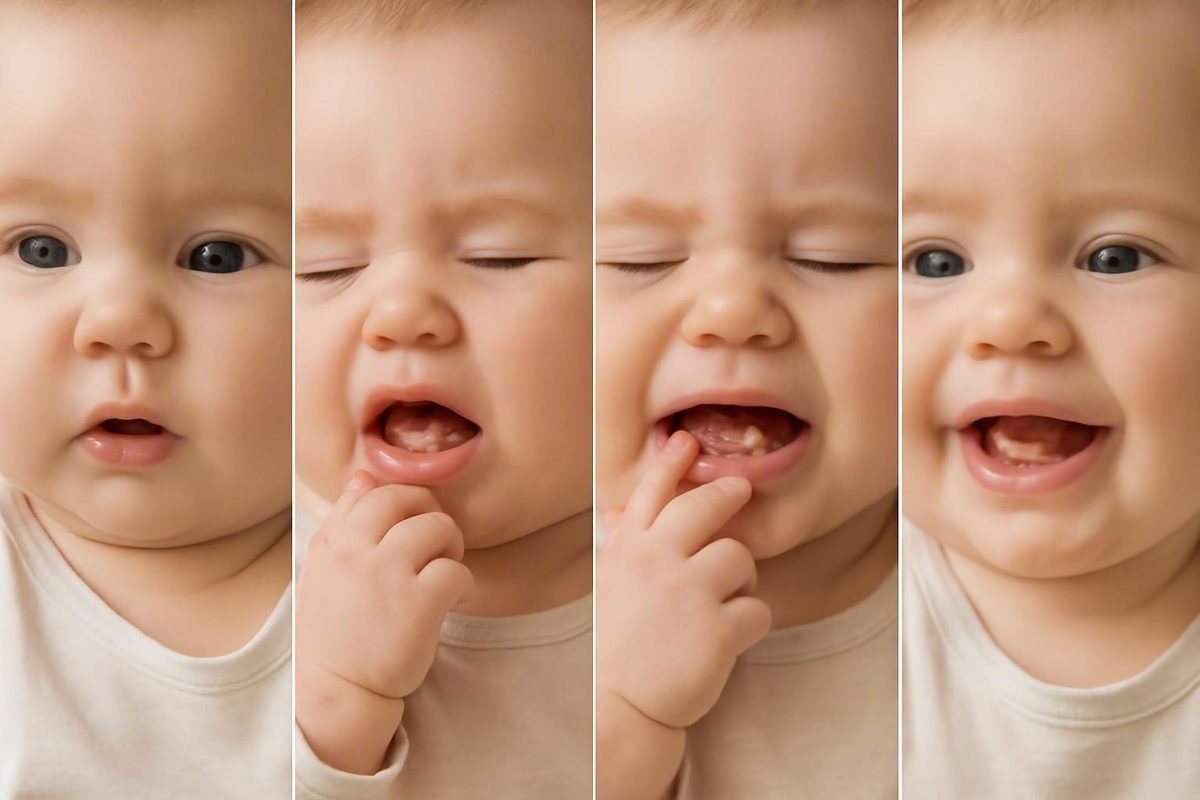
Overview
The five stages of teething, as commonly described, are: teeth developing beneath the gums from birth to about 6 months, the first incisors around 6 to 8 months, the first molars around 10 to 14 months, the canines around 16 to 23 months, and the second molars from about 23 to 33 months. Every age in that sequence is an estimate, not a deadline, and children vary widely on either side of it.
It is also worth knowing up front that the five-stage model is a simplified editorial framework, not a formally standardized clinical classification. Sources that use it draw the stage boundaries differently, some competing pages use seven stages instead of five, and the evidence reviewed for this article does not establish that any pediatric dental authority formally recognizes one official five-stage system. Detailed eruption charts, such as the one published by Children’s Hospital Los Angeles, show broad, overlapping age ranges for individual teeth that do not fit neatly into five tidy boxes.
Two more qualifications make the framework safer to use. First, timing varies: Children’s Hospital Los Angeles notes that infants start teething around 6 months on average, but some babies get a first tooth as early as 3 months, and some do not have all 20 primary teeth until age 3. Second, discomfort is episodic, not continuous. A child moving through a stage is not expected to be uncomfortable for months at a time — active eruption episodes typically last only days, then subside.
The five stages of teething
The table below is a snapshot of the five commonly cited stages, drawn from the pediatric dental pages that popularized the model and cross-checked against the tooth-by-tooth ranges from Children’s Hospital Los Angeles. Treat it as an orientation map: ages are approximate, stages overlap in real children, and the framework itself is simplified rather than official.
| Stage | Approximate age (estimate) | Tooth group | What caregivers may notice | Safe first response |
|---|---|---|---|---|
| 1 | Birth to ~6 months | All 20 primary teeth developing below the gums | Usually nothing tooth-related; drooling at this age is often developmental | No teething action needed unless a tooth is actively erupting |
| 2 | ~6–8 months | First incisors (front teeth), typically lower before upper | Drooling, chewing, tender gums, fussiness during eruption episodes | Clean-finger gum massage; supervised firm rubber teether |
| 3 | Commonly cited as 10–14 months | First molars (detailed charts place them later, ~13–19 months) | Chewing, gum swelling, irritability, possible sleep disruption | Chilled (not frozen) washcloth or teether, supervised |
| 4 | ~16–23 months | Canines (between incisors and molars, top and bottom) | Similar episodic signs; child can often point to sore gums | Same non-drug comfort measures, used during active episodes |
| 5 | ~23–33 months | Second molars (the last primary teeth) | Episodic discomfort at the back of the mouth | Same measures; seek advice for severe or persistent symptoms |
Each stage section below follows the same repeatable pattern — estimated age, tooth group, what you may notice, and what you can safely do — so you can apply it regardless of whether your child’s timing matches the labels.
Stage 1: Birth to about 6 months — teeth developing below the gums
Stage 1 is not really a teething stage in the way caregivers usually mean it; it is usually the period before any tooth emerges — though some babies can have a first tooth come in as early as 3 months. As pediatric dental sources describing the five-stage model note, babies are born with a full set of twenty primary teeth already formed beneath the gums. Those teeth develop quietly during the first months of life.
The practical takeaway is that age alone does not establish active teething. A three- or four-month-old who drools and mouths objects is often simply doing what infants that age do; it does not necessarily mean a tooth is on the way, and this stage should not be read as implying months of pre-eruption discomfort. Teething is not a continuous process — Kids Smiles Dental notes that symptoms appear only while teeth are actively erupting, typically for about a week at a time.
Stage 2: Around 6 to 8 months — the first incisors
Stage 2 is when most caregivers see the first tooth. The incisors — the flat front teeth — are typically the first to erupt, and the commonly cited window is around 6 to 8 months. Children’s Hospital Los Angeles gives the lower central incisors a broad range of 3 to 10 months and the top central incisors 8 to 12 months, which is a useful reminder that the tidy 6-to-8-month label sits inside much wider real-world variation. A first tooth at 4 months or at 11 months can both be unremarkable.
During an active eruption episode, you may notice extra drooling, an urge to bite and chew, tender or swollen gums where the tooth is emerging, fussiness, or lighter sleep. A safe, supported response is the one the FDA and the American Academy of Pediatrics recommend: gently rub the gums with a clean finger, or offer a firm rubber teething ring to chew on under supervision. Treat the age range as a description of what commonly happens, not a milestone your child must hit.
Stage 3: Commonly cited as 10 to 14 months — first molars
Stage 3 in the popular model covers the first molars — the broader chewing teeth behind the incisors — at roughly 10 to 14 months. This is the stage where the simplified framework and detailed eruption charts diverge most visibly. The Children’s Hospital Los Angeles chart places the top first molars at 13 to 19 months and the lower first molars at 14 to 18 months — later than the commonly cited stage label. Meanwhile, the lateral incisors (the teeth beside the front two) erupt across 9 to 16 months, which means the teeth actually emerging during the “10 to 14 months” window are often incisors rather than molars.
The lesson is not that either source is wrong, but that the five-stage model compresses overlapping ranges into clean labels. If your 12-month-old is cutting a lateral incisor rather than a molar, nothing is off schedule.
Molars have a larger surface than incisors, and some children seem to find their eruption more bothersome, though the evidence does not establish that this is true for every child. During active episodes you may see the familiar cluster — chewing, gum swelling, irritability, disrupted sleep — and the same non-drug responses apply: gum massage, a chilled (never frozen) washcloth, or a supervised firm teether.
Stage 4: About 16 to 23 months — canines
Stage 4 covers the canines, the pointed teeth that fill the gap between the incisors and the first molars on both the top and bottom arches. The Children’s Hospital Los Angeles chart puts the top canines at 16 to 22 months and the lower canines at 17 to 23 months, which lines up closely with the commonly cited stage range — one of the points where the simplified model and the detailed chart agree well. As always, these are approximations, and a canine arriving somewhat earlier or later is within normal variation.
By this age, many toddlers can communicate discomfort more directly — pointing at their mouth, refusing certain foods, or rubbing their cheeks — which can make active episodes easier to identify. The safe responses do not change: gently massage the sore gum area with a clean finger for a minute or two, offer a chilled washcloth or a firm rubber teether under supervision, and remember that the FDA advises against frozen teethers because an object that is too hard or too cold can hurt a child’s gums. Expect symptoms to come in bursts as each tooth breaks through, not as a continuous months-long ordeal.
Stage 5: About 23 to 33 months — second molars
Stage 5 is the final commonly cited stage: the second molars, the large back teeth that complete the set of 20 primary teeth. The upper and lower ranges overlap rather than arriving together — Children’s Hospital Los Angeles lists the lower second molars at 23 to 31 months and the top second molars at 25 to 33 months. Once these erupt, primary-tooth teething is complete, which for some children is not until close to their third birthday.
Because second molars are the largest primary teeth, this stage is often described as the most uncomfortable, and the source that popularized the five-stage sequence simply describes it as the eruption of the large molars. The evidence establishes the tooth group and the timing, but not a universal pain ranking — some toddlers sail through second molars while others struggle, and it would be misleading to promise any caregiver that this stage will be the worst (or the easiest). What holds across children is the episodic pattern: expect several days of discomfort per erupting tooth, apply the same supervised non-drug comfort measures, and seek professional advice if discomfort is severe or unusually persistent rather than assuming it is just “the hard stage.”
How the five-stage model compares with tooth-by-tooth eruption ranges
The five-stage model trades precision for memorability. It is genuinely useful as a quick orientation — five labels are easier to hold in mind than ten overlapping ranges — but it hides two things a caregiver often needs: the difference between upper and lower teeth, and the lateral incisors, which do not appear in the five-stage sequence at all. The table below shows the tooth-by-tooth eruption ranges published by Children’s Hospital Los Angeles so you can see where your child’s actual pattern fits.
| Tooth type | Approximate eruption range |
|---|---|
| Lower central incisors | 3–10 months |
| Top central incisors | 8–12 months |
| Top lateral incisors | 9–13 months |
| Lower lateral incisors | 10–16 months |
| Top first molars | 13–19 months |
| Lower first molars | 14–18 months |
| Top canines | 16–22 months |
| Lower canines | 17–23 months |
| Lower second molars | 23–31 months |
| Top second molars | 25–33 months |
Reading the two frameworks side by side explains most of the apparent contradictions caregivers run into. The lower central incisors can arrive anywhere from 3 to 10 months — a seven-month spread that the five-stage model compresses into “around 6 to 8 months.” The lateral incisors span 9 to 16 months, straddling the boundary between “stage 2” and “stage 3,” which is why a one-year-old cutting a lateral incisor looks off-schedule against the stage labels but perfectly ordinary against the chart. And the first molars, labeled 10 to 14 months in the popular model, sit at 13 to 19 months in the detailed chart — a conflict between reputable pages that the sources themselves do not reconcile.
This inconsistency runs deeper than one tooth group. The pages reviewed for this article do not agree on stage boundaries even when they agree on the count: one pediatric dental source defines stage 2 as simply 6 months while another uses 6 to 8 months, and other popular resources organize the same timeline into seven stages instead of five. The evidence available for this article does not establish that any professional dental body — such as the American Academy of Pediatric Dentistry or the American Dental Association — formally recognizes a five-stage classification, and a current professional-body eruption chart to authoritatively settle the conflicting ranges was not among the sources reviewed. If a precise answer matters for your child, a pediatric dentist can assess the actual eruption pattern directly.
The practical way to use both tools: reach for the five-stage model when you want a rough sense of what comes next, and reach for the tooth-by-tooth chart when your child’s timing does not match the stage labels. The broad, overlapping ranges in the detailed chart often show that apparent “early” or “late” teething is still within normal variation; if your child’s timing falls outside those ranges or continues to concern you, a pediatric dentist can assess it directly.
Signs that may accompany active teething
The signs most consistently associated with active tooth eruption are local and behavioral. Pediatric dental guidance describes the quintessential cluster as irritability or fussiness, drooling, chewing on firm objects, and sore or sensitive gums. Children’s Hospital Los Angeles lists a broader set of observations that may accompany eruption:
- Drooling, sometimes with skin rashes around the mouth
- Increased biting, chewing, and gnawing
- Swollen, red, or tender gums where a tooth is emerging
- Irritability, behavior changes, or appetite changes
- Disrupted sleep patterns
- Cheek rubbing, gum rubbing, or ear pulling
- Occasional cough or gag from extra saliva
Two qualifications keep this list honest. First, these signs vary considerably between children — some babies show most of them, others cut teeth with barely a signal — and none of them is exclusive to teething. A fussy, drooling baby is not necessarily teething, and assigning every difficult day to teeth can delay noticing something else. Second, several items on the list (ear pulling, elevated temperature, coughing) overlap with illness signs and are covered separately in the red-flags section below, because persistence or accompanying symptoms changes what they may mean.
The timing pattern matters as much as the signs themselves. The full eruption process is long — starting around 6 months on average and, per Children’s Hospital Los Angeles, sometimes not finishing until age 3 — but discomfort is not spread evenly across that span. Kids Smiles Dental explains that teething is not a continuous process: a baby experiences symptoms only while teeth are actively erupting, for roughly a week at a time. Children’s Hospital Los Angeles frames it similarly, noting that each new teething episode can last around 3 to 8 days.
That episodic pattern gives caregivers a useful interpretive rule: if the signs fit teething, expect them to build as a tooth approaches the surface and ease within days of eruption. Symptoms that persist well beyond a typical several-day episode, or that escalate rather than resolve, deserve a different explanation — and, where the red-flag criteria below apply, a professional one.
Safe ways to soothe teething discomfort
The most strongly supported comfort measures for teething are simple, non-drug, and supervised. The U.S. Food and Drug Administration, citing American Academy of Pediatrics recommendations, endorses gently rubbing or massaging the infant’s gums with a clean finger and offering a firm rubber teething ring — specifically not liquid-filled — for the child to chew on. Children’s Hospital Los Angeles adds a practical detail on the massage technique: rub the gums with a clean finger or damp washcloth for one to two minutes to ease discomfort.
Within those boundaries, caregivers have a small set of reliable options:
- Gum massage: one to two minutes with a clean finger or damp washcloth, repeated as needed during an active episode.
- A firm rubber teether: solid, not liquid- or gel-filled; Children’s Hospital Los Angeles suggests teething toys made of natural rubber or BPA-free silicone.
- A chilled washcloth or teething ring: cooling can be soothing, but do not freeze these items — contact with objects that are too cold or too hard can harm the gums and teeth, a caution the FDA repeats about frozen teething rings.
Supervision is not optional with any of these. The FDA specifically advises caregivers to watch children with teething rings so they do not accidentally choke, and the same logic applies to washcloths and any object a baby mouths. Chilled means refrigerator-cool, not freezer-hard: the goal is gentle counter-pressure and mild cooling on sore gums, not an ice-hard surface.
Because active eruption episodes typically run only about 3 to 8 days, these measures usually need to carry a family through a short window rather than months of continuous management. If simple measures are not enough — if discomfort seems severe, or persists well beyond a typical episode — that is a signal to talk with your pediatrician or pediatric dentist rather than to escalate to products from the list below.
Teething remedies and products to avoid
Several products marketed for teething carry documented risks serious enough that U.S. regulators have warned against them outright. The FDA — the U.S. medicines and medical-products regulator — warns that prescription and nonprescription medicines containing benzocaine or lidocaine, as well as homeopathic teething tablets and similar products, can be dangerous to children and can lead to serious injury and even death. Topical benzocaine — found in nonprescription oral products including Anbesol, Orajel, and others — can cause methemoglobinemia, a serious and sometimes fatal condition in which the oxygen-carrying capacity of red blood cells is greatly reduced. An FDA regulatory letter estimates that more than 400 cases of benzocaine-associated methemoglobinemia in the U.S. have been reported or published since 1971, and states that these products should not be used in infants under two under any circumstances — adding that the agency is unaware of recent studies demonstrating benzocaine’s effectiveness for teething pain, partly because gels wash out of an infant’s mouth within minutes. Prescription viscous lidocaine carries its own grave risks, including heart problems, seizures, severe brain injury, and death when too much is applied or swallowed.
Teething jewelry is a separate hazard. In a safety communication, the FDA warned against teething necklaces and bracelets after reports of death and serious injury, including an 18-month-old strangled by an amber teething necklace during a nap and a 7-month-old who choked on beads from a wooden teething bracelet while supervised. The agency notes it has not evaluated manufacturers’ claims that amber’s succinic acid relieves pain, and recommends parents not use these products.
Three further practices are worth ruling out. Liquid- or gel-filled teething rings should be avoided — the FDA specifies a firm, not liquid-filled, teether, and Children’s Hospital Los Angeles gives the same advice. Frozen teethers or washcloths can injure gums; chilled is the limit. And hard foods deserve caution: some sources suggest a peeled, chilled cucumber or carrot to chew, but the same pediatric dental guidance acknowledges that pieces may break off and become choking hazards. Because the available evidence documents the hazard without establishing safe feeding-readiness criteria, hard foods should not be treated as a routine teething remedy — the supervised non-food options above accomplish the same goal without that risk.
Symptoms that need professional advice
The clearest boundary in the teething evidence is this: teething causes mild, local, short-lived symptoms — and not much else. Children’s Hospital Los Angeles states it directly: teething commonly leads to mild fussiness, drooling, and gum sensitivity, but it does not cause high fevers, diarrhea, vomiting, persistent coughing, or cold-like symptoms. When those appear, they may indicate a more serious infection, and blaming them on teeth risks delaying care for the real cause.
Contact your pediatrician or pediatric dentist rather than waiting out a “teething episode” if you observe any of the following:
- High fever. Teething is not an explanation for a high fever, and it should be evaluated on its own terms.
- Diarrhea or vomiting. Neither is an established teething symptom.
- Persistent cough or cold-like symptoms. Extra saliva during eruption can produce an occasional cough or gag, but coughing that persists — or comes with congestion or other illness signs — points elsewhere.
- Prolonged ear pulling. Children’s Hospital Los Angeles notes that ear pulling or rubbing can be a sign of an ear infection; contact your infant’s pediatrician if it continues or is accompanied by a high fever.
- Severe or persistent discomfort. Typical eruption episodes ease within days; distress that is intense, escalating, or lasting well beyond that pattern warrants evaluation.
A note on fever wording, because sources genuinely conflict here: some teething pages say fever is not caused by teething at all, while others refer loosely to a “low-grade fever” as a teething sign, and the Children’s Hospital Los Angeles symptom list itself includes “elevated body temperature” among possible observations while separately stating that teething does not cause high fevers. The imprecise phrase “low-grade fever” is best avoided as a decision tool. The safe reading of the combined evidence is that a genuinely warm, warm-cheeked baby during an eruption episode is possible, but a fever significant enough to concern you should never be attributed to teething by default — measure it, and involve your pediatrician.
None of this means every deviation is an emergency. The point is narrower: teething explains local gum symptoms and short episodes of fussiness, and it should not be used to explain systemic illness signs. When in doubt, describing what you are seeing to your child’s pediatrician — including how long it has lasted and whether a tooth is visibly erupting — is a low-cost step that resolves most uncertainty.
Oral care after the first tooth appears
The first erupted tooth changes your job from watching to caring. As soon as teeth begin to erupt, pediatric dental guidance recommends starting a routine of brushing twice a day, using an infant toothbrush and a grain-sized amount of fluoride toothpaste. That tiny quantity matters at this age: enough fluoride to protect the new enamel, little enough to be safe for a child who cannot yet spit reliably.
The other milestone is the first dental visit, and it comes earlier than many families expect. Children’s Hospital Los Angeles notes that the American Academy of Pediatric Dentistry encourages parents and caregivers to connect every child to a pediatric dentist no later than 12 months of age — which, for most children, means during or shortly after the first incisor stage, long before the molars and canines arrive. An early dental relationship also gives you a professional to consult when your child’s eruption pattern does not match the five-stage labels, or when you are unsure whether a symptom belongs to teething at all.
Taken together, the timeline and these two habits cover the whole arc: identify the approximate stage, expect several-day episodes rather than continuous discomfort, soothe with supervised non-drug measures, escalate illness-like symptoms to a professional, and start brushing and dental visits as soon as the first tooth makes its appearance.